Nine weeks after the outbreak of the Iran conflict, the global economy has been facing a record oil supply shortfall. However, oil prices have remained relatively subdued, far below their all‑time highs. Oil strategists at JPMorgan warn that this situation may soon reverse, as notable deviations have emerged in the supply and demand calculation model.
In commodity markets, the basic arithmetic logic for market equilibrium is simple: supply volume plus inventory reduction equals consumption volume plus inventory increase.
In plain terms, it refers to how much crude oil is left in storage facilities and how fast such inventories are being depleted.
A JPMorgan strategy team led by Natasha Kaneva, Global Head of Commodities Strategy, wrote: “Commodity markets always tend toward balance; the market must clear. If output falls below demand, such a supply gap cannot be sustained.”
JPMorgan data shows that by late April, global supply disruptions had reached 13.7 million barrels per day (mbpd), accounting for nearly 15% of the world’s total daily oil demand of around 100 million barrels.
Faced with supply disruptions, the market has only a few adjustment tools. The primary option is to utilize spare capacity to raise output and fill the supply gap. Nevertheless, most global spare capacity is concentrated in the Persian Gulf, and the closure of the Strait of Hormuz has nearly halted all exports from the region.
JPMorgan pointed out that adding 1 million barrels of new daily capacity in the United States usually takes 6 to 12 months to launch.
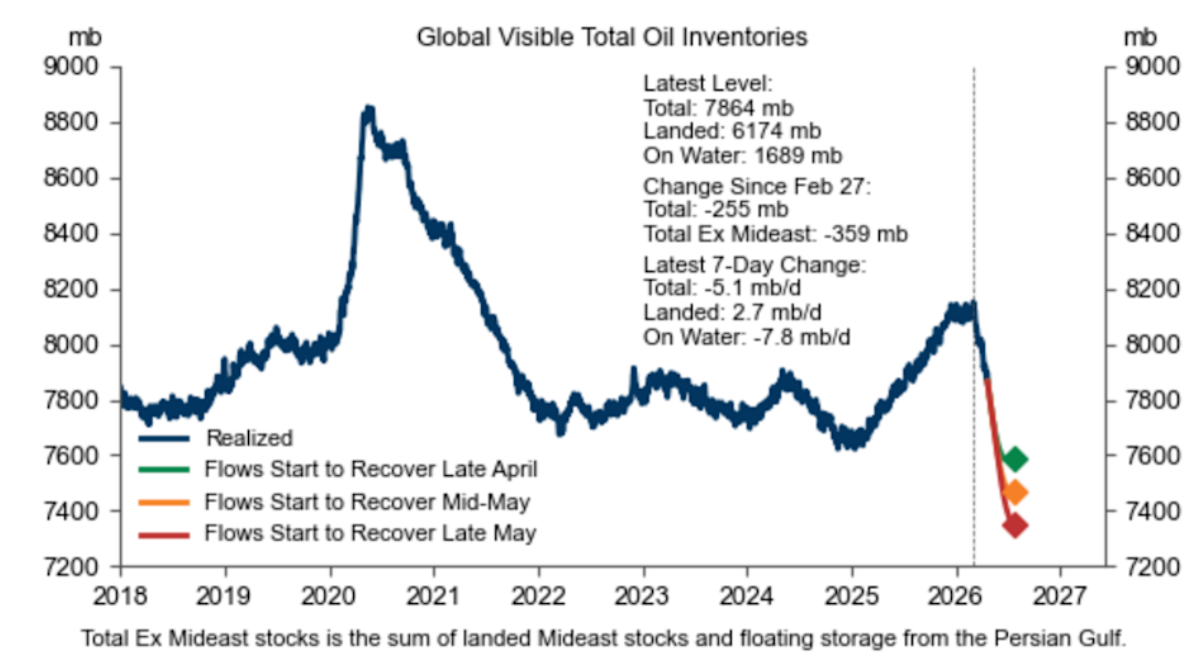
Inventories serve as the second major adjustment tool, which has been activated almost immediately. Strategists stated that as countries tapped strategic reserves to curb sharp price hikes, global inventory drawdowns hit a staggering 7.1 million barrels per day in April.
In March 2026, the International Energy Agency (IEA) coordinated its 32 member states to release a record 400 million barrels of oil reserves. According to Goldman Sachs research, even if the Strait of Hormuz reopens by late April, global oil inventories are still set to fall to historic lows.
Even with limited spare capacity and inventories hovering near historic lows, oil prices have yet to hit record levels.
Since the conflict began, futures prices for international benchmark Brent crude and U.S. benchmark WTI crude have risen by roughly 40%. Even the intraday wartime highs — Brent at $118.35 per barrel and WTI at $112.95 per barrel — remain about $20 below the 2008 all‑time highs.
Subdued risk premiums on expectations of a U.S.-Iran ceasefire, large-scale inventory withdrawals based on the assumption of an early reopening of the Strait of Hormuz, and an unusually sharp demand contraction have jointly capped futures prices.
In addition, muted futures prices fail to reflect the full transaction cost of crude amid market scarcity. In recent weeks, near-month spot prices in Asia have been far higher than benchmark futures quotes, reaching $210 per barrel in Singapore and a striking $286 per barrel in Sri Lanka.
Strategists at major Wall Street banks warn that market conditions may change rapidly without progress in the Middle East situation.
Last weekend, Goldman Sachs oil strategists raised their Q4 oil price forecasts, lifting Brent’s target from $80 to $90 per barrel and WTI from $75 to $83 per barrel, based on the assumption that Persian Gulf oil production will gradually return to normal by late June.
Goldman Sachs noted: “Macroeconomic risks are greater than implied by crude oil fundamentals alone, amid upside oil price risks, extremely elevated refined product prices, growing product shortages, and the unprecedented scale of this supply shock.”
Citigroup forecasts even higher prices, stating that Brent crude could surge to $150 per barrel if supply disruptions last into June, with an average Q4 price of $100 per barrel.
Demand destruction, the final buffer against price spikes, has already worsened notably. JPMorgan projects that global observable oil demand will drop by 4.3 million barrels per day on average in April, nearly double the peak demand destruction seen during the 2008 global financial crisis, when oil prices hit record highs.
However, JPMorgan strategists noted: “It is striking that such severe demand losses have occurred at price levels that are not extreme by historical standards.”
Citigroup pointed out that Iran has strong incentives to gain leverage by keeping the Strait of Hormuz closed and tightening global oil supplies. As negotiations between Washington and Tehran remain deadlocked, there is no clear turning point for the global market.
Citigroup analysts added that traders still expect the large-scale conflict to be resolved quickly, keeping oil prices artificially suppressed and disconnected from real market fundamentals.
Comments