Those who followed the markets closely on Thursday, February 24, must have done so on the edge of their seats. Apple stock (AAPL) ended the session higher by 1.7% — but not before trading down a whopping 4.5% right at the opening bell.
The Apple Maven tells the story of this wild day of trading for the Cupertino company’s stock. We then look at historical data to project what investors might witness next.
AAPL: one of those days
From the lows of less than $153 at 9:30 a.m. EST to the high of nearly $163 at 4 p.m. EST, Apple stock climbed an incredible 6.2%. Such a spike in share price from the opening to the closing bells was the largest since August 2015, and the second largest since the Great Recession of 2008.
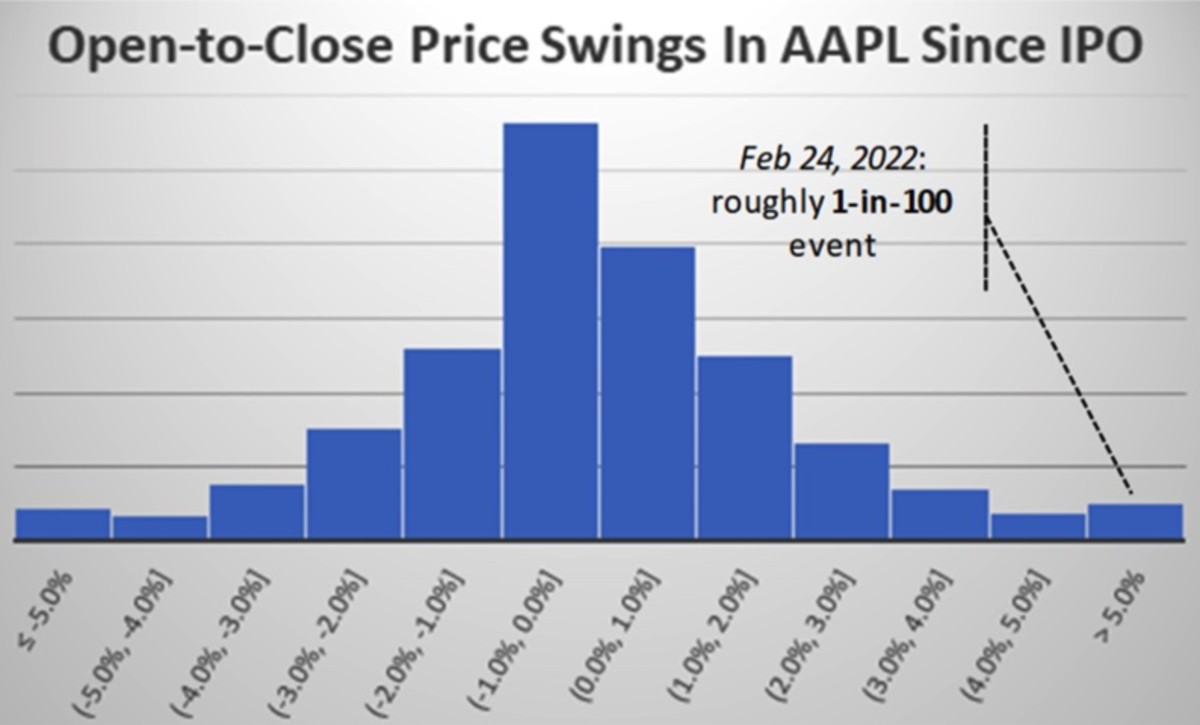
Below is a histogram that shows the distribution of open-to-close price swings in Apple stock since the company’s IPO, in 1980.
The share price movement on February 24, 2022 was historic. In fact, this was about a one-in-100 event, considering the company’s entire publicly traded life. If only the post-iPhone era is considered, the massive rally was as rare as one in about 400 trading days.
DM Martins Research
The spike can be mostly justified on the developments surrounding the Ukraine crisis. The market had a very bearish reaction to the invasion during the night, which set AAPL up for a sizable gap down in the morning.
However, throughout the day, European countries and the US unveiled their plans to impose heavy sanctions on Russia for its actions in Eastern Europe. Optimism returned to the stock market, and Apple shares recovered alongside the major indices.
What happens next?
Since the launch of the iPhone, in 2007, Apple stock’s annual volatility has been 32% — nearly twice as high as the diversified S&P 500’s. But in the 30 days following an open-to-close rally of 5% or more, this ratio has historically been much higher:a whopping 62%, on average!
The data is consistent with the idea that wild intraday swings in share price tends to be associated with a period of uncertainty. Therefore, here’s one very good guess about what could happen to Apple stock next: large gains and large losses in the short term, a.k.a. high volatility.
This is an important observation, since many optimistic investors may hope that Wednesday would mark the beginning of a long-lasting rally. In fact, the data suggests that the opposite might be true.
On average, Apple stock has climbed 2.9% per month (i.e., 30 calendar days) since 2007. But in the 30 days following an open-to-close rally of at least 5%, the average return has been a much less impressive (negative) -2.7% — with dizzying highs of +40%andlows of -44%!
Once again, the data supports the idea that large intraday movements are probably much more indicative of volatility and underwhelming returns in the short term than of an imminent leg higher in share price. Apple stock investors should set their expectations accordingly.
Comments