Brent crude oil trades around $99 a barrel; U.S. indexes on course for sharp losses
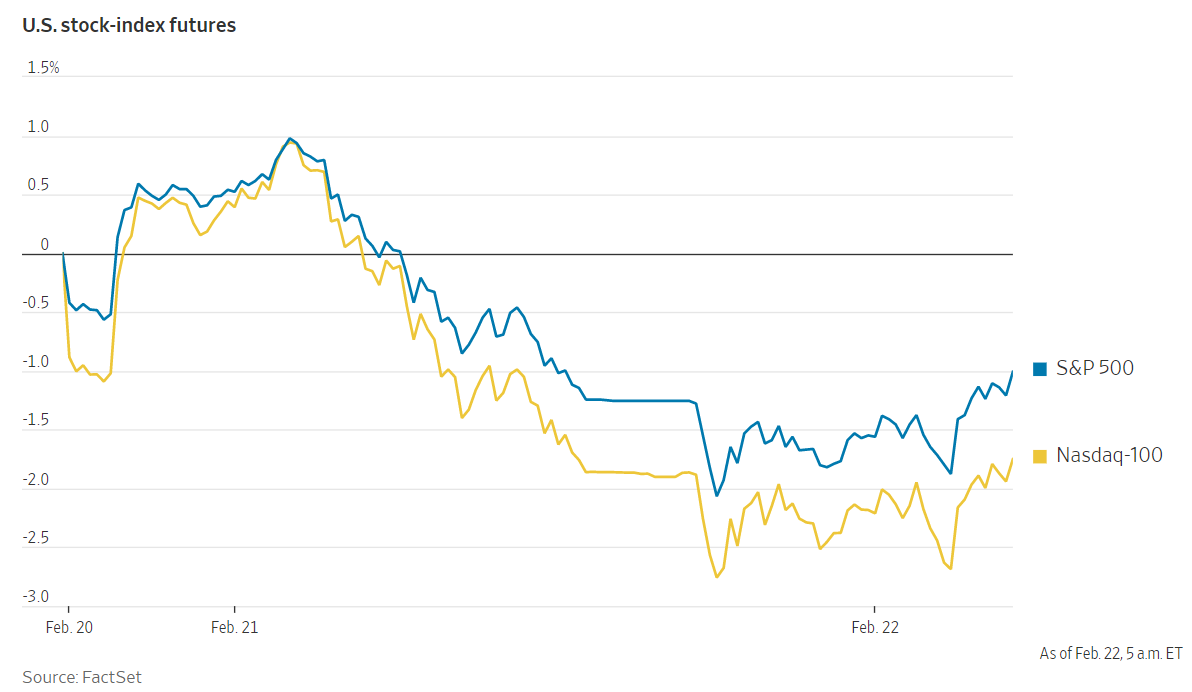
Oil prices jumped, while global stocks and U.S. futures fell, after Russian President Vladimir Putin ordered troops into two breakaway areasof Ukraine, bringing fears of all-out war to their highest level so far.
U.S. stock futures fell, putting indexes on course for losses when markets reopen following the Presidents Day holiday. Futures on the S&P 500 fell 1%, while technology-heavy Nasdaq-100 futures declined 1.7% and Dow Jones Industrial Average futures fell 0.9%.
Russia’s benchmark MOEX stock index fell 5%,adding to Monday’s 10.5% drop, which was its biggest daily percentage decline in almost eight years. The ruble edged higher against the dollar, after falling to its lowest level since February 2020.
European indexes fell, with the pan-continental Stoxx Europe 600 down 0.7%. Asia’s benchmark indexes closed lower, with Hong Kong’s Hang Seng indexes down 2.7% and Japan’s Nikkei 1.7% lower.
Brent crude, the global oil benchmark, surged almost 4% to $99.06 a barrel, taking it within sight of $100 a barrel for the first time since 2014. European natural gas prices jumped 6%, amid fears that a conflict could reduce supplies from Russia, the continent’s largest gas supplier.
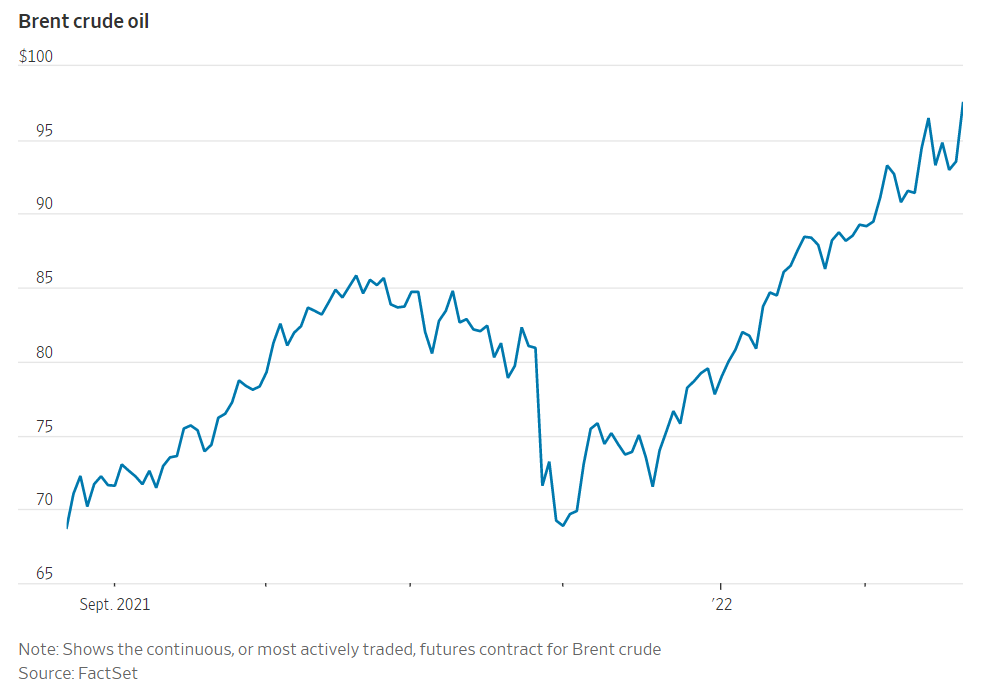
Investors worry that conflict between Russia and Ukraine—and heightened tension between Moscow and the West—could disrupt supplies of oil and some other key commodities. That could add further impetus for central banks to act forcefully to bring inflation back under control.
“Investors have switched from thinking it is posturing, saber-rattling to thinking there has become a real threat of a conflict,” said Altaf Kassam, head of investment strategy and research for Europe, the Middle East and Africa at State Street Global Advisors. “Things have gotten to a point where it feels like it is hard to step back from.”
The yield on the benchmark 10-year U.S. Treasury note dropped to 1.903%. Bond yields fall as prices rise, and investors typically bid up the prices of safe-haven assets such as U.S. government bonds at times of stress.
“The Ukraine situation has become more tense when the markets are already in a potentially unstable condition because of global rapid inflation and rate-increase expectations in the U.S.,” said Takahide Kiuchi, an economist at Nomura Research Institutein Tokyo.
Risk aversion is likely to continue, said Masahiro Ichikawa, a strategist at Sumitomo Mitsui DS Asset Management in Tokyo. U.S. Secretary of State Antony Blinken and Russian Foreign Minister Sergei Lavrov are scheduled to meet on Thursday.
Mr. Ichikawa said a Russian invasion of Ukraine would likely prompt strict economic sanctions from the U.S. and Europe, curbing international supplies of Russian oil. In that scenario, “If oil prices rise sharply beyond $100, gasoline prices will rise in the U.S., and inflation will accelerate further, forcing the Fed to consider raising rates at a faster pace,” he said.
In Asia, concerns also weighed on Chinese internet stocks Tuesday, with Alibaba Group Holding’s Hong Kong shares falling more than 3% and the Hang Seng Tech Index dropping 2.7%.Meituan,whose shares tumbled Friday after the government ordered cuts to the fees that online platforms charge restaurants, fell another 5.1%.

Comments