IBM's second-quarter results fell short of expectations for both revenue and profit, leading the company to reduce its full-year revenue growth outlook.
After the market closed on July 22nd, IBM reported its Q2 financials. Revenue grew only about 1% year-over-year to $17.2 billion, with adjusted earnings per share at $2.93, both missing analyst forecasts.
IBM revised its 2026 revenue growth forecast downward from "over 5%" in April to a range of "4% to 5%".
Analysts anticipate that as the atypical cycle of mainframe sales is digested and software business initiatives progress, the market's focus will shift to whether IBM can meet its full-year free cash flow guidance.
The company's CEO, Arvind Krishna, noted in a letter to investors last week that enterprise clients accelerated hardware purchases ahead of anticipated price increases, which led to underperformance in sales of Z series mainframes and transaction processing software.
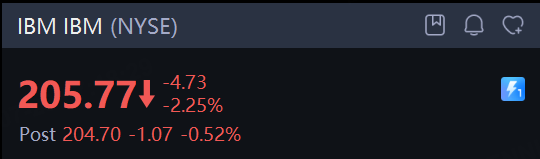
Following the earnings release, IBM shares fell about 0.5% in after-hours trading.
Sharp Decline in Mainframe Sales Weighs on Performance
IBM's Infrastructure segment revenue for the second quarter was $3.84 billion, a 7% year-over-year decrease. A core driver of the quarter's pressure was the Z series mainframe revenue, which plunged 42% compared to the same period last year.
CFO James Kavanaugh explained that the demand drop primarily stemmed from a timing mismatch in client purchases, where enterprises front-loaded hardware buys ahead of expected price hikes, depleting sales that would typically occur in the normal cycle.
This dynamic also left Consulting revenue flat year-over-year at $5.33 billion, failing to provide meaningful support for the overall results.
The preliminary figures IBM released last week had already highlighted these issues. The revenue and adjusted EPS numbers officially reported on Wednesday were largely in line with the data disclosed a week earlier.
This rare pre-announcement of disappointing results is uncommon in the tech sector and triggered a strong market reaction at the time, with the stock plummeting 25% in a single day, marking IBM's largest one-day decline on record.
Software Segment Shows Relative Resilience, Supporting Profits
In contrast to the Infrastructure segment's significant decline, IBM's higher-margin Software division demonstrated more stable performance.
Second-quarter Software revenue reached $7.76 billion, a 5% increase year-over-year. Kavanaugh stated that the full-year revenue growth expectation for the Software segment remains at 6% to 8%.
In recent years, through acquisitions like Red Hat, HashiCorp, and Confluent, IBM has aggressively pursued a strategic shift towards becoming a high-growth software company, making the Software business a crucial profit contributor.
However, IBM also faces market skepticism regarding disruption from artificial intelligence. It was noted that Starbucks is considering replacing software from several vendors, including IBM, with internally built tools.
Addressing this, Kavanaugh stated that Starbucks pays IBM approximately $2 million annually for that application and acknowledged that the application is "easy to disrupt with AI."
He emphasized, however, that the vast majority of IBM's software products are deeply embedded in clients' business infrastructure and data systems, making them far more difficult to replace than such peripheral applications.
Accelerating Cost Cuts to Counter Growth Pressures
Facing a growth slowdown, IBM announced it will accelerate its cost-reduction initiatives.
Kavanaugh indicated these measures include cutting third-party technology spending, optimizing supply chain management, and reducing administrative costs. He expects the total employee headcount to remain relatively stable for the full year.
In its Wednesday statement, IBM said it is leveraging artificial intelligence to scale software development, enhance sales and marketing effectiveness, and optimize its supply chain.
These actions are intended to improve profit margins and free cash flow while strengthening the company's ability to capture significant growth opportunities.
Concurrently, during the quarter, IBM signed a letter of intent to build a quantum chip foundry in the United States and launched an AI programming tool called Bob. This tool, based on multiple generative models, is already being used by over 80,000 employees.
Comments