- The Hang Seng Index has risen 16.6 per cent in the preceding six weeks, driving the benchmark to an 11-month high after the Lunar New Year holiday
- Alibaba, JD.com lead tech stock losses while HSBC, Sands China and Country Garden also slip in broad-based market weakness
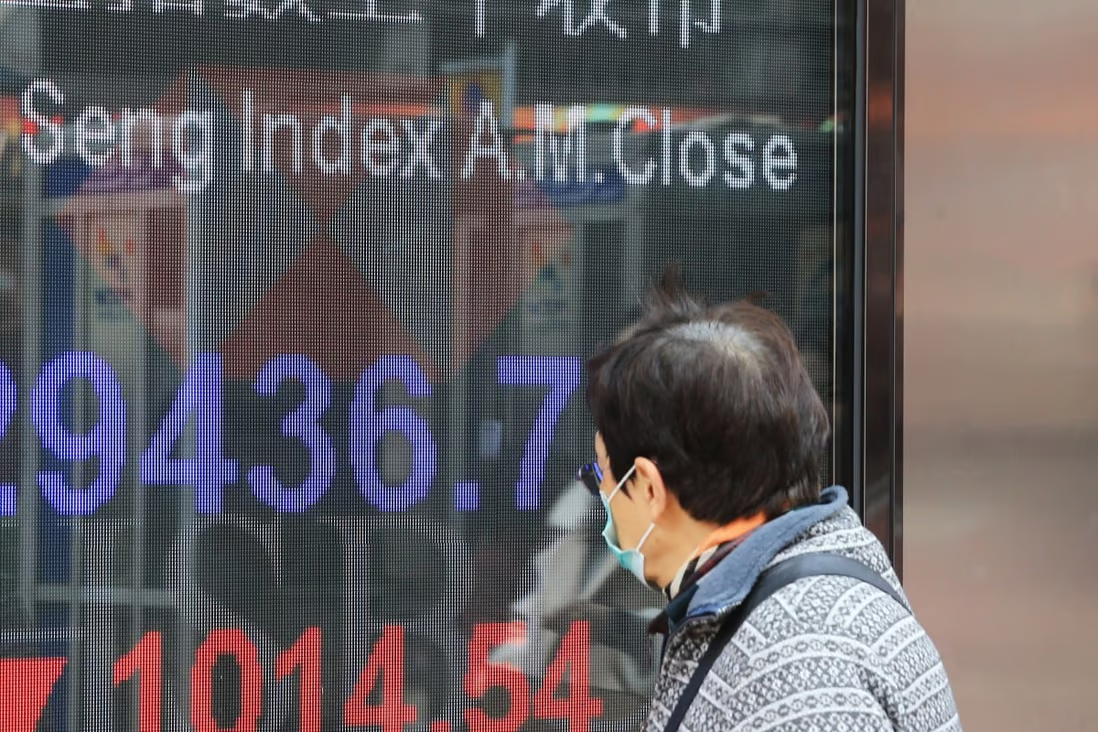
Hong Kong stocks slipped, sending the market to its first week of losses in seven, as investors scaled back their holdings amid concerns about short-term earnings and valuations while the local currency weakened.
The Hang Seng Index fell 1.9 per cent to 21,551.60 at 9.56am local time, taking the setback this week to more than 3 per cent. The Tech Index tumbled 1.4 per cent, snapping a five-week rally. The Shanghai Composite Index retreated 0.8 per cent.
HSBC sank 2.4 per cent to HK$56.25, while Macau casino operator Sands China fell 2.6 per cent to HK$28.40. Developer Country Garden lost 2.8 per cent to HK$2.83. Among tech losers, Alibaba Group declined 2.5 per cent to HK$106.30 and JD.com slumped 3.2 per cent to HK$228.80 while Tencent slid 0.4 per cent to HK$381.60.
Mainland Chinese funds sold more than HK$10 billion (US$1.3 billion) worth of Hong Kong-listed stocks this week through Thursday, according to Stock Connect data. The European Central Bank and the Bank of England both raised their key rates by 50 basis points versus a quarter-point move by the Federal Reserve, pressuring on local currency.
“The local stock market will slightly pull back today” because of the risk of fund outflows, said Dickie Wong, executive director at Kingston Securities. The bigger ECB and BOE rate hikes are part of the reason why the Hong Kong dollar is losing steam, he added.
The Hong Kong dollar has weakened 0.4 per cent against the US dollar this year, the only loser among 12 major Asian currencies, according to Bloomberg data.
The Hang Seng Index has risen about 50 per cent in the current rally from the bottom in late October, boosting the city’s market capitalisation by US$1.5 trillion. A bull-market eluded Chinese onshore stocks, even as global hedge funds have rebuilt their exposure in Chinese stocks to near an all-time high, suggesting the market is exhausted and overcrowded.
Elsewhere, the Nikkei 225 in Japan and the S&P ASX 200 Index in Australia rose by 0.3 per cent and 0.6 per cent respectively, while the Kospi Index in South Korea lost 0.1 per cent.
Comments