US lawmakers agreed in principle to raise the US debt ceiling and avert a default, although the deal has to pass through a divided Congress
China’s industrial profits fell 20.6 per cent in the January-April compared with the same period last year, data published at the weekend showed
Hong Kong stocks swung between losses and gains, as trade remained volatile with sentiment fluctuating between the lift provided by the tentative agreement to raise the US debt ceiling and worries about China’s weak economic recovery.
The Hang Seng Index was down 0.3 per cent at 18,669.24 as of 11.25am local time, giving up an earlier gain of as much as 0.7 per cent and hovering around a six-month low. The Tech Index lost 0.5 per cent while the Shanghai Composite climbed 0.1 per cent.
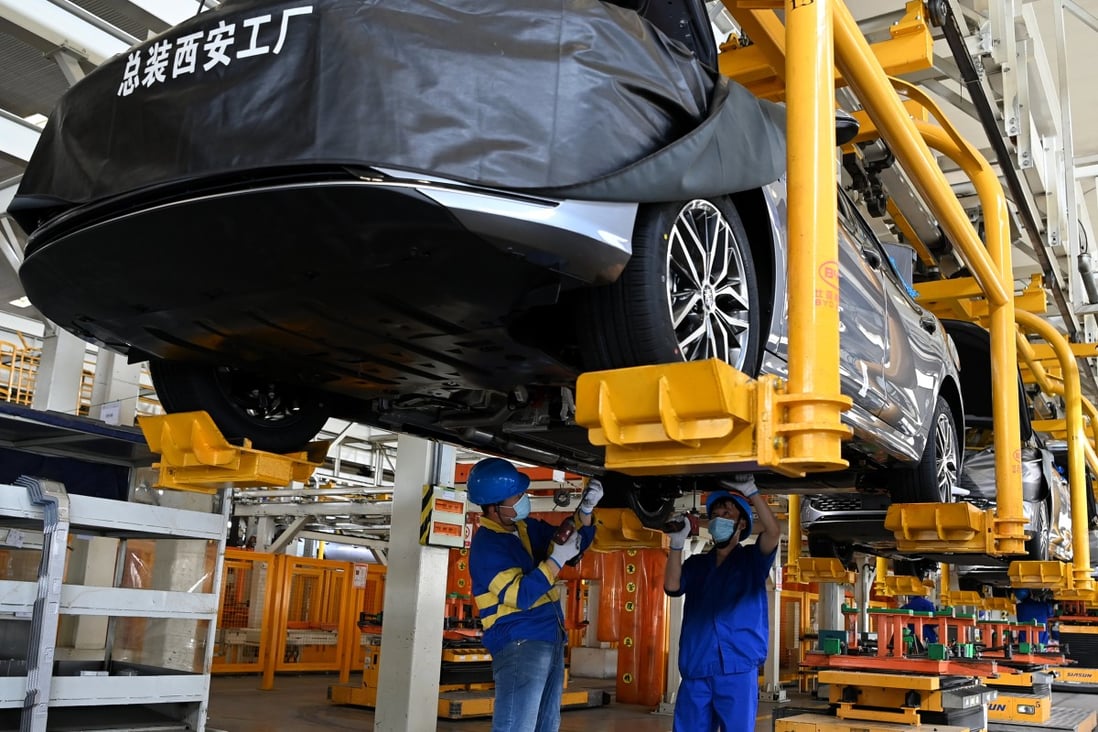
Among the main losers were Tencent which eased 1.1 per cent to HK$319, food-delivery giant Meituan that slumped 5.8 per cent to HK$118.70, and e-commerce platform JD.com which was down 1.2 per cent to HK$128.60. Electric vehicle maker BYD which dropped 1.4 per cent to HK$231.20 and Geely Auto which weakened 0.8 per cent to HK$9.21, also provided the drag.
Limiting losses, search engine operator Baidu jumped 3.7 per cent to HK$120.8, while gaming giant NetEase surged 7.9 per cent to HK$140.80. China’s biggest chip maker Semiconductor Manufacturing International Corporation (SMIC) surged 4 per cent to HK$20.25, while PC maker Lenovo jumped 5.3 per cent to HK$7.52.
Weighing on sentiment was news about the world’s second biggest economy. China’s industrial profits fell 20.6 per cent in the January-April compared with the same period last year, although it was slower than the 21.4 per cent decline reported in the first quarter, according to data from the National Bureau of Statistics (NBS).
The weak economic data is still the market’s biggest concern at the moment, analysts at BOCI Securities including Wang Jun said in a note on Monday. “The economic recovery is not well-grounded, and it’s inevitable for the market to keep adjusting their expectation”, leading to a prolonged correction, Wang said.
But the optimism was provided by the agreement to suspend the US$31.4 trillion debt ceiling between Republicans and Democrats, as the world’s largest economy averted a historic default. US President Joe Biden and House Speaker Kevin McCarthy reached “a bipartisan budget agreement” after talks on Sunday.
“The great relief of the US debt ceiling resolution is at hand … but markets are so far reacting cautiously,” Clifford Bennett, chief economist at ACY Securities wrote in a note on Monday. The real relief may only come when the Bill passes in the House, he said.
The Hang Seng Index has retreated 17.5 per cent since peaking out in January after China’s opening started to lose momentum, erasing nearly US$600 billion from the city’s broader market.
Key Asian markets advanced on Monday. Japan’s Nikkei 225 Index jumped 1.3 per cent, Australia’s S&P ASX 200 gained 1.1 per cent while South Korea’s Kospi Index added 0.2 per cent.
Comments