The Delaware court halted the conversion of APEs into AMC common stock, causing a surge in AMC's common shares but impacting short sellers and arbitrage traders negatively.
While AMC's stock surge is good news for shareholders, it poses challenges for the company's management, which relies on the conversion to boost liquidity and reduce debt.
With the conversion denied, AMC must find alternative ways to raise funds, as box office revenues are expected to improve gradually but may not reach pre-pandemic levels anytime soon.

APE Conversion Deal Blocked
The drama surrounding the conversion of AMC Preferred Equity units (APEs) into AMC Entertainment common shares took a surprising turn on Friday, July 22, when Delaware Judge Vice Chancellor Morgan T. Zurn denied the settlement with the plaintiff, blocking the conversion, which surprised investors.
Earlier, there had been a high expectation that the Delaware Court would approve the settlement and proceed with the conversion, as the special master indicated favoring "denying the objections to the settlement."
Zurn's decision to block the conversion was based on her belief that the proposed deal was too wide-reaching. It would have allowed common stockholders to relinquish any legal claims they might have, even if those claims were connected to the APE units they owned.
It was also clarified that the settlement payment in extra common stock does not form the basis for releasing claims based on APEs, given that it comes "out of their pockets."
"Fundamentally, in voting and value, what is bad for the common is good for the APE. Awarding more shares to common stockholders necessarily comes at the expense of preferred units."
The Vice-Chancellor also mentioned that her decision had nothing to do with market manipulation theories that thousands of shareholders had complained about through their letters to the judge.
This ruling caused a significant surge in the company's common shares, increasing up to 100% in after-hours trading. After the verdict, AMC shares were trading at $8.80, closing at $4.40, while the APE units dropped as much as 63% to $0.67.
Brace for The MOASS
From a logical standpoint, an arbitrage trade based on the conversion of the two equities seemed reasonable, given that both common and preferred shares held the same economic and voting value but traded at a significant spread.
The conversion of APEs into common shares would result in substantial dilution for existing AMC shareholders. As a result, any obstacle in the conversion process positively impacted AMC common stock but harmed APE shares.
With the Delaware court blocking the execution of the conversion, it was more than just an obstacle; it was a major setback for short sellers and arbitrage traders.
In my previous article, I highlighted that AMC was - and still is - the most expensive stock for short sellers to borrow in the entire market precisely because of the immense demand for shorting AMC based on the broad confidence of the conversion. Traders wishing to bet against AMC Entertainment had to pay fees greater than 1,000% to borrow shares to short due to the high demand for shorting and the limited availability of shares.
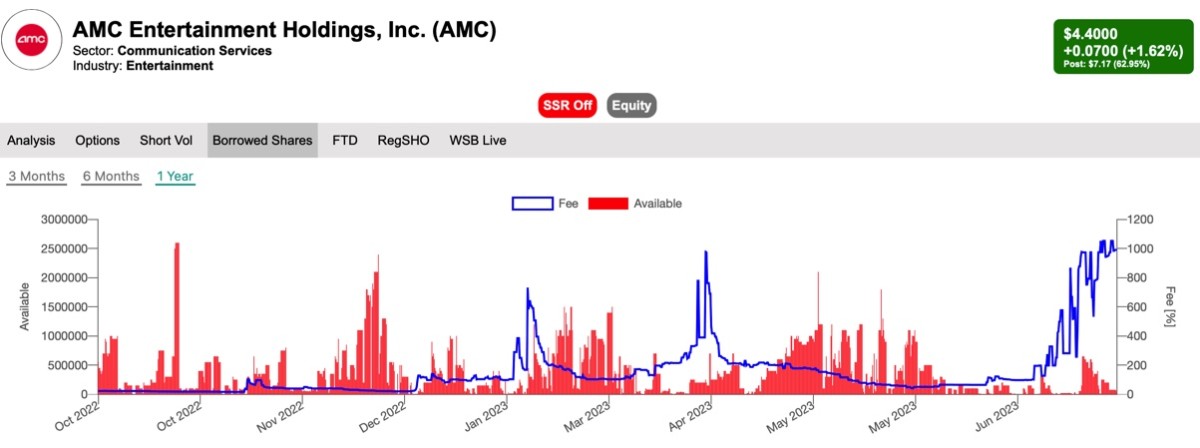
Borrowing fees in quadruple digits are outrageously high and present significant risks in the event of an upward movement in share price. And that is precisely what is happening, as after-hours activity indicates, pointing to a massive short squeeze.
Many AMC shareholders, commonly known as "Apes," have been anticipating the "Mother Of All Short Squeezes" (MOASS).
While the recent movements may not yet be as substantial as those seen in 2021, considering the current situation surrounding AMC and the market timing, I believe there is a possibility of a notable increase in AMC shares during the next couple of trading sessions.
This potential surge is likely because short sellers will probably need to cover or close their positions at huge losses.
Good News For Shareholders, Bad News For AMC
AMC's shares skyrocketing due to the halted APE conversion is undoubtedly great news for the company's shareholders, but it is a cold shower for the company's management.
AMC had pinned its hopes on the APE conversion to inject much-needed cash into its delicate liquidity position, burdened by high debt. According to B. Riley analyst Eric Wold, converting the APEs into common shares could have potentially allowed AMC to raise as much as $16 billion in equity.
Now, AMC must explore alternative ways to raise funds that don't involve equity offerings. Although box office numbers are expected to improve over the next few years gradually, they are not likely to reach pre-pandemic levels anytime soon.
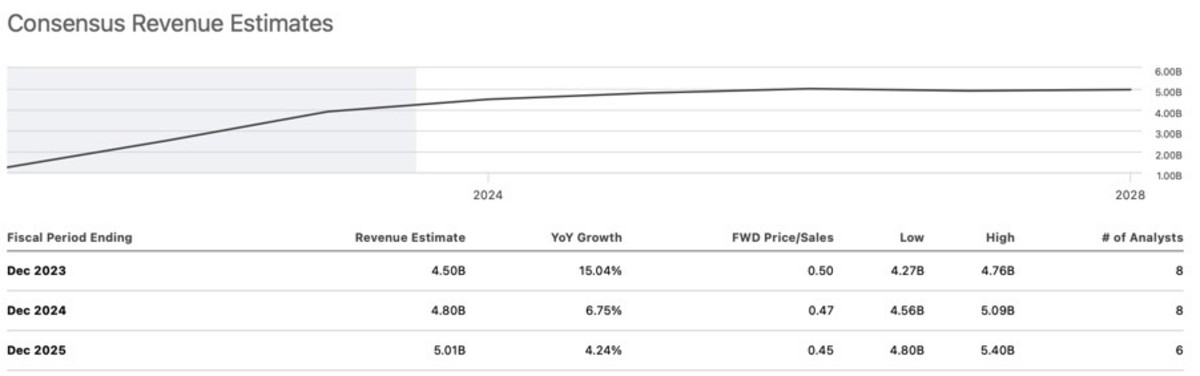
Projections indicate that AMC's revenues will grow by 15% year on year in 2023, reaching $4.5 billion annually, and another 6.7% in 2024, reaching $4.80 billion annually. However, this would still be approximately 14% below pre-pandemic levels.
Comments