Abstract
Rocket Lab USA, Inc. will report its quarterly results on August 10, 2026 Post-Mkt; this preview summarizes last quarter’s financial performance, consensus expectations for revenue and earnings this quarter, updated contract wins, and how these developments could shape near-term stock drivers and analyst sentiment.
Market Forecast
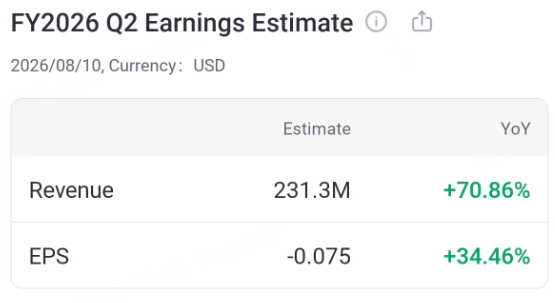
Consensus tracking implies Rocket Lab USA, Inc.’s current-quarter revenue of 231.35 million US dollars, a 70.86% year-over-year increase, and EPS of $-0.08 per share (estimate $-0.075), an improvement of 34.46% year-over-year; EBIT is projected at -58.96 million US dollars, reflecting a year-over-year change of -15.05%. Forecasted gross margin and net profit margin for the quarter are not disclosed, and therefore are omitted.
Space Systems remains the core revenue engine with last quarter revenue of 136.69 million US dollars (approximately 68.22% of total), while Launch Services contributed 63.66 million US dollars (31.78%), with the mix supported by government- and civil-contract deliveries. The most promising near-term catalyst is defense- and government-driven awards tied to responsive launch and satellites, highlighted by a 266.00 million US dollars multi-launch U.S. Space Force agreement and multiple NASA missions, underpinning robust top-line growth momentum into the current and coming quarters.
Last Quarter Review
In the previous quarter, Rocket Lab USA, Inc. delivered revenue of 200.35 million US dollars, gross margin of 38.18%, GAAP net loss attributable to shareholders of 45.02 million US dollars with a net margin of -22.47%, and adjusted EPS of -0.07; revenue rose 63.46% year-over-year and adjusted EPS improved 41.67% year-over-year. A key financial highlight was a revenue beat versus consensus (by roughly 10.66 million US dollars), with losses narrowing year-over-year on stronger mix and operating scale.
Main-business highlights: Space Systems generated 136.69 million US dollars, reflecting the segment’s central role in quarterly revenue composition; Launch Services contributed 63.66 million US dollars, supported by a steady cadence of missions and growing demand for responsive and defense-related launch capacity. While segment-level year-over-year growth rates were not disclosed, the overall mix and contract flow indicate that Space Systems remained the larger growth contributor.
Current Quarter Outlook
Main business: Space Systems delivery cadence and margin focus
Space Systems is positioned to remain the largest revenue contributor this quarter, anchored by production and delivery milestones across satellite platforms, key subsystems, and mission solutions. Revenue visibility has strengthened on the back of multi-mission awards and backlog conversion tied to government and commercial programs, including recent NASA launch contracts that reinforce a stable flow of hardware and services. From a profitability standpoint, mix within Space Systems matters: shipments of higher-value components such as solar power solutions and avionics, alongside integrated satellite builds, tend to support gross margin, which in the last quarter stood at 38.18% company-wide and will be closely watched for continuation or expansion.
Operationally, execution centers on hitting schedule and quality targets across a diversified order book while mitigating supply-chain and labor constraints that could pressure throughput or cost. With the broader company guiding toward a significant year-over-year revenue lift (to around 231.35 million US dollars this quarter), investors will focus on whether Space Systems can sustain both growth and margin discipline as deliveries scale. Management’s ability to accelerate backlog conversion without materially elevating program risk or warranty cost is likely to influence the trajectory of gross profit dollars and adjusted EPS through the second half.
Most promising business: Defense-responsive launches and programs tied to quick-turn missions
Responsive launch and defense-oriented programs present the clearest step-function catalyst this quarter and beyond, evidenced by the announced 266.00 million US dollars multi-launch agreement supporting U.S. national security missions. The successful VICTUS HAZE mission demonstration for the U.S. Space Force showcased rapid integration, deployment, and on-orbit operations—capabilities that translate into both reputational capital and future pipeline potential. These awards tend to favor predictable funding and mission cadence, which can reduce revenue volatility relative to purely commercial manifests.
Near term, revenue recognition will be a function of contracted milestones and launch timing, with Launch Services revenue last quarter at 63.66 million US dollars providing a baseline for comparison. The margin profile for responsive defense launches can benefit from scope, complexity, and value-added engineering, though it also carries execution and schedule risk that will be carefully monitored by investors. If the company continues to execute quick-turn missions and secures incremental task orders or options conversions, the ramp in high-certainty defense revenue could meaningfully influence quarterly results and sentiment.
Key stock-price swing factor this quarter: Neutron development, deal updates, and gross margin trajectory
Program timing and capital allocation around Neutron remain a core swing factor for sentiment, as investors look for updates on milestones, test campaigns, and any adjustments to expenditure or schedule. Recent commentary in market reports suggests prior target dates have shifted, making incremental disclosures on build, testing progress, and customer engagement material to the stock’s near-term path. Clear signals on gating items and risk mitigation—especially for primary structures and propulsion—would help narrow confidence intervals around medium-term earnings power.
Another focus is transaction and contract newsflow, including the proposed strategic combination with a satellite communications peer referenced in recent market coverage. Any new information on deal structure, expected synergies, regulatory timing, and financing would influence both strategic narrative and valuation multiples this quarter. Finally, gross margin trajectory is pivotal: with last quarter’s company-wide gross margin at 38.18%, investors will scrutinize whether the mix of Space Systems and Launch Services this quarter sustains, compresses, or expands margins, and whether operating leverage translates into an adjusted EPS trend that tracks the forecast improvement of 34.46% year-over-year.
Analyst Opinions
Based on recent commentary and coverage, the majority view is bullish. Buy ratings have been reiterated or maintained by several institutions—Needham (Buy; 120.00 US dollars target), Stifel (Buy; 105.00 US dollars target), Craig-Hallum (Buy), and Cantor (Buy, noting the successful VICTUS HAZE mission)—while neutral stances were observed at Piper Sandler (Neutral; 83.00 US dollars target) and Wells Fargo (Hold; 60.00 US dollars target). Supplementing this stance, one major global bank’s team raised a bull-case valuation framework, citing accelerating contract momentum and broader solution-set expansion.
The bullish cohort highlights three core points. First, the revenue glide path appears to be inflecting more quickly than previously modeled, with this quarter’s revenue estimate at 231.35 million US dollars implying a 70.86% year-over-year jump, driven largely by Space Systems and defense-linked mission work. Second, execution wins such as VICTUS HAZE and new government awards reinforce confidence that Rocket Lab USA, Inc. can convert technical capability into recurring, milestone-driven revenue. Third, while EBIT is still projected to be negative at -58.96 million US dollars for the quarter, analysts expect operating leverage to improve as higher-margin deliveries scale, consistent with the forecasted 34.46% year-over-year improvement in EPS.
In framing upside scenarios, bullish analysts point to the breadth of announced awards—such as the 266.00 million US dollars multi-launch agreement—and to recurring NASA missions as signs of durable demand. They also note that backlog accumulation and conversion timing are aligning with a period of heightened government activity in space-related programs, supporting sustained revenue visibility. Importantly, several Buy-rated views now incorporate a larger role for defense-responsive missions in their near-term models, which raises confidence that headline revenue growth can translate into steadier quarterly beats.
These favorable views are balanced by two watch items that do not overturn the majority stance. Neutral-rated analysts remain cautious on the timing and cost envelope for Neutron, suggesting that further schedule clarity is required before meaningfully revising medium-term profitability assumptions. A second area of caution is integration and capital planning around potential strategic transactions, where deal synergies and execution will need to be proven over time. Even so, the consensus within the bullish camp is that near-term catalysts—contract deliveries, launch cadence, and strong quarterly revenue estimates—offer a supportive setup for the print, with clear checkpoints to assess execution through the quarter and into the next.
Overall, the balance of institutional commentary favors the upside case this quarter: more analysts are Buy than Neutral/Hold, and their arguments hinge on visible contract conversion, a rising revenue base concentrated in Space Systems, expanding defense-responsive opportunities, and a projected improvement in per-share losses year-over-year. Investors will look for confirmation in the August 10, 2026 Post-Mkt release that revenue and EPS track the current forecast and that management’s updates on program milestones align with the accelerating top-line narrative.
Comments