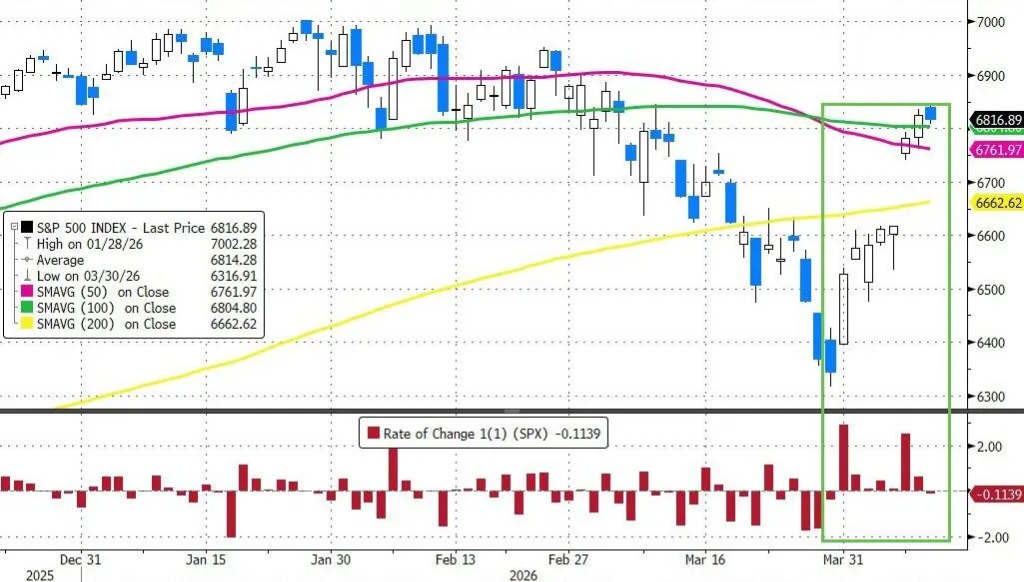
A final agreement between the US and Iran has yet to be reached, leaving risk sentiment on watch as Monday’s trading commences. Earlier, ceasefire news has driven a rapid unwinding of geopolitical risk premiums, with US equity investors pouring back into pre-conflict flagship trades led by AI. Data show the S&P 500 and Nasdaq 100 have risen for seven consecutive sessions, marking the longest winning streak since September 2025. The Euro Stoxx 600 posted its largest single-day gain since March 2022 on Wednesday.
In a recent report, Louis Miller, Head of Global Portfolio Solutions at Goldman Sachs, noted that gold mining stocks have conspicuously lagged the latest rebound, creating a sharp divergence between share prices and robust earnings revisions. The bank maintained its year-end 2026 gold price forecast of $5,400 per ounce, citing that miners have benefited from positive operating leverage, resulting in a material improvement in free cash flow.
Meanwhile, AI infrastructure-related trades have rallied roughly 17% to 18%, while high-beta momentum baskets have delivered their best two-day performance since the pandemic. Momentum has not yet entered overbought territory; should fundamentals remain solid during the upcoming earnings season, the current rally has room to extend further. AI infrastructure has emerged as the key catalyst for earnings season, with the information technology sector projected to post earnings growth of as much as 44%.
On hedging strategies, Goldman Sachs recommends purchasing drawdown protection directly by “targeting the source of risk”. Traditional hedging instruments have become less effective amid rising stock-bond correlation and diminishing safe-haven appeal of the Japanese yen, making VKO put options a low-cost alternative.
Gold Miners Show Striking Dislocation, Supported by Central Bank Demand
Gold miners rank among the most compelling dislocation opportunities in the current market. Despite a recent bounce, the gold miner basket remains approximately 16.9% below its pre-conflict highs, standing in stark contrast to persistently strong earnings per share revisions.
Commodities analysts at the bank held onto their $5,400-per-ounce year-end 2026 gold price forecast, underpinned by continued diversification by central banks, normalization in speculative positioning, and an expected 50-basis-point rate cut by the Federal Reserve. The report highlighted that gold miners have seen substantial improvements in free cash flow thanks to positive operating leverage, with potential to boost dividend payouts.
Furthermore, recent gold price volatility has been partly driven by crowded positioning stemming from a surge in front-month option demand earlier this year. Should de-risking be largely complete, long-term upside risks would tilt meaningfully higher in scenarios of renewed escalation, particularly as concerns over Western fiscal sustainability intensify.
AI Trades Retake Market Leadership
Market focus in US equities has clearly shifted back to pre-conflict themes. The software and semiconductor relative strength pair has dropped 23.7% week-to-date, ranking at the bottom of performance leaders. In contrast, AI infrastructure-related trades have staged a broad rebound: the Asia AI computing basket rose 17.9%, the US optical networking basket gained 17.4%, and the global memory basket advanced 17.5%.
High-beta momentum baskets recorded their strongest two-day gain since the COVID-19 pandemic this week, fueled by a rapid unwinding of geopolitical risk premiums following the ceasefire announcement. The report showed that the correlation between momentum baskets and AI trades has risen to elevated levels, while its correlation with software/semiconductors has fallen to lows — consistent with the TMT momentum basket posting its best five-day performance on record.
Momentum has not yet reached overbought levels. If fundamentals hold firm during earnings season, the current breakout rally can continue. For contrarian investors who view the selloff in the software sector as excessive, Goldman Sachs suggests positioning via call spread options on the software recovery basket.
Upcoming Earnings Season: AI-Driven Earnings Growth, Cyclicals Still Have Upside
Approximately 40% of the S&P 500’s baseline 12% EPS growth forecast for 2026 is expected to come from AI infrastructure spending. The consensus estimate calls for 44% year-over-year EPS growth in the information technology sector for the first quarter, accounting for 87% of the index’s total earnings growth for the quarter — setting a high bar for AI capex-related trades.
Top picks in AI infrastructure include the memory basket and the AI data center basket, the latter of which has recently expanded to include emerging sub-segments such as liquid cooling, optical networking, and inference beneficiaries. Both baskets have seen price action diverge from EPS revisions, with the first-quarter earnings season poised to act as a catalyst for prices to converge with fundamentals.
Outside the technology sector, market focus will center on how companies navigate energy price shocks and supply chain disruptions. Should first-quarter earnings and forward guidance support the baseline scenario of 12% earnings growth, markets will further price in growth and recession risks, pushing cyclicals higher relative to defensives — a pair that currently trades roughly 6.3% below its year-to-date highs.
Emerging Markets Under Repricing; China A-Shares Boast Structural Advantages
Although a two-week ceasefire agreement triggered a brief rebound in Asia-Pacific markets, the choppy price action since then signals fragile investor confidence. Since the outbreak of Middle East tensions, foreign investors have materially reduced risk exposure, with South Korea seeing $24 billion in net outflows, leading the region in capital flight.
Given light positioning and intact regional fundamentals, investors will gradually shift from broad “risk-off” positioning to strategic allocations in market segments structurally insulated from energy shocks.
China’s economy is better positioned to withstand oil price shocks than its global peers, supported by its energy diversification strategy and high penetration of renewable energy. Undemanding valuations further strengthen the investment case for China A-shares. Goldman Sachs remains constructive on China’s HALO trade and maintains an overweight stance on the Asia AI computing theme, which is supported by the “AI supercycle” validated by Samsung’s record first-quarter results.
Comments