Alphabet is closing in on NVIDIA at a striking pace, standing just one step short of claiming the crown of the world’s largest company by market capitalization. As Google’s parent firm, it has completed a remarkable transformation from an AI outsider to an all-round AI winner in less than a year, and its robust stock performance is reshaping the market cap hierarchy among tech giants.
As of last Friday’s close, Alphabet’s market capitalization stood at $4.8 trillion, while NVIDIA’s market value rebounded to $5.2 trillion after a three-day rally this week, sharply narrowing the gap between the two.
Over the past six months, Alphabet’s share price has surged by 38% cumulatively, with a staggering monthly gain of 34% recorded solely in April, marking its best monthly performance since 2004. By contrast, NVIDIA’s stock has risen merely 8% over the same period, underperforming both the S&P 500 and Nasdaq 100 indices.
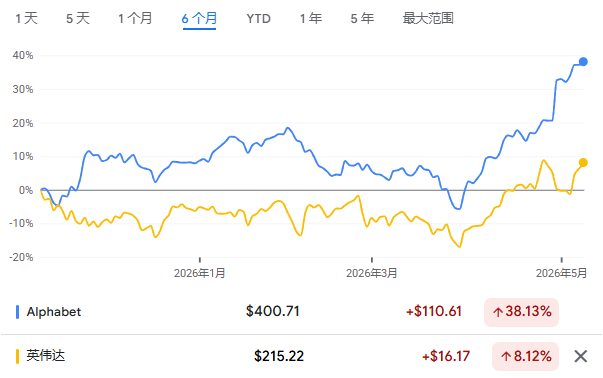
From AI chips and cloud computing to search advertising and autonomous driving, Alphabet holds a pivotal position in nearly every critical link of the AI ecosystem — the core reason behind surging investor confidence in the company. Analysts are rapidly lifting earnings estimates: over the past month, the consensus forecast for Alphabet’s 2026 net profit has been revised up by roughly 19%, while the 2027 outlook has been raised by more than 7%.
Market Cap Catch-Up: Gap Slashed by Over $1.5 Trillion in Six Months
On October 31 last year, NVIDIA boasted a market cap of $4.9 trillion, compared with Alphabet’s less than $3.4 trillion, representing a gap of over $1.5 trillion. The differential has now shrunk to approximately $400 billion.
Alphabet last claimed the title of the world’s largest firm by market cap with a brief lead over Apple in early 2016. Currently, Apple’s market capitalization stands at $4.3 trillion, Microsoft at $3.1 trillion, and Amazon at $2.9 trillion, leaving Alphabet firmly locked in second place.
Investors believe Alphabet’s eventual takeover of the top spot is fundamentally logical. Luke O’Neill, Chief Investment Officer at CooksonPeirce Wealth Management, commented: “Alphabet has a meaningful presence across nearly every corner of the AI ecosystem. The combination of its entire lineup positions it favorably to emerge as the biggest winner in AI.” The firm holds stakes in both Alphabet and NVIDIA.
Full-Scale AI Layout: Reach Extends to Every Critical Node From Chips to Models
While NVIDIA remains the leader in AI chips, Alphabet is mounting a challenge with its in-house developed TPU (Tensor Processing Unit) chips, which are gaining traction among an expanding base of enterprise clients. Alphabet CEO Sundar Pichai stated that TPU chips will soon be made available to Google Cloud customers, allowing them to deploy operations within their own data centers.
According to a research note published by Citizens analyst Andrew Boone on May 5, Alphabet is projected to generate approximately $3 billion in revenue from TPU-related infrastructure in 2026, with the figure set to jump to $25 billion in 2027.
Beyond chips, Alphabet owns a portfolio of massive core businesses including Google Search, Google Cloud, YouTube and Waymo. Its Gemini AI large language model is widely regarded as one of the industry’s top-tier offerings. Additionally, Alphabet is a major investor in Anthropic, whose Claude model also ranks among the sector’s leading generative AI products.
Divyaunsh Divatia, Research Analyst at Janus Henderson Investors, noted: “Alphabet has everything investors could want, which is why market participants feel so comfortable holding its shares. It boasts multiple viable avenues to win in AI — generating revenue from search, chips, cloud services, YouTube and Gemini across diversified streams.”
Elevated Valuation: Limited Upside With Underappreciated Risks
Despite buoyant market sentiment, further upside for Alphabet’s stock has turned relatively constrained. Based on data compiled by Bloomberg, analysts set an average 12-month price target of around $422 for the stock, representing a premium of merely 5.4% above last Friday’s closing price. The stock has already rallied 160% over the past year.
In valuation terms, Alphabet is currently trading at 28 times forward P/E ratio. While this is far below the extreme levels seen during the dot-com bubble, it is notably above its 10-year average of under 21 times and close to its highest historical multiples since 2008.
Risks remain impossible to overlook. Gemini and other flagship AI models could be overtaken by rivals at any time, and Alphabet’s stock slump last year fully demonstrated how swiftly market sentiment can shift in the AI era.
Nevertheless, O’Neill remains relatively optimistic about the current valuation, citing Warren Buffett’s classic maxim: “It’s far better to buy a wonderful company at a fair price than a fair company at a wonderful price.” Notably, Berkshire Hathaway, Buffett’s conglomerate, took a stake in Alphabet last year — an unusual move for the renowned value investor to allocate capital toward tech stocks.
“Even though it is no longer a bargain, the current price is still reasonable,” O’Neill said. “It is undoubtedly a wonderful company.”
Comments