Abstract
ServiceNow will release its quarterly results on July 22, 2026 Post-Mkt; this preview compiles last quarter’s performance, the latest consensus forecasts, and recent analyst commentaries to frame the near-term earnings setup.
Market Forecast
The market currently expects ServiceNow, Inc. to deliver revenue of 3.93 billion US dollars for the upcoming quarter, implying 25.87% year-over-year growth, alongside estimated adjusted EPS of $0.854 with 19.69% year-over-year growth and an estimated EBIT of 1.04 billion US dollars with 23.23% year-over-year growth. There is no formal consensus margin forecast disclosed for the quarter; recent quarterly baseline margins were a 75.07% gross margin and a 12.44% net profit margin.
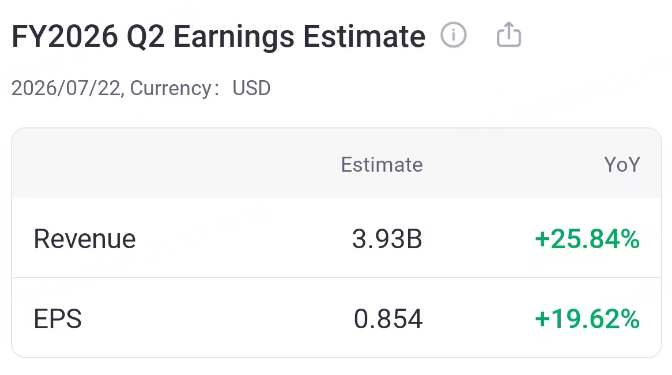
ServiceNow’s core subscriptions business remains the primary growth driver into the print, with demand supported by upsell to AI-rich bundles and sustained large-enterprise renewals. Within subscriptions, the company’s AI-enabled add-ons are positioned as the most notable growth vector; while not broken out as a separate revenue line, last quarter subscriptions contributed 3.67 billion US dollars and overall revenue rose 22.09% year over year, providing a larger base for higher-tier uptake.
Current Quarter Outlook
Main subscriptions business
Subscriptions are expected to carry the topline again this quarter, anchored by continued renewals and tier upgrades across IT, employee, and customer workflows. The forecasted revenue of 3.93 billion US dollars implies a material acceleration versus last quarter’s 3.77 billion US dollars, with consensus for 25.87% year-over-year expansion. While no explicit margin guidance is available, the recent gross margin level of 75.07% suggests headroom for operating leverage if revenue beats are driven by subscription mix rather than services. The most informative datapoints on the call are likely to be net new annual contract value, renewal rates, and the attach rate of AI features within subscription tiers, because these directly influence the durability of growth beyond a single quarter.
Packaging and pricing changes are a central swing factor. Recent channel checks indicate healthy customer acceptance of double-digit price uplifts when moving to AI-enriched tiers and evidence of earlier-than-usual renewals. These dynamics can produce a near-term uplift in subscription revenue and push some deal activity forward into the quarter, but they also increase the importance of measuring volume metrics such as seats, workflow expansion, and AI usage to validate sustainability. Federal and large enterprise verticals have been flagged as resilient demand pools, and any commentary or datapoints around deal velocity in these cohorts will help investors calibrate the back-half setup.
On the negative side, management previously highlighted that geopolitical frictions delayed the closing of some large deployment agreements in certain regions, which translated into a modest subscription headwind earlier in the year. The base case into this print assumes a portion of those delayed deals advance later in the year; if confirmation of closure timing slips again, investors may haircut near-term growth expectations. Intra-quarterly volatility in software sentiment, influenced by peers’ results, may also amplify stock moves if the company’s revenue and CRPO trends diverge from expectations.
AI add-ons and higher-tier bundles
The company’s AI capabilities—commercialized through offerings such as Now Assist and AI-enriched bundles including higher-tier “Pro Plus” packages—remain the standout growth catalyst. Earlier disclosures indicated net new annual contract value for AI features more than doubled year over year in a recent quarter, suggesting strong demand for automation and generative capabilities embedded directly in workflows. As management migrates customers to standardized multi-tier bundles with AI features, two drivers matter this quarter: the rate of adoption for AI tiers in both new and renewing accounts, and the realized price uplift versus legacy packaging.
The monetization model is also evolving. Management has introduced more consumption-oriented elements for AI features, augmenting the traditional seat-based model. That can lengthen the growth runway by tying revenue more closely to usage, but it also means revenue timing depends on deployment pace and utilization. For this quarter, investors should look for signals on usage ramp—tickets handled, knowledge articles generated, or automated task volumes—as proxies for consumption that could progressively translate into revenue. Margin impact depends on the balance between incremental compute costs for AI inference and subscription pricing uplifts; any commentary on unit economics will help refine medium-term operating margin expectations.
Partnership momentum increases the probability of sustained demand. Recent collaborations and joint offerings with global systems integrators and technology partners were announced to modernize risk platforms, unify data for AI, and support mission-critical monitoring. These relationships typically accelerate enterprise adoption by reducing integration friction and offering pre-built blueprints tailored to vertical use cases. This quarter’s pipeline commentary—especially around partner-sourced deals and co-sell motions—will help gauge how quickly AI-enhanced bundles penetrate the installed base and new accounts.
Key stock-price drivers this quarter
The first driver is the revenue print versus the 3.93 billion US dollars consensus and the quality of the beat, if any. A beat driven by subscriptions with clear evidence of AI attach and tier upgrades likely commands a higher multiple than one skewed to services. The second driver is forward-looking demand indicators, particularly current remaining performance obligations and the guidance cadence for the back half of the year. Investors will watch whether net-new and renewal trends align with the recent narrative of earlier renewals and improved pricing, as that underpins the forecasted 25.87% year-over-year growth.
The third driver is profitability and cash generation trajectory, even without formal margin guidance. If revenue mix and scale efficiencies hold, the recent 75.07% gross margin baseline and 12.44% net margin offer room for incremental operating leverage; the market will parse opex phasing and any commentary on AI-related cost structure to assess EPS durability. The fourth driver is management’s update on the timing of previously delayed large agreements; confirmation of closure windows can pull demand risk forward or push it out, and may be reflected in qualitative guidance. A fifth influence is peer read-throughs and broader software sentiment: recent sector moves around large-cap technology prints can create beta-driven volatility, making the company’s own CRPO and pipeline disclosures even more central to how the stock re-rates post-print.
Analyst Opinions
The balance of recent institutional commentary is decisively bullish. Across the notes and updates collected in the last six months, the ratio of bullish to bearish views skews overwhelmingly positive, with multiple Buy and Overweight reiterations and upgrades, and no material Sell or Underperform ratings in the sample; a minority Neutral stance was observed but does not change the prevailing tone. Given the absence of bearish calls in the dataset, the following synthesizes the majority view.
Several prominent institutions have highlighted the earnings setup and longer-term monetization opportunity. J.P. Morgan reaffirmed a Buy, citing the company’s technology leadership and near-term catalysts around AI-enhanced workflows. Barclays initiated with a Buy, emphasizing durable subscription growth and the monetization of AI features embedded into core workflows. TD Cowen reiterated a Buy as well, pointing to catalysts including AI adoption, pricing, and a supportive valuation framework. William Blair maintained an Outperform view predicated on accelerating AI adoption and a credible path to materially higher revenue by the end of the decade. Raymond James and Truist both reiterated Buys and raised or affirmed price targets in the mid-teens to low-hundreds range, focusing on the positive demand tone and improved execution signals. Benchmark raised its price target while maintaining a Buy, and Guggenheim upgraded the shares to Buy, marking a constructive inflection in sentiment.
Beyond ratings, the principal analytical threads underpinning bullishness are consistent. Analysts expect the quarter’s 3.93 billion US dollars revenue consensus and 0.85 adjusted EPS to be achievable under a backdrop where AI-driven upsell supports both growth and unit economics. Channel checks referenced by one institution showed a “substantive” positive shift in the AI-related narrative, with customers accepting double-digit price increases when moving to AI-enriched tiers and with evidence of earlier renewal timing—both of which could pull forward revenue and help secure the 25.87% year-over-year growth implied by consensus. Another recurrent point is that platform standardization into tiered bundles simplifies packaging, enabling better attach of AI features and clearer value capture, thereby bolstering average revenue per customer.
In addition, analysts note that recent partnership announcements with large integrators and technology firms should expand go-to-market reach and reduce deployment friction for AI modules. The expected benefits include faster implementations, broader use-case coverage, and stronger positioning in complex enterprise environments, all of which can support sequential improvement in net new annual contract value. This aligns with earlier evidence of AI-related ACV more than doubling year over year in a recent quarter, a datapoint that many investors will seek to see reflected in current-quarter bookings color.
Margin considerations also appear in bullish arguments. While explicit guidance is limited, research notes suggest that gross margin should remain resilient thanks to the high subscription mix, and that operating leverage can improve as revenue scales and AI monetization offsets incremental compute costs. Positive commentary emphasizes that if the revenue beat, should it occur, is skewed to higher-margin subscription activities and accompanied by stable cost discipline, adjusted EPS can outpace the topline cadence, reinforcing the 19.69% year-over-year EPS growth embedded in estimates.
Finally, on risk calibration, the majority view acknowledges earlier references to large-regional-deal timing delays but frames them as scheduling rather than demand destruction. Bulls expect a portion of those deals to close later in the year, supporting a steadier second-half trajectory. In the same vein, a handful of institutions referenced that broader software sentiment has been volatile around large-cap peer prints; however, they argue that company-specific drivers—AI attach, pricing uplift, and partner-led pipeline expansion—are enough to keep the revenue and earnings trajectory intact, thus positioning the stock for a constructive reaction if key metrics meet or exceed thresholds.
Taken together, the consensus narrative into July 22, 2026 is that ServiceNow, Inc. is set up to deliver on the 3.93 billion US dollars revenue and 0.85 adjusted EPS estimates, with upside probability if AI adoption and tier upgrades show through in bookings and revenue mix. Analysts will focus on disclosure around AI attach rates, renewal timing, and the closure status of previously delayed large agreements. A clean beat with encouraging CRPO and pipeline signals would validate the bullish stance and can catalyze multiple expansion. Conversely, if AI monetization or deal timing evidence is thin, shares could be sensitive given recent sector volatility—an outcome the majority of institutions consider less likely based on current checks and partner momentum.
Comments