At a crucial moment in the Republican Party's push for Trump's "Beautiful Bill,"Moody'sIs the downgrade of the US credit rating a coincidence or deliberate?
After the U.S. stock market closed on Friday (May 16), Moody's Ratings announced that it would downgrade the U.S. credit rating from the highest level of Aaa to Aa1. Following this downgrade, the United States, the world's largest economy, has been downgraded to below its highest rating, AAA, by all three major rating agencies.
The timing of Moody's downgrade is particularly sensitive, as earlier that day, Trump's massive tax reform plan failed to pass due to obstruction from hardline Republicans within the House Budget Committee. As market participants have commented:
The timing is very special, as Republicans are trying to get Trump's "Big Beautiful Bill" passed in committee... As we all know, this is no coincidence in Washington.
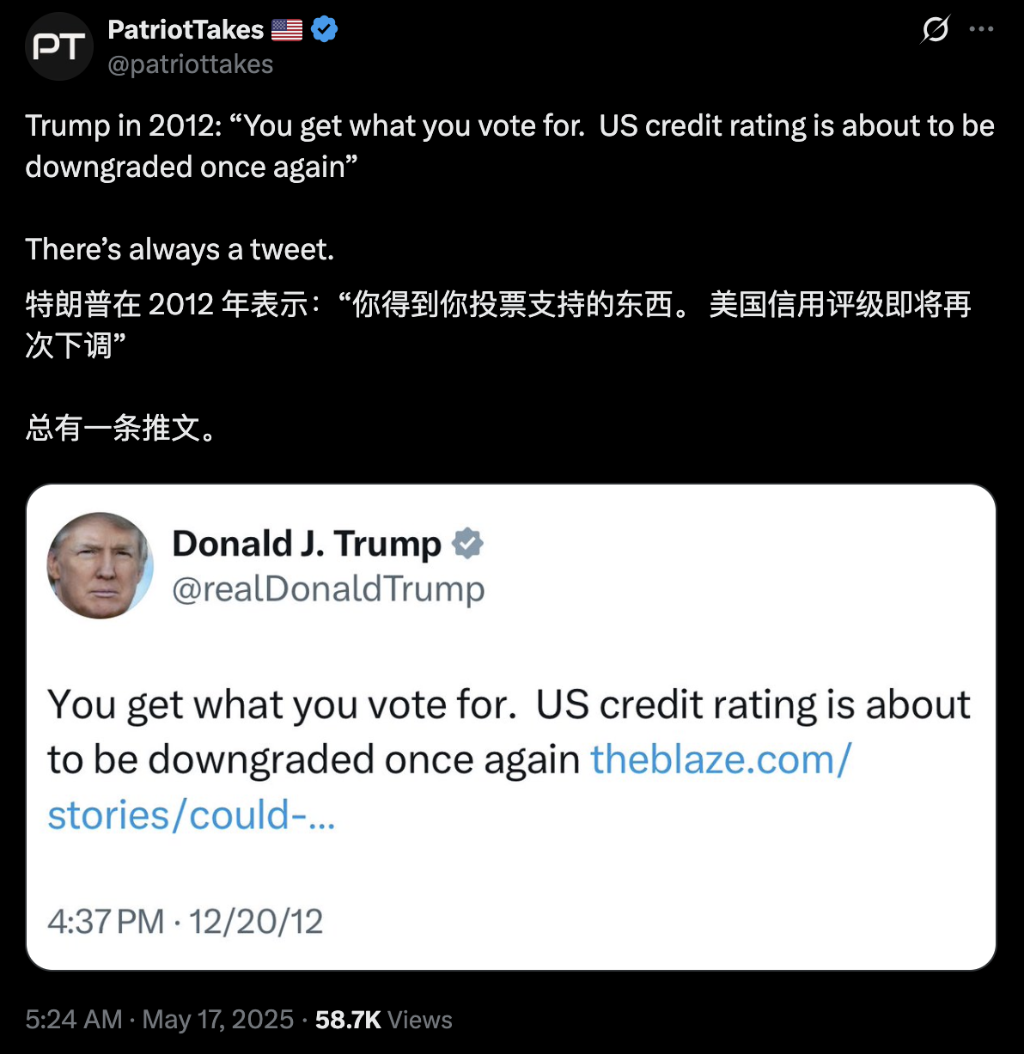
Interestingly, in 2012, Trump tweeted that the United States' credit rating would be downgraded again as a criticism of then-President Obama, but the rating agencies did not actually "take action." However, now that he is president, the rating has actually been downgraded, which can be considered a "severe slap in the face."
Following Moody's downgrade announcement, the market reacted immediately, with major U.S. stock index futures falling and Treasury Bond yields climbing. Wall Street strategists generally believe that this downgrade is not surprising, but it will further damage market confidence and could trigger a stock market correction.
The timing of relegation is delicate.
According to reports, just hours before Moody's announced the downgrade, a blockade led by hardline Republicans prevented Trump's tax reform bill from passing the House Budget Committee.As previously reported by Wall Street Insights, the U.S. House Budget Committee rejected the Republican Party's massive tax and spending bill with a vote of 21 against and 16 in favor. In this vote, four hardline Republican representatives—Representatives Chip Roy, Ralph Norman, Josh Brecheen, and Andrew Clyde—joined the Democratic camp and voted against the Republican-proposed bill.
These hardline lawmakers threatened to refuse to support the bill unless House Speaker Johnson, also a Republican, agreed to further cut Medicaid, the Medicaid program for low-income Americans, and completely repeal the Democratic Party's green energy tax cuts.
This Bill aims to extend The tax cuts implemented by The Trump administration in 2017 and is known as "The One, Big, Beautiful Bill," but The bipartisan Joint Congressional Tax Committee estimates that The Bill will increase The deficit by $3.72 trillion over ten years.
It is worth noting that Moody's warned in its downgrade statement that if Trump's tax reform bill continues, it will add approximately $4 trillion to the United States' structural deficit over the next decade. The statement also specifically mentioned:
"Multiple U.S. administrations and Congresses have consistently failed to reach an agreement on measures to reduce the annual fiscal deficit and interest payments, and do not believe that the fiscal plan currently under discussion can achieve substantial reductions in mandatory spending and deficits for many years to come."
Moody's also noted in its statement that the ratio of U.S. government debt to interest payments has been rising steadily over the past decade and is now far higher than that of other sovereign countries of the same level. Federal interest expenditures are projected to account for approximately 30% of fiscal revenue by 2035, significantly higher than 18% in 2024 and 9% in 2021.
Wall Street: This gives US stocks a reason to pull back.
AlthoughS&P 500The index has rebounded from last month's lows and has recovered ground lost this year, but many on Wall Street remain skeptical of the rise, as the impact of tariffs on business and consumer confidence could be reflected in economic data in the coming months.Moody's move further exacerbated the complex risks facing the US market, which Wall Street analysts pointed out actually gave US stocks a reason to correct.
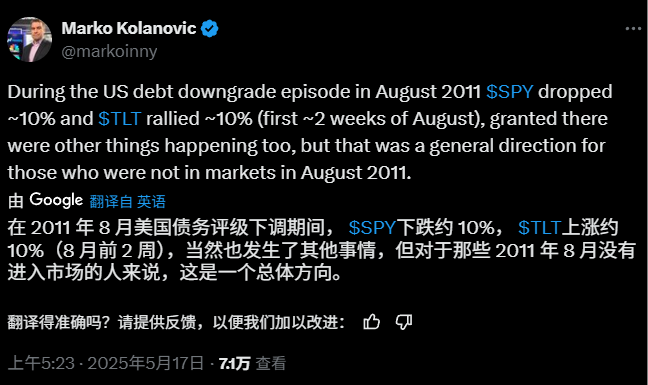
JPMorgan ChaseMarko Kolanovic, former chief strategist and co-head of global research, posted on social media:
During the downgrade of the US debt rating in August 2011,S&P 500 Index ETFThe 20-year US Treasury ETF fell by about 10%, while the 20-year Treasury ETF rose by about 10% (in the first two weeks of August). Of course, other things happened, but for those who did not enter the market in August 2011, this is a general direction.
Eric Beiley, Executive Director of Wealth Management at Steward Partners, said:
"This is a warning sign. The U.S. stock market is about to hit its ceiling after a welcome rebound. Moody's credit rating downgrade could prompt money managers to take profits after the sharp rise in the stock market over the past month."
Max Gokhman, Deputy Chief Investment Officer at Franklin Templeton Investment Solutions, warns:
"Given the relentless, unfunded fiscal spending spree, the Treasury Bond downgrade is not surprising, and such spending will only accelerate with current congressional plans. Furthermore, debt repayment costs will continue to rise as large investors (including sovereign and institutional investors) begin to gradually swap U.S. Treasury Bond for other safe-haven assets." Unfortunately, this could exacerbate pressure on US Treasury bonds, put further downward pressure on the dollar, and reduce the attractiveness of US stocks.
Ivan Feinseth, Chief Investment Officer of Tigress Financial Partners, emphasized the potential global impact:
"U.S. Treasury Bond is considered one of the safest investments in the world. When the U.S. credit rating is downgraded, turmoil could have a more negative impact on the sovereign debt of other countries. It remains to be seen how this will affect stock markets in the coming weeks, but caution is likely following the recent strong rise in the stock market."
Michael O'Rourke, chief market strategist at JonesTrading, believes the market reaction could be similar to when S&P downgraded the U.S. rating in 2011:
"I expect the stock market to experience a round of profit-taking, following a strong rebound. When S&P downgraded the U.S. rating in 2011, the U.S. Treasury Bond initially fell, but safe-haven buying subsequently led to a rebound."
Comments