According to the Wind Chasing Trading Desk, Goldman Sachs has issued a bullish rating on Xiaomi in several recent reports, raising its target price for Xiaomi from HK$65 to HK$69 and maintaining its buy rating. It projects compound annual growth rates of 27% for revenue and 40% for net profit from 2024 to 2027, respectively.
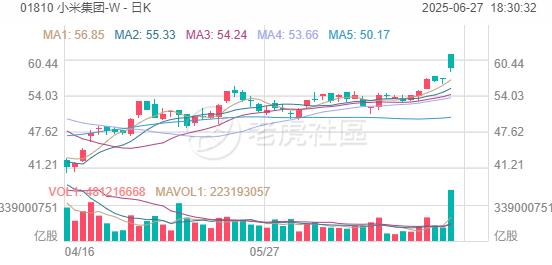
In its report, Goldman Sachs pointed out that pre-sales of the YU7 far exceeded market expectations, and its record-breaking performance will solidify Xiaomi's leading position in the high-end automotive market, surpassing its competitors in terms of configuration.。 Goldman Sachs has raised its forecast for Xiaomi's electric vehicle deliveries from 2025 to 2027 by 1-6%.
AI glasses usher in a new chapter in Xiaomi's ecosystem. Goldman Sachs believes that Xiaomi's entry marks the industry's entry into a stage of mainstream brand competition.AI glasses are expected to replicate the explosive growth trajectory of TWS headphones.China IntelligentThe eyewear market is projected to reach 2.9 million pairs by 2025, with Xiaomi's AI glasses expected to account for 10% of the market share.
In addition, the success of YU7 is alsoCATLThis will bring direct benefits, with CATL, as a major battery supplier, directly benefiting.Goldman Sachs expects the penetration rate of Kirin batteries to resume growth in the second half of 2025, which will significantly improve CATL's profitability.Therefore, we maintain our forecasts for CATL's A-share target price of RMB 323 and H-share target price of HKD 343, representing an upside potential of 27.8% and 5.7% compared to the current share price, respectively.
YU7's better-than-expected sales consolidate its position in the high-end market.
The Xiaomi YU7 electric SUV was officially launched on June 26, with first-hour orders reaching 289,000 units, far exceeding market expectations. This strong performance will solidify Xiaomi's leading position in China's high-end automotive market.Goldman Sachs stated that pre-sales far exceeded market expectations, and the YU7's pricing remained highly competitive.
The YU7 received 200,000 orders within 3 minutes of its release, with 122,000 locked orders. The total number of orders climbed to 289,000 units within 1 hour, far exceeding the previously expected target of 150,000 orders within 24 hours, demonstrating the strong demand from consumers for Xiaomi's high-end SUV products.
The retail prices of the YU7 standard, Pro, and Max versions are RMB 253,500, RMB 279,900, and RMB 329,900, respectively, which is basically in line with the expected average price of RMB 285,000. Compared to the SU7's average selling price of RMB 262,000 (including tax) from the second quarter of 2024 to the first quarter of 2025, the YU7's pricing remains highly competitive.
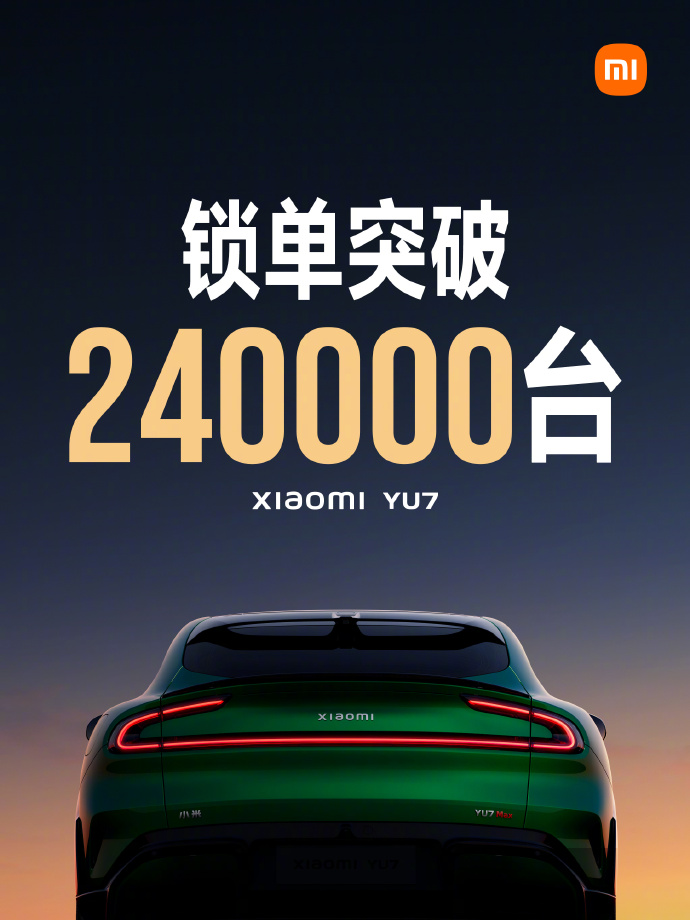
Looking further, the YU7 boasts outstanding technological highlights, comprehensively surpassing its competitors in the same class. Goldman Sachs stated that the YU7 outperforms its competitors in terms of size, driving performance, and range, and will compete with...TeslaExisting high-end SUVs such as the Model Y and Li Auto L6 are in direct competition.
The YU7 series has achieved multiple breakthroughs in technical specifications. The standard version is equipped with a 96.3kWh battery pack and has a CLTC range of 835 kilometers, making it the model with the longest range among pure electric SUVs with battery packs under 100kWh. The Pro and Max versions offer ranges of 760 and 770 kilometers respectively, ranking first among four-wheel drive pure electric SUVs.
Unlike the SU7 series, which only features an 800V platform in the Max/Ultra versions, the YU7 series comes standard with an 800V architecture. The Max version can complete a 10%-80% charge in 12 minutes and a range of 620 kilometers in 15 minutes. In terms of powertrain, the entire series is equipped with an upgraded HyperEngine V6S Plus rear-wheel drive motor, with a maximum power of 288kW and a torque of 528N·m.
In addition, Goldman Sachs believes that strong demand for the YU7 will support capacity expansion plans. Based on the strong demand, Goldman Sachs has revised its electric vehicle deliveries forecast for 2025-2027 by 1-6%, to 411,000, 800,000 and 1.174 million vehicles respectively.
AI glasses are opening up new boundaries in the Xiaomi ecosystem, and the industry is expected to replicate the explosive growth path of TWS headphones.
Meanwhile, the debut of Xiaomi's AI glasses marks a further expansion of the company's ecosystem boundaries and is expected to occupy an important position in the rapidly growing Chinese smart glasses market.Goldman Sachs predicts that Xiaomi will ship approximately 200,000 AI glasses by 2025, equivalent to a 10% share of China's smart glasses market.。 China's smart glasses market is projected to reach 2.9 million units by 2025, including 2.16 million units of smart audio glasses, providing Xiaomi with huge growth potential.
Xiaomi also released AI glasses as its next-generation portable AI terminal, with the standard version priced at 1,999 yuan. In terms of technical specifications, it weighs only 40 grams and has a battery life of 8.6 hours, compared to...GoalRay-Ban is 20% lighter and has a 40% longer battery life. Equipped with a Snapdragon AR1 processor and a 12MP camera, the software integration features include real-time translation in 10 languages, multimodal Q&A, seamless payment, and human-vehicle-home ecosystem control.
The standard version is priced at 1999 yuan, while the electrochromic version is priced at 2699 yuan and 2999 yuan respectively. Their pricing strategy has a competitive advantage and is expected to accelerate consumer acceptance.
The Goldman Sachs research report also pointed out that AI glasses are standing at a historical juncture for TWS headphones in 2017 and are expected to replicate the latter's explosive growth trajectory.With the release of Xiaomi's AI glasses, this emerging product category has reached a key turning point.
China's AI/AR glasses market is expected to expand rapidly at a compound annual growth rate of 56%, from 479,000 units in 2024 to 6.962 million units in 2030, with a market size of US$1.339 billion. This growth rate is highly similar to the 64% compound annual growth rate of TWS headphones between 2017 and 2023, indicating that AI glasses are at a tipping point for technological adoption.
Besides Xiaomi,AlibabaByteDanceAmazonandAppleBoth will launch AI eyewear products in 2025-26, forming a strong new product pipeline. Meta plans to release Oakley Meta glasses in July, priced at $399-499; ByteDance Vision+ is priced at $270 and is expected to be released between 4Q25 and 2026; Apple's smart glasses are expected to be released in 2026.
It is worth mentioning that Goldman Sachs predicts that the revenue share of AI/AR glasses business for most supply chain companies will be less than 5% by 2025, but with the rapid growth of the market, this proportion is expected to increase significantly, bringing new growth momentum to related companies.
The Yu7 will drive a rebound in CATL's penetration rate of high-end batteries, and improved product structure is expected to significantly enhance profitability.
The successful launch of the YU7 has brought direct benefits to CATL.According to Goldman Sachs analysis, the official release of the Xiaomi YU7 model has brought CATL an important opportunity to improve its product structure, and the penetration rate of highly profitable Kirin batteries is expected to rebound in the second half of 2025. Xiaomi has become CATL's largest high-end battery customer, and this strategic partnership will significantly enhance CATL's profitability.
Xiaomi has also rapidly grown into an important customer of CATL. Data shows that Xiaomi's share of CATL's domestic electric vehicle battery installations reached approximately 10% in the first quarter of 2025, a significant increase compared to approximately 4% in the second quarter of 2024, alongside CATL's two largest electric vehicle battery customers, Tesla and...auspiciousThe gap is narrowing.
Goldman Sachs stated that the release of the YU7 will drive the penetration rate of CATL's high-end Kirin battery products to resume growth in the second half of the year.
Data shows that since 2024, lithium iron phosphate batteries have accounted for more than 20 percentage points of CATL's installed capacity, rising from 50% in the first quarter of 2024 to about 70% in the first quarter of 2025. The penetration rate of Kirin batteries decreased from about 15% in the first quarter of 2024 to about 10% in the first quarter of 2025. With the successive launch of models equipped with high-end batteries, such as the Xiaomi YU7, this trend is expected to reverse.
Goldman Sachs further stated:
Improved product structure will be a key driver of CATL's profit per unit expansion.The company's mixed unit gross profit is expected to increase from RMB 152/kWh in 2025 to RMB 169/kWh in 2030. This improving trend has not yet been fully recognized in the market, providing investors with excellent investment opportunities.
Based on the same valuation methodology, Goldman Sachs maintains its forecasts for CATL's A-share target price of RMB 323 and H-share target price of HKD 343, representing an upside potential of 27.8% and 5.7% compared to the current share price, respectively.
Comments