TradingKey - Gold Prices Surge Over 70% in 2025, While Bitcoin Falls Over 5%. Is There Still a Chance for a Reversal?
On Tuesday (December 23), gold prices surged again, breaking above the $4,400 mark, surpassing the record set in October this year. During the early Asian trading session, spot gold ( XAUUSD) prices jumped nearly 1%, temporarily trading at $4,482, reaching another all-time high.
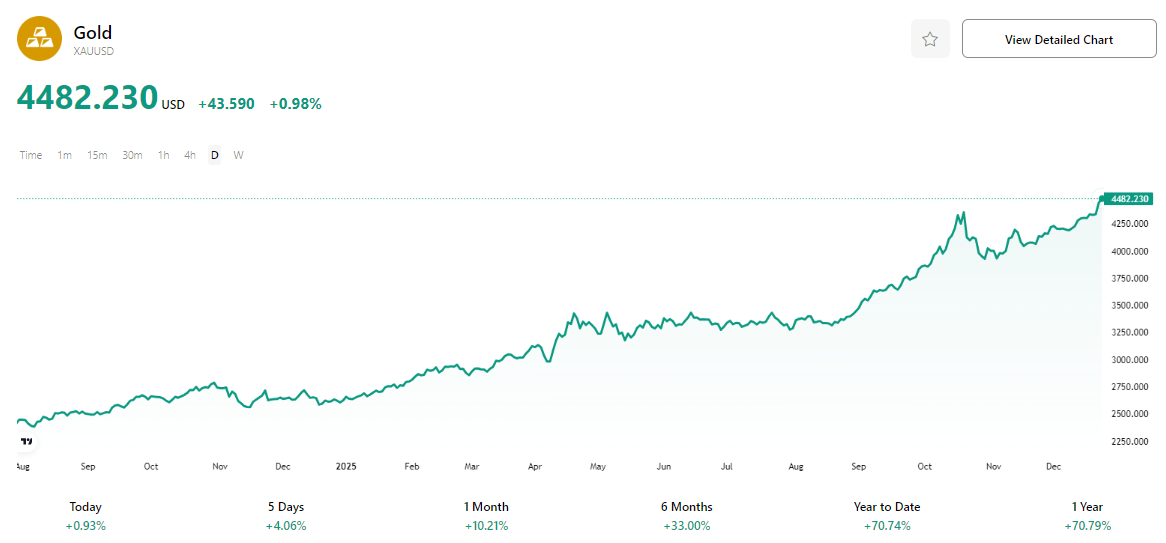 Gold Price Chart, Source: Tradingkey.
The direct impetus for this round of gold price increases was escalating geopolitical conflict, specifically the rising tensions between the United States and Venezuela. Furthermore, the weak inflation and employment data released last week in the U.S. reinforced expectations for a Federal Reserve rate cut in 2026, with the market broadly betting on two rate cuts by the institution next year.
Year-to-date, safe-haven demand has continuously driven gold prices higher, accumulating a gain of over 70%. The rise in gold prices is not driven by a single event but rather by multiple consecutive catalysts, including geopolitical conflicts, trade tensions, aggressive purchases by global central banks, and anticipated Federal Reserve rate cuts.
Despite the astonishing rally in gold prices, numerous investment banks are actively bullish on gold's performance next year. Goldman Sachs, for instance, believes gold will continue its upward trend, forecasting a rise to $4,900 by 2026. Furthermore, Deutsche Bank predicts a rise to $5,000 next year, while JPMorgan Chase suggests gold prices could ascend to $5,200-$5,300 per ounce next year.
However, Bitcoin (BTC) , often hailed as "digital gold," has seen its price stagnate and appears to have lost its safe-haven function. While Bitcoin prices experienced significant increases in the first and third quarters of 2025, it faced substantial corrections in Q2 and Q4, ultimately leading to a cumulative decline of over 5% this year.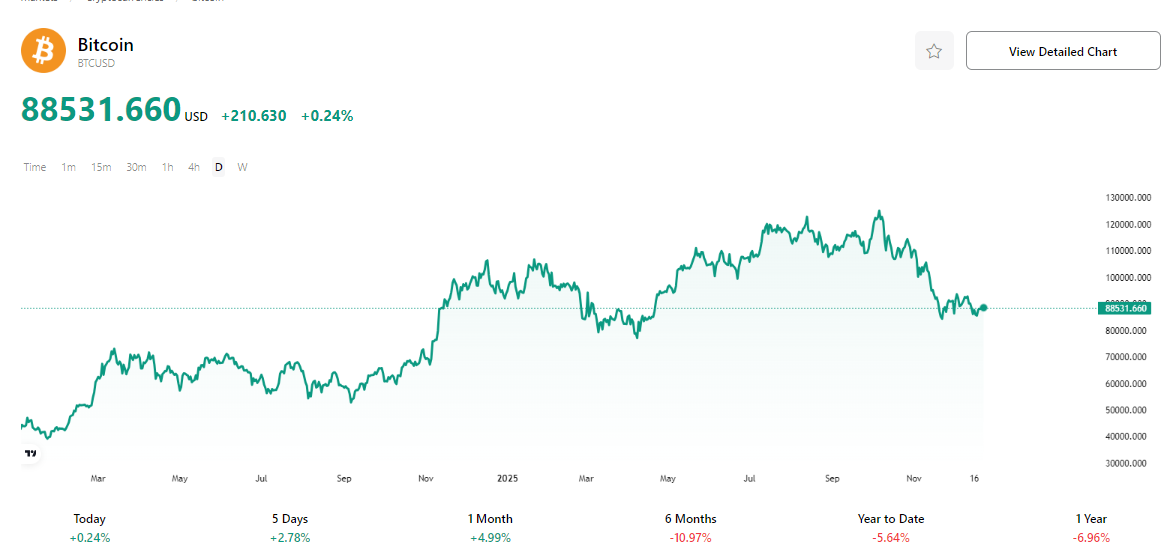 Bitcoin Price Chart, Source: Tradingkey.
Bitcoin is also considered a safe-haven asset, so why has its price significantly underperformed gold? In 2025, sustained market demand for safe-haven assets is an undeniable fact. However, Bitcoin's safe-haven function may currently be more of a slogan or acknowledged only by a small segment of the population, as many countries, at least, do not genuinely regard it as such.
Although some major economic powers (such as the United States, China, and the United Kingdom) hold substantial amounts of Bitcoin, these holdings are primarily acquired through confiscation or other means, rather than active purchases. This suggests that these governments do not perceive Bitcoin as a safe-haven asset akin to gold, leading investors not to consider allocating to Bitcoin when seeking true safe haven.
From a safe-haven perspective, Bitcoin indeed falls far short of gold and may not be accepted by governments. However, cryptocurrency is an emerging market, and various countries might accept or even reserve Bitcoin to seize strategic high ground. This represents Bitcoin's most significant opportunity to potentially overtake gold in the future.
Currently, aside from the United States, many countries, particularly China, have not directly announced Bitcoin reserves but have held significant amounts without movement. While their intentions are unknown, this clearly helps reduce Bitcoin selling pressure and could very likely attract other nations to join the ranks of Bitcoin strategic reserves in the future.
Find out more
Comments