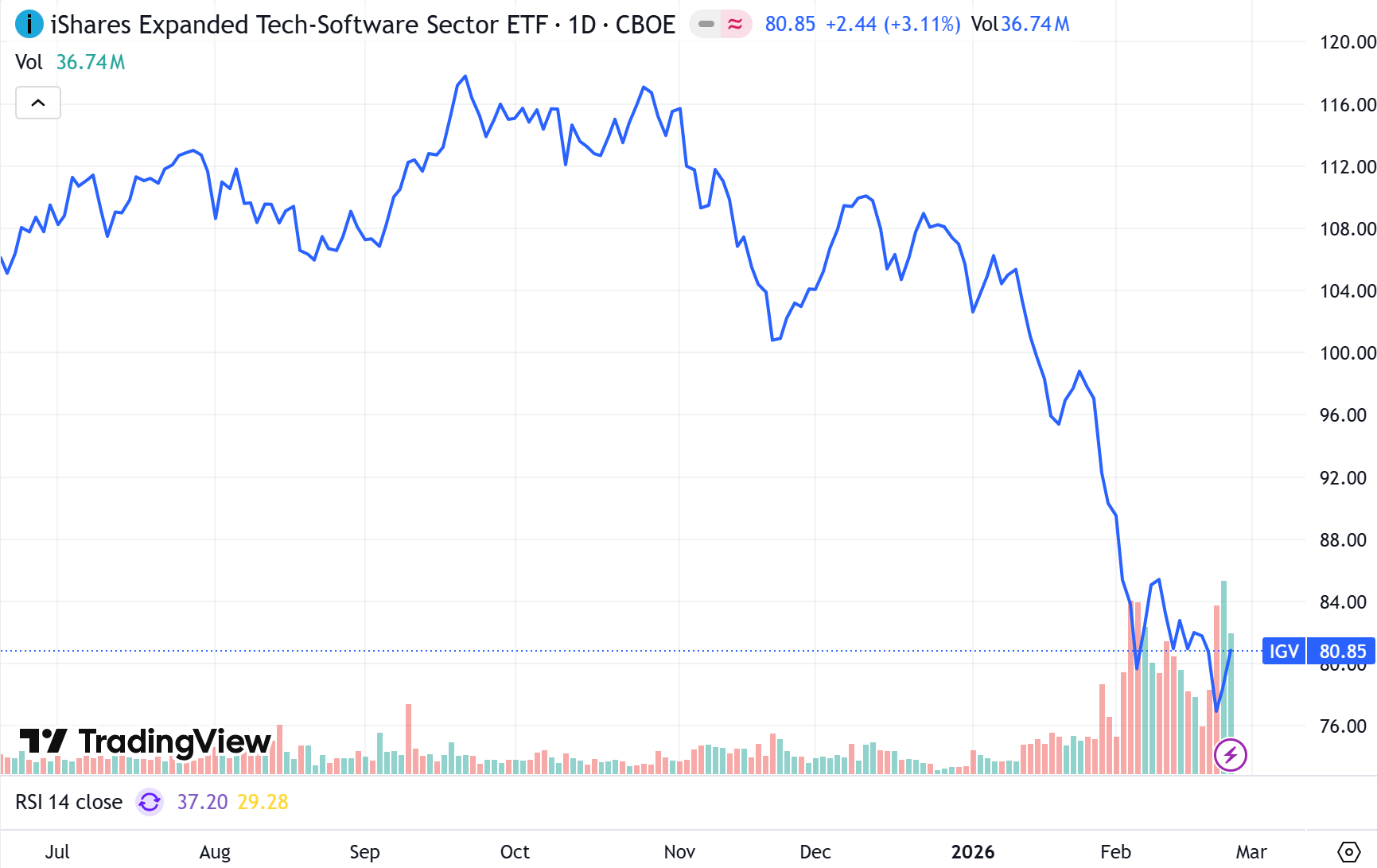
Since October 2025, the global software sector (SaaS) has experienced a prolonged, sluggish decline. This retreat reached an emotional freezing point in February 2026, triggered by a deep memo from Citrini Research titled 'The 2028 Global Intelligence Crisis.' This report not only predicted a catastrophe brought by technical deflation but also raised fundamental logical questions regarding the 'human intelligence premium' that has formed over the past fifty years.
Source: TradingView
I. The Intelligence Displacement Spiral and the Erosion of Middle-Class Credit Foundations
The core logic of the Citrini report lies in its proposed 'Intelligence Displacement Spiral.' In this model, generative AI is no longer merely an auxiliary tool for productivity enhancement but has evolved into a direct substitute for labor. When companies exchange short-term profit impulses for large-scale layoffs of white-collar positions, a paradoxical state of 'phantom GDP' emerges: while corporate book profits are growing, the white-collar class, the backbone of the economy, suffers from income loss, leading to a contraction in social aggregate demand.
This structural unemployment crisis is rapidly spreading from fields such as low-end ghostwriting, basic legal services, and tax auditing to industries that survive on information asymmetry, such as real estate brokerage and high-end financial intermediation. A deeper crisis lurks in the $13 trillion U.S. mortgage market. Historically, high-earning elites with credit scores above 780 were considered the most stable foundation of the financial system. However, when this class loses its workplace bargaining power and sustained repayment ability due to AI displacement, the credit erosion of underlying assets could trigger a systematic leverage break similar to 2008.
However, when examining this doomsday-toned report, the market often overlooks its most impactful asymmetrical prediction: before the presupposed 2028 crash, the S&P 500 will first hit 8,000, and the Nasdaq is expected to break the 30,000 mark. This extreme logical divergence suggests that the current market downturn is likely a violent clearing of retail positions orchestrated by institutions using 'fear of the future,' aimed at clearing the opposing side for the final carnival toward 8,000.
II. The Job Time Gap and Gold Pricing Logic Under Monetary Defense Mechanisms
Regarding the report's prediction of skyrocketing unemployment, we must confront the 'asymmetry of destruction and creation.' The speed at which AI destroys old jobs is measured in 'weeks'—through API integration, entire functional departments can become redundant in an instant. In contrast, the speed at which society creates and trains for new roles, such as 'AI ethics auditors' or 'emotional asset managers,' spans 'years.' This 'creative destruction vacuum' created by this time gap makes a macro consumption contraction over the next 12 to 18 months a high-probability event.
But economic operations possess self-defense mechanisms. If the unemployment rate indeed surges toward 10.2% by 2028 as projected, the Federal Reserve will not stand by as the social contract collapses. The inevitable path is to initiate an unprecedented rate-cutting cycle and restart massive quantitative easing (QE). When the world is once again flooded with liquidity to hedge against technical deflation, fiat currency credit will face its ultimate test. In this context, gold—as the only physical anchor capable of hedging a 'credit collapse'—is seeing its prices hit consecutive new highs, essentially as an advanced pricing of future massive fiat currency devaluation.
III. The Law of Conservation of Value: The Migration of Wealth from 'Payrolls' to 'Balance Sheets'
The greatest logical flaw in the Citrini report lies in its assumption that saved labor costs will vanish into thin air. According to the law of conservation of value, wealth is not destroyed but undergoes a migration between species. The billions in costs saved by companies will not enter a vacuum; instead, they will be transformed into excess corporate profits, larger-scale stock buybacks, or returned to consumers through price reductions. This capital will eventually flow into new areas of human desire, such as life sciences, deep space exploration, or the high-end experience economy.
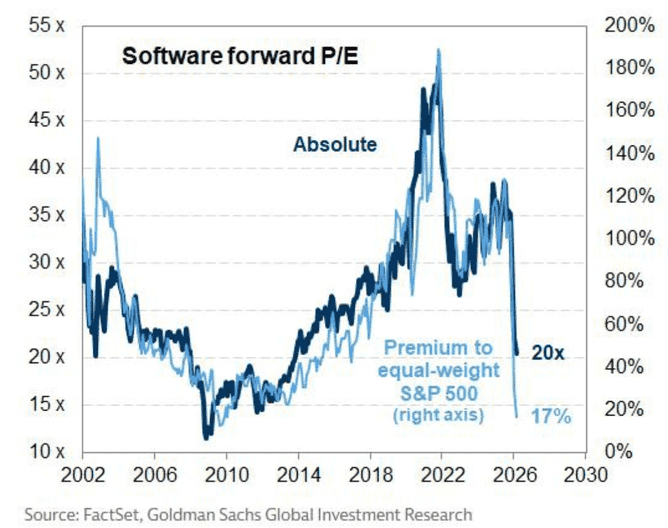
The current pain in the SaaS industry is actually due to the market confusing the 'evolution of capabilities' with the 'replacement of roles.' Taking Anthropic's recently released product as an example, while its powerful Agent capabilities triggered market panic about the disappearance of software, it has proven to be more of an empowerment of the existing ecosystem. Through deep integration with financial terminals like FactSet and Bloomberg, and its underlying logic connection with Salesforce Agentforce, Anthropic is proving it provides the engine for evolution rather than destroying the cockpit. Companies with deep vertical industry data remain indispensable snipers on the battlefield. The overall valuation of the software sector has fallen back to historical lows; however, such low-valuation phases often breed investment opportunities, especially for companies with solid fundamentals that have been 'wrongly sold off' by the market.
Source: FactSet
IV. Valuation Anchors and Physical Layer Sovereignty: Seeking Safe Havens of Certainty
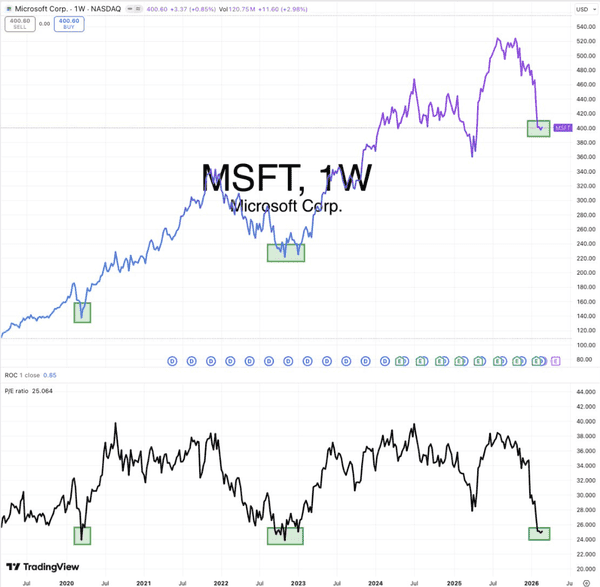
In the mist of valuation reshaping, Microsoft provides a textbook reference paradigm. Despite market concerns over high capital expenditures and potential hits to seat-based fees, historical valuation charts show that Microsoft's P/E ratio has pulled back to around 25x. This figure perfectly matches the lows of the 2020 circuit breaker bottom and the eve of the 2023 AI explosion. As a giant with the world's deepest distribution channels, Microsoft is using AI to increase average revenue per user (ARPU), pushing its channel value monetization capabilities to the limit. If subsequent earnings reports show continued double growth in revenue and profit, it will prove that the current sell-off is purely a cognitive mismatch.
Source: TradingView
Additionally, while the software layer is in a melee, investment certainty is shifting entirely toward the 'Physical Layer Iron Triangle.'
- Semiconductor Sovereignty: Focus on manufacturers such as Marvell and Broadcom that provide customized ASIC chips; they are the unavoidable toll booths in the wave of enterprise self-developed models.
- Energy Foundation: The endgame for AI is power. Stable baseload energy provided by nuclear giants such as Constellation Energy (CEG) is the physical foundation supporting 'Abundant Intelligence.'
- Computing Infrastructure (Utilities): Amazon's (AMZN) AWS is the ultimate winner under this logic. As long as the demand for computing tokens grows exponentially, Anthropic and all its applications running on AWS are effectively paying taxes to Amazon.
V. Conclusion: Endgame Thinking Through the Mist
The 2026 market is essentially an ultimatum about perception. Wealth has not disappeared; it has simply flowed from the 'payrolls' of white-collar workers to the 'balance sheets' and 'electricity bills' of hyperscalers. On the journey toward S&P 8,000, investors should treat the Citrini report as a reference for extreme stress testing rather than a guide for flight. At moments of extreme emotional panic, seeking out giants who hold physical resources, possess distribution sovereignty, and whose valuations have returned to historical anchors is the only path to escape the disaster of intellectual devaluation and capture the dividends of the era.
Find out more
Comments