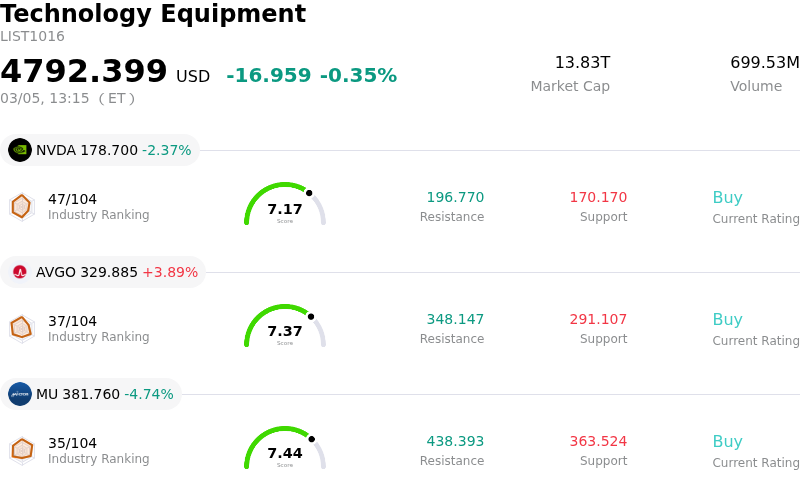
Taiwan Semiconductor Manufacturing Co Ltd (TSM) moved down by 3.56%. The Technology Equipment sector is down by 0.35%. The company underperformed the industry. Top 3 stocks by trading volume in the sector: NVIDIA Corp (NVDA) down 2.37%; Broadcom Inc (AVGO) up 3.89%; Micron Technology Inc (MU) down 4.74%.
What is driving Taiwan Semiconductor Manufacturing Co Ltd (TSM)’s stock price down today?
The downward movement in TSM's share price today appears primarily driven by broader market dynamics rather than specific company-related announcements. Elevated geopolitical tensions, particularly concerning developments in the U.S.-Iran conflict, have triggered a widespread "risk-off" sentiment across global equity markets. This has prompted investors to adopt more cautious positioning, disproportionately affecting the semiconductor and AI-related sectors. Concerns have also been raised by South Korea's chip industry regarding potential disruptions to the supply of key chipmaking materials due to the Middle East crisis, which could lead to increased energy costs and prices across the sector.
Coupled with these macroeconomic and geopolitical headwinds, there has been notable profit-taking in the chip stock segment. Following a period of significant gains and heightened investor expectations, many AI-driven semiconductor stocks have experienced pullbacks, indicating that some investors are unwinding their long positions. Institutional portfolio adjustments also contributed to the selling pressure, with several major investment firms reportedly reducing their holdings in TSM during the latter part of last year.
Despite these short-term market pressures, the underlying fundamentals and long-term outlook for TSMC remain robust. Analyst consensus ratings for the stock are largely positive, with many maintaining "Buy" recommendations and optimistic price targets. The company continues to project strong growth, particularly in its AI chip revenue, and is moving forward with significant capacity expansion plans. The current price action is therefore largely attributed to external market volatility and profit-taking in a high-performing sector, rather than any new negative company-specific developments.
Technical Analysis of Taiwan Semiconductor Manufacturing Co Ltd (TSM)
Technically, Taiwan Semiconductor Manufacturing Co Ltd (TSM) shows a MACD (12,26,9) value of [11.24], indicating a neutral signal. The RSI at 50.38 suggests neutral condition and the Williams %R at -48.11 suggests oversold condition. Please monitor closely.
Fundamental Analysis of Taiwan Semiconductor Manufacturing Co Ltd (TSM)
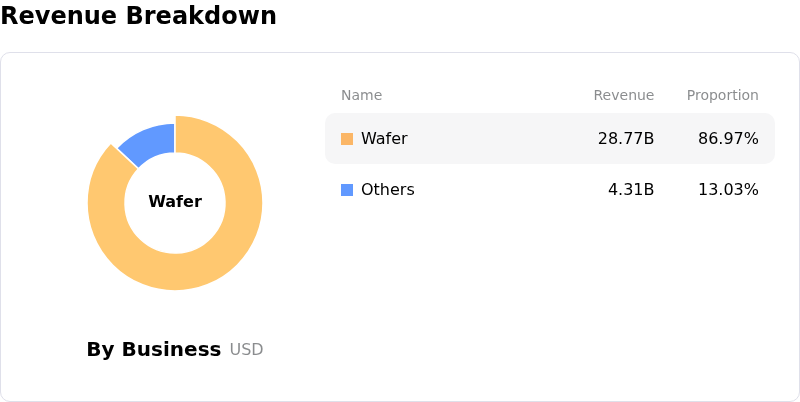
Taiwan Semiconductor Manufacturing Co Ltd (TSM) is in the Technology Equipment industry. Its latest annual revenue is $122.22B, ranking 2 in the industry. The net profit is $55.12B, ranking 2 in the industry. Company Profile
Over the past month, multiple analysts have rated the company as Buy, with an average price target of $410.08, a high of $520.00, and a low of $205.00.
More details about Taiwan Semiconductor Manufacturing Co Ltd (TSM)
Company Specific Risks:
- The extreme geographical concentration of Taiwan Semiconductor Manufacturing Company's (TSM) advanced chip production in Taiwan creates a significant unpriced supply-chain risk, making the company highly vulnerable to military conflict, blockades, or natural disasters in the region.
- Nvidia's decision to reallocate production capacity for its H200 chips from China-bound sales at TSM, due to an ongoing regulatory quagmire, indicates TSM's direct exposure to evolving US-China technology trade restrictions and potential shifts in client demand.
- Despite TSM's proactive reassurances, escalating geopolitical tensions in the Middle East have triggered broader semiconductor sector sell-offs, impacting TSM shares due to market fears regarding potential disruptions to raw material supply chains and increased macro headwinds.
- Recent significant institutional profit-taking and concerns over TSM's elevated valuation after a strong rally indicate potential downside pressure and increased sensitivity to market sentiment shifts or future earnings reports.
Find out more
Comments