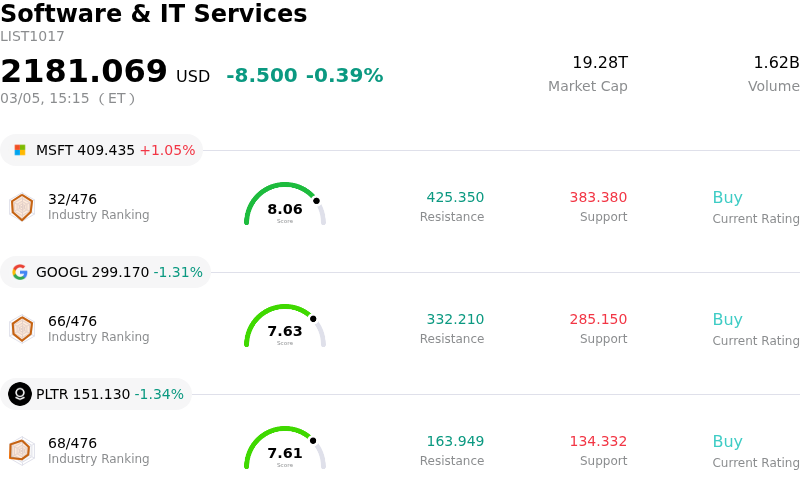
Alibaba Group Holding Ltd (BABA) moved down by 3.07%. The Software & IT Services sector is down by 0.39%. The company underperformed the industry. Top 3 stocks by trading volume in the sector: Microsoft Corp (MSFT) up 1.05%; Alphabet Inc Class A (GOOGL) down 1.31%; Palantir Technologies Inc (PLTR) down 1.34%.
What is driving Alibaba Group Holding Ltd (BABA)’s stock price down today?
Alibaba Group Holdings experienced notable downward movement today, driven by a confluence of factors including leadership changes within its key artificial intelligence division, ongoing geopolitical tensions, and broader concerns regarding China's economic outlook and regulatory environment.
A significant contributor to today's pressure on the stock was the recent departure of Lin Junyang, the head of Alibaba's Qwen AI division, along with other key personnel exits. This development has raised concerns among investors regarding the leadership stability and execution capabilities of Alibaba's critical AI initiatives, which are central to its future growth strategy. While Alibaba has reportedly moved quickly to form a new task force led by its top executives to accelerate foundation model development and has hired a Google DeepMind contributor, the immediate impact of the talent churn appears to be weighing on market sentiment.
Furthermore, persistent geopolitical risks and regulatory scrutiny continue to cast a shadow over Alibaba. Allegations linking the company to US military ties have placed it under increased scrutiny, prompting concerns about potential investigations and data sharing sensitivities. Alibaba's inclusion on a Pentagon watchlist in February 2026 also previously contributed to a sell-off in its shares. The US International Trade Commission's recent announcement of an investigation into Chinese state support and pricing practices in the biotechnology sector adds to a general climate of caution regarding US-China relations, impacting overall sentiment towards Chinese tech stocks.
The broader macroeconomic landscape in China is also a contributing factor. Beijing's announcement of a 2026 GDP growth target of 4.5% to 5%, the lowest since the early 1990s, has dampened the economic outlook, which can negatively affect major Chinese companies like Alibaba. Additionally, a legal overhang in the form of a securities litigation tied to Alibaba, highlighted in a recent class-action recovery report, serves as a reminder of potential ongoing legal exposures. While some analysts maintain a generally positive outlook and institutional investors like ARK Investment Management have increased their positions, these positive signals are currently being overshadowed by the prevailing negative catalysts.
Technical Analysis of Alibaba Group Holding Ltd (BABA)
Technically, Alibaba Group Holding Ltd (BABA) shows a MACD (12,26,9) value of [-3.85], indicating a sell signal. The RSI at 22.17 suggests sell condition and the Williams %R at -98.21 suggests oversold condition. Please monitor closely.
Fundamental Analysis of Alibaba Group Holding Ltd (BABA)
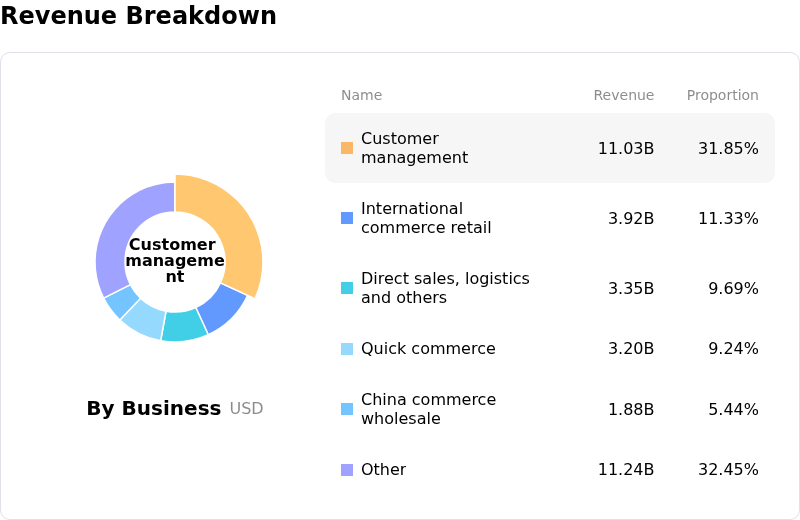
Alibaba Group Holding Ltd (BABA) is in the Software & IT Services industry. Its latest annual revenue is $138.07B, ranking 5 in the industry. The net profit is $17.94B, ranking 6 in the industry. Company Profile
Over the past month, multiple analysts have rated the company as Buy, with an average price target of $198.13, a high of $271.45, and a low of $120.00.
More details about Alibaba Group Holding Ltd (BABA)
Company Specific Risks:
- Alibaba faces a potential investigation for securities fraud initiated by The Portnoy Law Firm, which could lead to a class-action lawsuit and negatively impact the company's financial practices and governance.
- The company's earnings outlook is deteriorating, with significant year-over-year EPS decline expected and negative free cash flow, driven by substantial capital expenditure in AI and quick-commerce initiatives that are pressuring profitability and operating margins.
- Leadership instability in the critical Qwen AI division, marked by the unexpected resignation of its head, Lin Junyang, and other senior exits, raises concerns about the execution and future growth of Alibaba's AI strategy.
- Persistent geopolitical and regulatory scrutiny, including alleged lending irregularities from Chinese authorities and potential U.S. restrictions on advanced AI chip exports to China, introduce significant operational and market risks.
Find out more
Comments