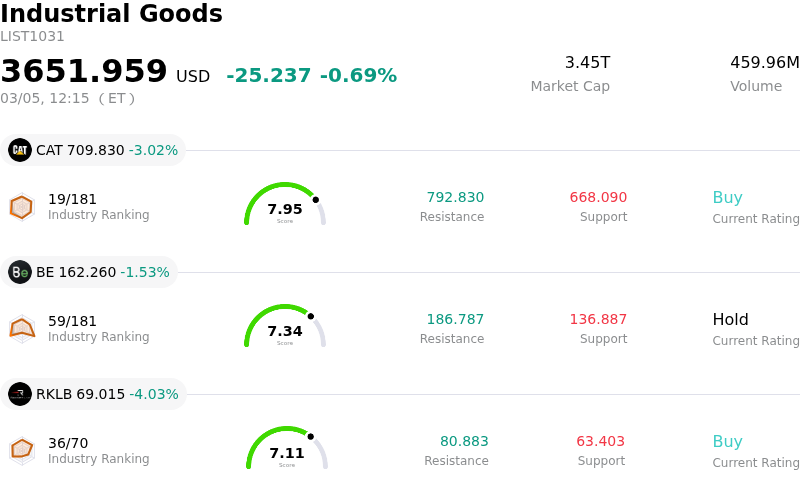
Caterpillar Inc (CAT) moved down by 3.02%. The Industrial Goods sector is down by 0.69%. The company underperformed the industry. Top 3 stocks by trading volume in the sector: Caterpillar Inc (CAT) down 3.02%; Bloom Energy Corp (BE) down 1.53%; Rocket Lab USA Inc (RKLB) down 4.03%.
What is driving Caterpillar Inc (CAT)’s stock price down today?
Caterpillar (CAT) experienced a downward movement in its stock price today, likely driven by a combination of elevated valuation concerns, persistent cost pressures from tariffs, and a broader macroeconomic environment marked by sticky inflation.
Despite recent strong financial performance, including an earnings beat and significant revenue growth in the fourth quarter of 2025, and a record backlog, the stock has been trading at a premium valuation. Several analysts have indicated that the stock's current price reflects elevated expectations, with some suggesting that parts of its rally are momentum-driven rather than purely fundamental. Its forward price-to-earnings ratio and price-to-sales ratio are notably higher than both its historical averages and industry peers, prompting warnings about potential valuation risk. This makes the stock particularly sensitive to any perceived headwinds or shifts in market sentiment.
A significant operational challenge for Caterpillar continues to be the impact of tariffs, which have resulted in substantial declines in operating margins across its segments. The company projects these tariff headwinds to remain considerable throughout 2026, directly affecting its profitability. This ongoing cost pressure serves as a drag on financial performance, potentially overshadowing positive growth indicators.
Furthermore, the macroeconomic backdrop presents additional concerns. The Federal Reserve's latest "Beige Book" report highlighted persistent inflation and stable, though not accelerating, economic activity. Fed officials, including the Richmond Fed President, have expressed continued concerns about elevated inflation and geopolitical tensions impacting consumer prices, suggesting a cautious stance on monetary policy and potentially prolonged higher interest rates. Such an environment can dampen investor enthusiasm for cyclical stocks like Caterpillar, especially those perceived as overvalued. While the long-term outlook for the US construction equipment market remains positive, supported by infrastructure investments, a competitor's recent forecast for "flattish" construction equipment sales in 2026 due to residential weakness suggests potential industry-wide caution.
Technical Analysis of Caterpillar Inc (CAT)
Technically, Caterpillar Inc (CAT) shows a MACD (12,26,9) value of [27.75], indicating a neutral signal. The RSI at 53.00 suggests neutral condition and the Williams %R at -69.51 suggests oversold condition. Please monitor closely.
Fundamental Analysis of Caterpillar Inc (CAT)
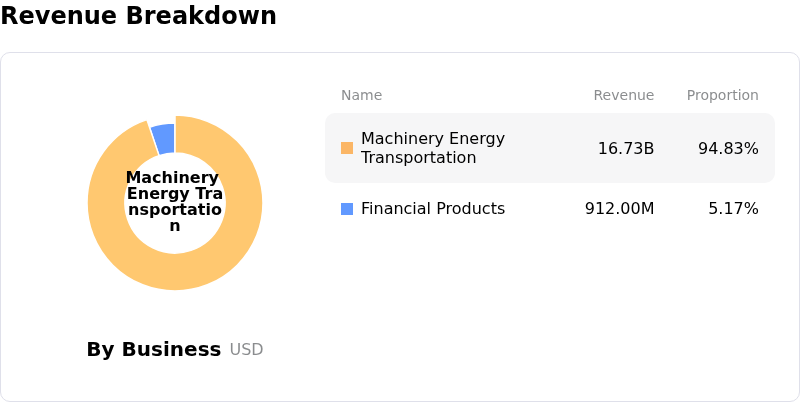
Caterpillar Inc (CAT) is in the Industrial Goods industry. Its latest annual revenue is $67.59B, ranking 1 in the industry. The net profit is $8.88B, ranking 1 in the industry. Company Profile
Over the past month, multiple analysts have rated the company as Buy, with an average price target of $715.86, a high of $878.00, and a low of $425.00.
More details about Caterpillar Inc (CAT)
Company Specific Risks:
- Vulnerability to a significant downturn in core end markets such as construction, mining, and energy, which could lead to rapid declines in equipment purchases and overall sales volumes.
- Risk of dealer inventory destocking, where an effort by independent dealers to reduce excess stock could cause a sharp and sudden reduction in Caterpillar's shipments, amplifying market downturns.
- Concerns regarding potential valuation compression if the current stock price reflects peak cycle conditions and analysts anticipate future earnings estimates to fall, suggesting the company may be priced for an unsustainable environment.
- Elevated financial leverage indicated by a substantial debt-to-equity ratio (2.03) that surpasses industry norms, posing potential challenges amidst financial market volatility or economic softening.
Find out more
Comments