TradingKey - Tesla ( TSLA) is at a clear turning point. As the share price continues to retreat, deliveries fall short of expectations, and inventory pressures mount, the market has begun to re-examine its growth logic. Valuations previously underpinned by high growth and long-term narratives now face a more realistic test: with the automotive business slowing and autonomous driving and robotics yet to materialize, Tesla's pricing system is also being recalculated.
Yesterday (April 2), Tesla's share price came under significant pressure following the release of delivery data. The market reaction was direct, with the stock plunging 5.42% at the close, marking its largest single-day drop since 2020. This adjustment is not an isolated incident; data shows that year-to-date, Tesla's stock has fallen nearly 20%.
For the market, what investors are selling off is not just a single quarter's figures, but rather a questioning of whether Tesla can still maintain the high growth and high premiums of the past.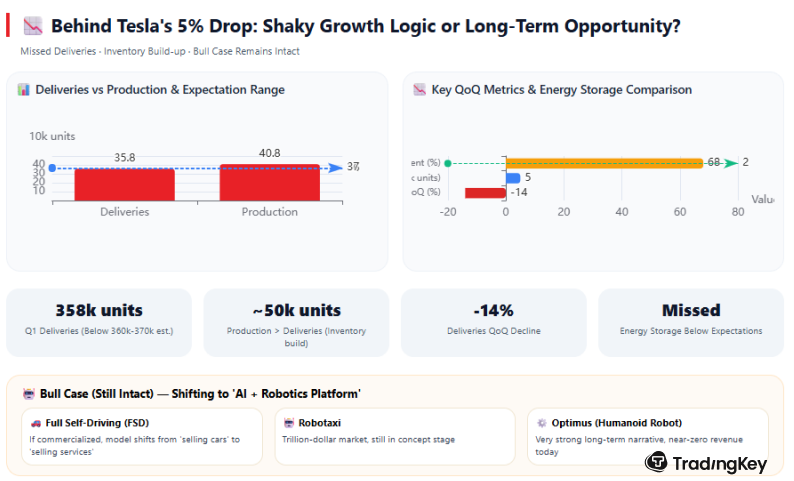
Why has Tesla’s stock price continued to fall recently? The core reason is shattered expectations.
Data shows that Tesla delivered 358,000 vehicles in the first quarter, significantly lower than the general market expectation of 360,000 to 370,000 units.
Notably, quarterly production exceeded deliveries by approximately 50,000 units, marking the largest production-delivery gap in nearly four years and signaling rising inventory pressure. This has led the market to worry that Tesla is shifting from a state of "demand exceeding supply" to one of "needing to digest inventory."
Meanwhile, the expiration of U.S. EV tax credits, delayed FSD approvals in Europe, and intensifying global competition have collectively weighed on the core electric vehicle business. Although the Chinese market continued to grow, with Q1 sales of China-made models up 23.5% year-over-year, weak demand in the U.S. failed to lift the overall performance.
This is also why Tesla's recent decline feels less like a "sudden bout of bad news" and more like "expectations being gradually eroded."
Furthermore, while Tesla's Q1 sales rebounded by approximately 6% year-over-year, they remained significantly below Wall Street expectations; this implies that the market does not lack "growth," but rather "growth that exceeds expectations." For a company whose valuation remains expensive and whose narrative relies heavily on future execution, even a slight shortfall in growth can trigger a valuation rerating.
Is Tesla facing a fundamental crisis?
Judging by the results alone, Tesla is still far from a "fundamental collapse." For the full year of 2025, the company's total revenue was $94.827 billion, down approximately $2.86 billion from the previous year; net income attributable to common stockholders was $3.794 billion, significantly lower than the $7.091 billion in 2024.
At the same time, Tesla still maintains $44.059 billion in cash, cash equivalents, and short-term investments, indicating its financial buffer is not fragile. In other words, it is not a company facing a cash flow crisis, but rather a high-valuation tech manufacturer entering a phase of slowing growth, declining profits, and valuation recalibration.
The most practical pressure still comes from the automotive business. While automotive revenue remains Tesla's cash cow, this business line is no longer as dominant as it once was.
Total automotive revenue in 2025 was $69.526 billion, a year-over-year decline; energy business revenue rose to $12.771 billion, and services and other revenue increased to $12.530 billion. This shows the company is indeed seeking growth outside of automobiles, but the problem is that deliveries and automotive margins still dictate the core valuation. Once the automotive segment slows, other businesses are not yet in a position to immediately take over.
Does Tesla still offer upside potential? Yes, but the realization cycle is longer.
The market's current focus on Tesla is not on the electric vehicle company itself, but on whether it can become an AI platform comprising autonomous driving, Robotaxi, and humanoid robots.
In its Q4 2025 update, Tesla explicitly mentioned that the company is transitioning from a hardware-oriented business to a "physical AI company" and is continuing to advance FSD, Robotaxi, Cybercab, and Optimus.
The problem is that while the visionary potential remains, the pace of delivery has not kept up. Robotaxi is currently small in scale, FSD approval in Europe has been delayed, and Cybercab and Optimus are still largely in the investment and groundwork stages.
For capital markets, this situation is familiar: the bigger the story, the more front-loaded the valuation; but once execution fails to keep pace, the stock price will undergo a "return from future to reality" discounting. Tesla does not lack a new narrative; rather, the new narrative is still too far from generating cash flow.
Can Tesla's stock price continue to rise in 2026?
Tesla's next earnings release is scheduled for April 22, ET, and the market will soon see more comprehensive financial and management guidance.
In terms of trading logic, whether the stock price can recover by 2026 depends not on whether the "story" remains intact, but on whether Robotaxi, FSD, and the energy business can demonstrate progress closer to commercialization, while delivery performance must avoid further significant deceleration.
As long as two of these variables begin to improve, the stock price may regain support; if deliveries remain weak, inventories continue to build up, and new businesses remain purely conceptual, the market will continue to compress its valuation.
From a more realistic perspective, it is not that a rally for Tesla in 2026 is impossible, but rather that the upside will rely more on "execution" than "vision."
The market's valuation logic has clearly shifted: whereas the market previously paid for high growth, it now wants to see if that growth can materialize. Even if Tesla remains one of the most buzzed-about EV and AI concept stocks, it will be much harder for the share price to return to its previous one-sided high elasticity unless the core automotive business re-accelerates.
Is Tesla Still Worth Investing In?
Judging by its current business fundamentals, Tesla is no longer cheap or an easy play. Delivery pressures, mounting inventory, intensifying competition, and a valuation that remains elevated all mean it is no longer the kind of growth stock that can be bought blindly.
However, from the perspective of a 'future platform narrative,' Tesla remains one of the few companies simultaneously betting on autonomous driving, robotics, and energy. Its long-term potential has not vanished; rather, the bar for realization has been raised significantly. The market continues to base a substantial portion of its valuation on future robotics and Robotaxis rather than current sales volume, which essentially makes the answer quite clear.
Find out more
Comments