The automaker shipped 480,126 EVs to consumers last quarter - much more than even bullish analysts projected
Tesla beat expectations with its latest delivery numbers.
Tesla on Thursday disclosed that it delivered tens of thousands more vehicles than expected by even the most bullish analysts for the second quarter of 2026.
But that wasn't enough to please investors. Tesla shares $(TSLA)$ fell 7.5% on Thursday, their biggest one-day decline since falling 8.2% on July 24, 2025, according to Dow Jones Market Data.
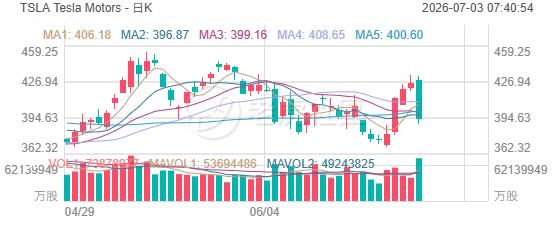
The move is likely a case of "buy on the rumor, sell on the news," according to Gene Munster, managing partner at Deepwater Asset Management. The stock had been on a tear ahead of Thursday's report. Munster also said that investors are questioning how much of an impact high gas prices had on Tesla's deliveries.
The automaker said it delivered 480,126 electric vehicles to customers between April and June - 18% more than the 406,000 units forecast by sell-side analysts, based on a consensus of estimates compiled by Tesla. Several analysts, though, had raised their expectations in recent days as promising data rolled in from international markets.
Deutsche Bank forecast sales of 416,000 vehicles, while Morgan Stanley was anticipating 413,000 units. The independent researcher who goes by Troy Teslike on Wednesday said he projected 466,000 vehicles to have been delivered last quarter.
Ahead of Tesla's sales release, Morgan Stanley's Andrew Percoco told MarketWatch that he would consider any result north of 425,000 deliveries to be clear beat. "That's probably what I would consider core consensus at this point," he said.
Tesla also sold 25% more vehicles than it did in the second quarter of 2025. It was the company's best quarter for EV sales since the third quarter of 2025, when Tesla and other carmakers received a boost in the U.S. from customers who pulled ahead their purchases so that they could benefit from expiring federal EV tax credits.
"Tesla deliveries are the first sign we're exiting the EV winter that started in March of 2024," Munster wrote on X.
Much of Tesla's sales growth is tied to Europe, where sales have trended stronger in recent months. That could continue, analysts say, as the company works to roll out its advanced driver-assistance system in new countries.
The company sold 467,762 Model 3 and Model Y electric compact cars and SUVs. It also sold 12,364 other models, including the Cybertruck electric pickup truck. Tesla discontinued its other luxury vehicles, the Model S and Model X, last quarter, and stopped taking new orders on April 1. Limited-edition versions of the Model S and Model X were handed off to customers in May.
In a note to clients, William Blair's Jed Dorsheimer noted that it was likely the last quarter bolstered by "last-time buys." That's another reason why some investors may not be overly enthusiastic about Tesla's sales, since the company won't have that measure of support going forward.
Tesla on Thursday also revealed that it deployed 13.5 gigawatt hours of energy-storage products in the second quarter. That's greater than the 9.6 GWh it deployed in the year-ago period, but slightly below the 13.8 GWh analysts were expecting.
It's also more than the 8.8 GWh that Tesla deployed in the first quarter, which was a surprise to Wall Street after multiple quarters of growth. The company's CFO, Vaibhav Taneja, told investors in April that Tesla expects to deploy more energy-storage products in 2026 than in 2025, noting that the business is "inherently lumpy."
Baird's Ben Kallo said in a recent note to clients that the energy business may be "underappreciated by investors." But it's starting to attract more interest among automotive investors, according to Percoco, who pointed to newer, similar endeavors from Ford Motor $(F)$ and General Motors $(GM)$.
Tesla's results stand mostly above its competitors, several of which had less fortunate quarters.
Ford on Thursday said its overall sales for the second quarter dropped 10%. Its EV sales sunk 40.7% compared to the year-ago quarter, while hybrid-vehicle sales fell 20%. Sales from GM were down 4.2% for the quarter, a performance that it said "reflected the smaller EV market," as well as inventory constraints and discontinued vehicles.
Lucid $(LCID)$ said it delivered 3,953 vehicles last quarter, below Wall Street's expectations for about 5,000 cars, according to FactSet data. The company also announced a number of organizational moves, including that CFO Taoufiq Boussaid would soon leave the company. Last month, Lucid laid off 18% of its U.S. staff and its chief operating officer departed.
Things were more positive at another of Tesla's EV rivals. Rivian Automotive (RIVN) on Thursday said it delivered 12,194 vehicles to customers last quarter, above its outlook of between 9,000 and 11,000 cars.
Rivian cited "robust growth" in its R1 and electric delivery-van sales versus the prior quarter. It also pointed to demand for the new R2 SUV.
The company raised its deliveries outlook for the full year to between 65,000 and 70,000 units. Its prior forecast topped out at 65,000 units.
Ford shares were up 2% on Thursday, while GM's stock was ahead 1%. Rivian's stock was taking off, jumping 8% shortly after the market open, while Lucid's stock was down 3%.
-William Gavin
(END) Dow Jones Newswires
Comments