TradingKey - On July 7, Samsung Electronics released a stunning Q2 earnings preview, but instead of rallying, its stock price faced massive institutional sell-offs on the day, plummeting nearly 7% at the close. This staged another classic 'buy the rumor, sell the news' scenario, while simultaneously sparking market concerns over its future: Will it rally to new highs in the second half of the year, or suffer a 'brutal crash'?
Samsung Electronics Stock Price Trend Review: Maximum Gain Over 200% in First Half of 2026
In the first half of 2026, the stock price movement of Samsung Electronics was nothing short of an "epic roller coaster" for the global semiconductor and AI industries. Soaring continuously from a low of 120,000 won to peak above 370,000 won, its maximum gain reached 208%. However, the stock price pulled back at the end of June, narrowing the gains to around 175%.
On January 2, 2026, Samsung Electronics opened at approximately 120,000 won and subsequently staged a gradual minor rebound. Entering February, Samsung Electronics' rally accelerated, with the stock price breaking through the 190,000 won mark in less than two months, representing a gain of over 50%. March saw a brief period of consolidation, but the stock subsequently became unstoppable, repeatedly breaking through key milestones—surpassing 200,000 won in April and 300,000 won in May.
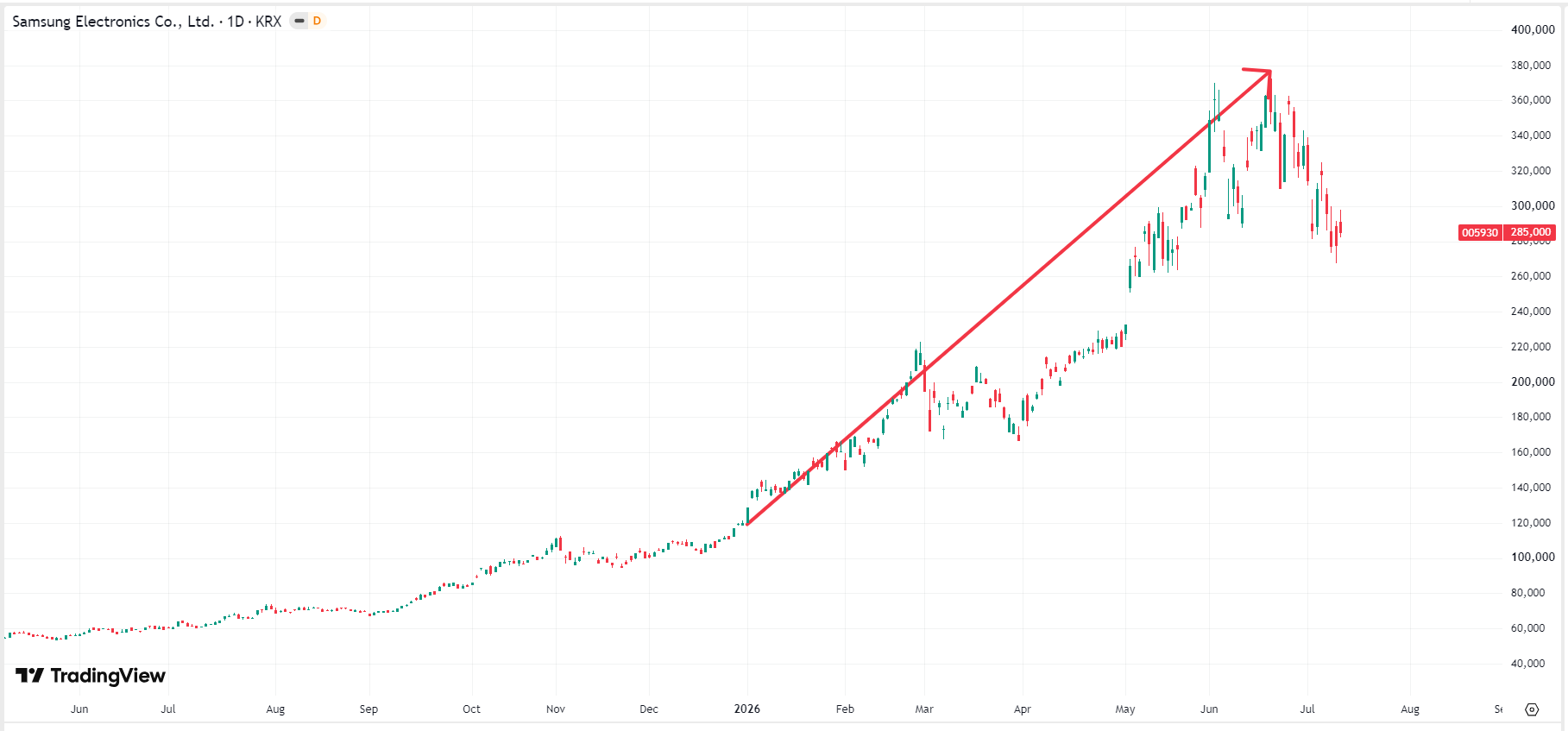 Samsung Electronics stock chart, Source: TradingView
Entering June, the frenzy surrounding AI concept stocks was pushed to its peak on the eve of earnings releases. On June 19, 2026, Samsung Electronics surged to an intraday high of 374,500 won, setting a historical high for the company. Since then, Samsung Electronics' stock price has continued to pull back, currently hovering around 380,000 won.
Why Is Samsung Electronics Share Price Rising?
Similar to Micron Technology ( MU ), the surge in Samsung Electronics' stock price in the first half of 2026 was not mere thematic hype, but was primarily a surge driven by solid fundamentals, resulting from the combination of the aggressive expansion of global AI computing infrastructure and an epic spike in memory chip prices.
In the first half of the year, Microsoft ( MSFT ), Google ( GOOG ), Meta ( META) and other global cloud giants embarked on an AI data center expansion arms race with OpenAI totaling up to $600 billion, leading to a severe supply-demand imbalance in conventional DRAM and enterprise SSDs (NAND flash) required for high-end servers. Among these, bulk conventional DRAM contract prices in the first quarter saw a staggering 90% to 95% increase in Q1, while Q2 contract prices rose by another roughly 30% on top of the high base in Q1. As the world's largest memory manufacturer, Samsung precisely executed a strategy of "controlling production and holding back sales," prioritizing capacity allocation to the highest-margin high-end server segment, making it a direct beneficiary of this wave of chip price hikes.
In the critical high-bandwidth memory (HBM) battleground for AI chips, Samsung has also won over the market. At the GTC 2026 conference, Samsung officially unveiled its core wafer technology for HBM4 / HBM4E designed for next-generation AI platforms. Meanwhile, market rumors continued to circulate that Samsung has passed or is about to pass validation for Nvidia ( NVDA )'s supply chain, providing the market with immense room for anticipation and attracting substantial speculative and long-term capital looking to "buy on expectations" and build positions early.
Although the surge in Samsung's stock price primarily benefited from the DRAM, NAND, and HBM provided by its semiconductor division, the cash flow support provided by the Device eXperience (DX) division, which encompasses consumer electronics and mobile, should not be overlooked. It is reported that Samsung's flagship Galaxy S26 series has become a global bestseller thanks to its more mature, exclusive Galaxy AI features, and steady shipments of high-priced smartphones have provided Samsung with excellent cash flow, ensuring it has the financial confidence to expand semiconductor production and R&D without worries, such as when procuring from ( ASML) the latest EUV lithography machines.
Samsung Electronics Stock Price Forecast: Will Pull Back to 160,000 Won in the Second Half?
Despite Samsung Electronics' impressive achievements in the first half of the year, as soon as its blowout Q2 earnings report was released, its stock price immediately faced "reverse liquidation" from large institutional sell orders. The stock price dropped directly below the key support level of the 280,000 won mark established over the past month, meaning that the high-level consolidation structure has been broken and will continue to correct downward, with the next key support level at 220,000 Korean won.
In an extreme scenario, Samsung's stock price could drop further to another level, falling to 160,000 Korean won. Recently, the U.S. military launched a new round of strikes against Iran and revoked oil sanction waivers, causing crude oil to surge 6%. The situation in the Middle East has once again become highly volatile, which is a heavy blow to the South Korean economy, which is heavily dependent on energy imports, and the overall market's valuation ceiling. If oil prices continue to skyrocket, it could reignite the recently cooled embers of inflation, potentially forcing the Federal Reserve (Fed) to turn hawkish in its future policy or even resume rate hikes to suppress secondary inflation, thereby lowering the P/E ratio ceiling that the market is willing to accord to AI tech stocks.
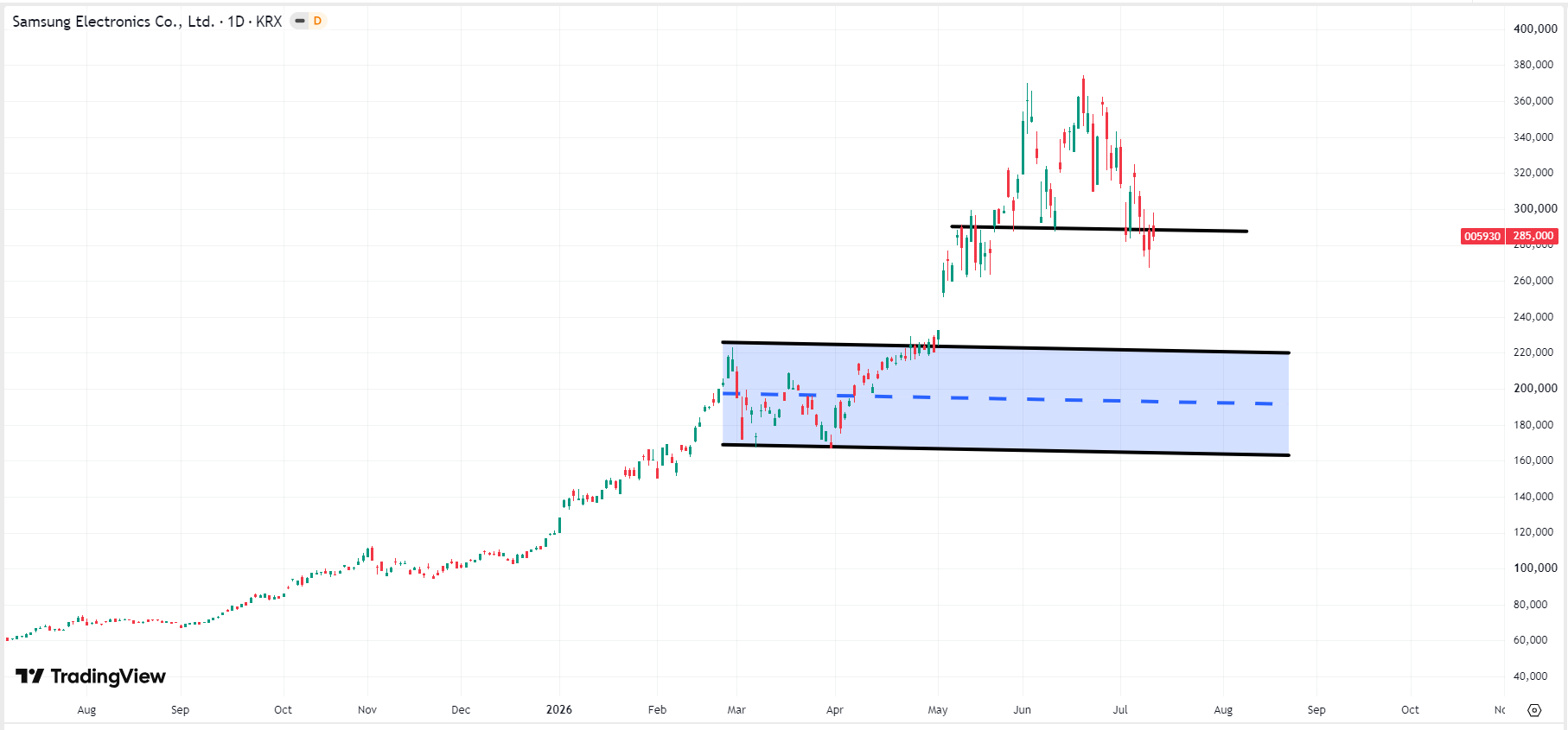 Samsung Electronics stock price chart, Source: TradingView
Despite the current unfavorable macroeconomic environment, if Samsung can secure and finalize HBM4 / HBM4E chip orders, it could not only reverse its decline but even push toward new highs. Reportedly, Samsung plans to gradually deliver its first batch of next-generation HBM4 products to Nvidia in the second half of the year. If it successfully overtakes its peers in terms of progress in the second half, it will serve as a catalyst for analysts to upgrade their ratings. Currently, Citi and Macquarie are the most aggressively bullish, with target prices reaching as high as 410,000 to 460,000 Korean won.
Find out more
Comments