TradingKey -On Thursday, July 17, shares of UnitedHealth Group Inc (NYSE: UNH) hovered near $425.20 following a Q2 2026 earnings release on July 16 that trashed estimates. Adjusted earnings per share (EPS) reached $6.38, topping the $4.91 expectation by a $1.47 cushion, which is a 30% upside. Sales totaled $112.03 billion, beating the $111.93 billion consensus figure. The company's medical benefit ratio was 86.7%, down from 89.4% a year ago. Optum operating income rebounded 29% to approximately $4 billion.
UnitedHealth lifted full-year 2026 guidance for adjusted EPS to $19.50 to $20.00. On the chart above, UNH is holding the ascending channel, and the relative strength index is approaching 50. Key resistance points are $433.60 and $443.30, with the ascending channel top at $454. A drop below $420.50 will see the next target at $411.80.
Q2 EPS Beat: Signs of a Turnaround?
UnitedHealth's second quarter 2026 adjusted earnings-per-share (EPS) of $6.38 blew past the $4.91 analyst expectation by $1.47, which is a 30% upside and the biggest quarter-over-quarter EPS beat the company has reported in quite some time. This comes after a 2025 full-year during which the company missed estimates and slashed guidance several times.
A medical benefit ratio of 86.7% declined from 89.4% on a year-over-year basis, or 270 basis points, a significantly lower number than the 88.47% average estimate. Optum operating income rose 29% to approximately $4 billion after falling 15% in Q1 2026. And the company also generated $11.1 billion in operating cash flow, equivalent to 1.9 times net income. Those three metrics, moving simultaneously in one quarter, is likely evidence that these cost reductions are not one-off items.
In addition to the EPS beat, UnitedHealth hiked its full-year 2026 adjusted earnings guidance to $19.50 to $20.00 per share after previously guiding for more than $18.25. The original guidance issued in January 2026 was at least $17.75 per share, and so far every guidance bump has been incremental. The company is raising the bar to almost $20.00 per share on an annual basis, which puts the full-year range near $20 for the first time since the company began cutting expectations in 2025.
Piper Sandler boosted its stock rating for the business, moving the price estimate for the company up from $420 to $475 in response to the second-quarter 2026 financial results. The average price target on Wall Street for the company currently sits at $419 per share, which shares of UnitedHealth have already exceeded. Expect further upgrades to the average price target in the coming weeks.
What the Medical Benefit Ratio Drop May Signal for H2 2026
The company's medical benefit ratio of 86.7% is the most critical metric because it directly impacts its bottom-line earnings per share, which means every 1% improvement is roughly equal to $1.1 billion in additional operating income on UnitedHealth's current premium revenue. Thus, the company's sequential 270 bps improvement from 89.4% in the second quarter 2025 to 86.7% in the second quarter 2026 is roughly equivalent to $3.0 billion in annual run-rate operating income growth, assuming the trend holds. CFO Wayne DeVeydt cautioned that medical costs remain elevated and the quarter does not mean utilisation pressures have disappeared.
That's all pretty standard conservatism for a company managing the bottom line, but the improvement came from deliberate actions to reduce medical costs: changes to its health insurance benefits, its product pricing strategy and, importantly, the exit of its membership in Medicare Advantage and ACA exchange plans that were priced below cost.
UnitedHealth had 48.5 million members in the second quarter, down 525,000 from the first quarter, due to the exodus from the ACA exchange and Medicare Advantage where pricing was not profitable enough. Management says it expects to drop around half a million more ACA exchange members and 1.1 million Medicare Advantage members in 2026, fully, a move that will reduce revenue but improve margin.
The $1.5 billion investment in artificial intelligence, which is beginning to make itself known in administrative cost decreases and the use of machine-learning technology to reduce prior authorisation wait times and streamline clinical workflow, CEO Stephen Hemsley said it's making headway on its culture change initiative ahead of schedule, the qualitative element behind the medical cost ratio improvement.
The DOJ Investigation; Why It Cannot Be Ignored Despite the Beat
The Justice Department has both civil and criminal investigations underway into UnitedHealth's Medicare practices, and a January Senate Judiciary Committee report called the insurer for engaging in aggressive coding practices to boost Medicare Advantage reimbursements. UnitedHealth said the report was inaccurate and its programs are in compliance with regulations, which remain unchanged, and there has been no movement on the investigations in the past quarter; its July 16 release used the same wording as earlier quarters about 'cooperating' with government inquiries.
These probes create a binary, performance-independent threat: Any settlement or court consent order requiring repayment of Medicare Advantage reimbursements could be a material earnings impact, regardless of the trending medical cost ratio.
UNH Technical Setup; Rising Channel, RSI 50, Key Levels at $425
The 4H chart chart shows UnitedHealth at $425.20, holding up in the rising channel with support at the 50-period EMA ($423.55) and 200-period EMA ($398.20) below. RSI near 50 is neutral following the earnings-day spike. The $420.50 level is a key support, with another $411.80 (channel bottom) if that is broken. A breakout over $433.60 will take the stock to $443.30 and then the channel's ceiling at $454.
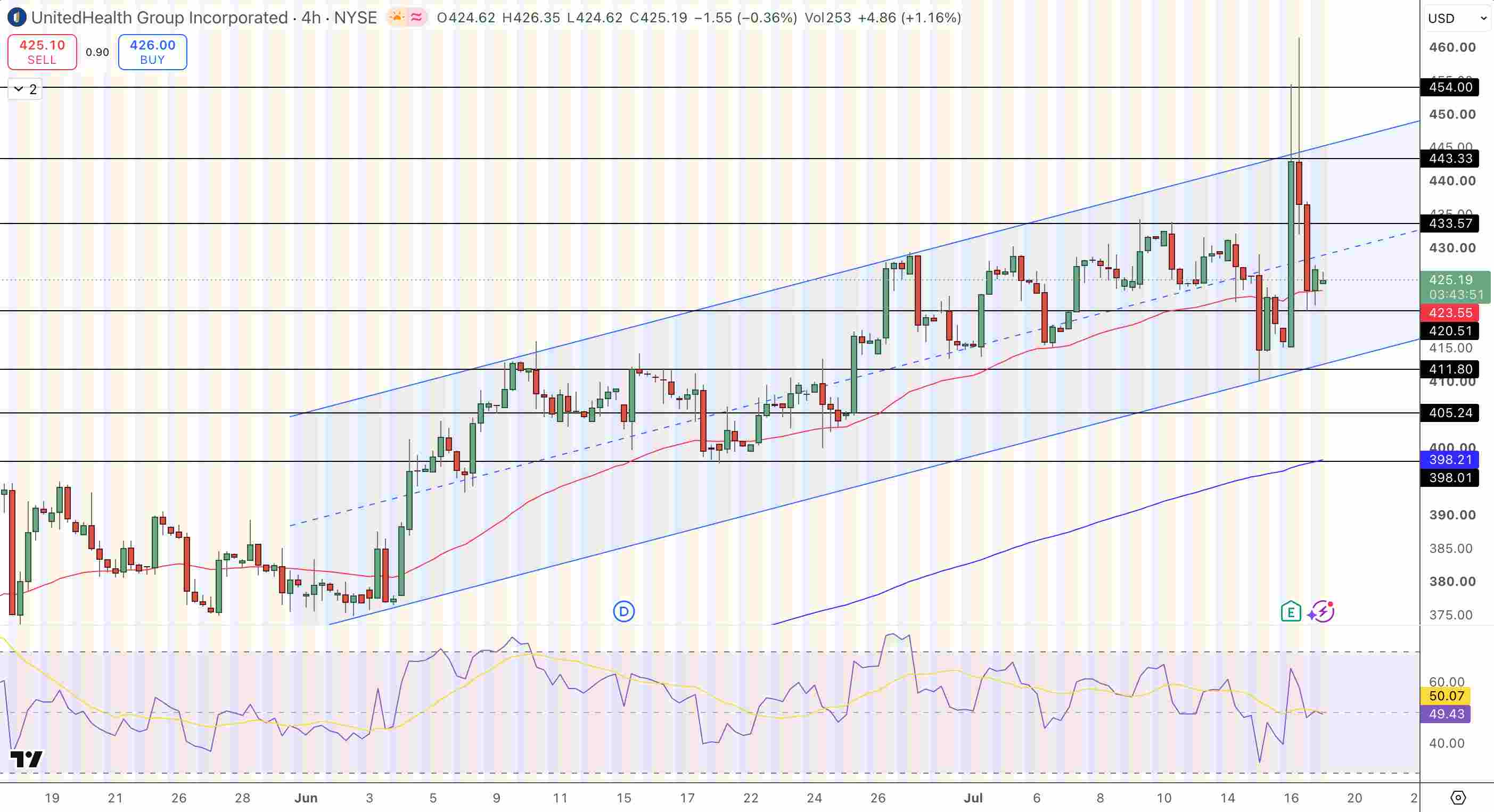
UnitedHealth (UNH) Price Chart - Source: TradingviewThe intraday surge to $454 on the day of the earnings call followed by a retreat to the $425 area represents the normal price discovery for a post-earnings market moving within a robust uptrend.
- Q2 beat: Adj EPS $6.38 vs $4.91 est (+$1.47 or +30%), revenue $112.03B vs $111.93B est.
- Medical ratio: 86.7% vs 89.4% YoY and 88.47% consensus, Biggest improvement in 8 quarters.
- FY2026 guidance: Adj EPS $19.50 to $20.00 (raised from >$18.25); revenue >$439B.
- Optum rebound: Operating income +29% YoY to ~$4B (after Q1's -15% miss).
- Resistance: $433.60, $443.30, $454 (channel top).
- Risks: DOJ civil and criminal Medicare investigation remains active; senate report on coding and billing practices.
How did UnitedHealth’s 30% Q2 2026 Earnings Surprise Happen?
UnitedHealth’s adjusted EPS of $6.38 blew past the $4.91 street consensus by $1.47 for a 30% earnings beat. The strong Q2 came from three key factors. First, medical benefits ratio fell to 86.7% in Q2 2026 from 89.4% in Q2 2025, way under analyst projections of 88.47%. Second, Optum operating income recovered from its 15% Q1 drop, and grew 29% to just under $4 billion. Third, UnitedHealth generated $11.1 billion, or 1.9x adjusted net income, in operating cash flow. The company also raised its full-year adjusted EPS guidance to $19.50 to $20.00, from prior guidance of over $18.25, implying management thinks the better-than-expected performance is likely not a one-time thing.
What Is the Medical Benefit Ratio and Why Is a Lower Number Good?
The medical benefit ratio (or medical cost ratio) is the portion of premium revenue paid out for members’ claims. A lower medical benefit ratio means the health insurer will keep a greater share of every insurance premium dollar for its own operating income. UnitedHealth reported its medical benefit ratio at 86.7% in Q2 2026, down from 89.4% in Q2 2025. This 270 basis point improvement in utilization suggests roughly $3 billion in annualized additonal operating income over the full year 2026, assuming utilization rates remain at this level. The better-than-expected medical cost ratio improvement stems from member benefit redesign, more prudent medical plan pricing, and planned exits from unprofitable ACA individual and Medicare Advantage markets. CFO Wayne DeVeydt noted that medical costs are still very elevated, and that one quarter does not confirm utilization pressures have truly returned to "more normal" levels.
What Is the DOJ Investigation into UnitedHealth?
The Department of Justice (DOJ) is conducting ongoing civil and criminal inquiries into the healthcare company’s use of Medicare Advantage and its associated coding practices to increase Medicare reimbursements. This inquiry was the focus of a highly detailed January 2026 Senate Judiciary Committee report that leveled many specific accusations about the company’s practices. UnitedHealth has disputed the accusations and stated that it is in the process of cooperating with the various government agencies investigating it, while adding that its programs and practices comply with all applicable laws. If the DOJ investigation concludes in a settlement, a civil consent order, or a criminal conviction, UnitedHealth could face penalties, required reimbursements or Medicare Advantage plan billing changes that could have an adverse impact on earnings. This risk is separate from how good or bad UnitedHealth’s medical benefit ratio looks on any quarterly basis.
Bottom Line
UnitedHealth blew past Q2 2026 adjusted earnings per share estimates by 30% as its medical benefits ratio dropped to 86.7%, the lowest level in eight quarters; Optum operating income climbed 29%; and management raised its full-year guidance to a range of $19.50 to $20.00 per share. The turnaround in operational performance management has been predicting since early 2025 is showing up in the financial results. UNH is trading at $425 within an ascending channel pattern with RSI approaching 50.
If prices trade above $433.60 in the coming weeks, targets will be $443.30 and $454. Support below $420.50 will be seen at $411.80, the base of the channel pattern. What UnitedHealth isn’t controlling is the ongoing DOJ investigation into its Medicare Advantage programs, the risk of which isn’t factored into the medical cost ratio improvement at all.
Find out more
Comments