TradingKey - Intel (NASDAQ: INTC) has started the week following one of the most dramatic post-earnings sell-offs to occur in 2026. The chip giant reported its best quarter in a number of years, reporting adjusted EPS that came in 110%+ higher than the consensus and issuing guidance while also signaling that its 18A process had made significant strides. The stock rose to $112.70 prior to falling almost 19% over the last two sessions.
However, this sell-off did not necessarily stem from a disappointing quarter but, rather, paralleled the AI sector-wide sell-off that took hold of stocks such as Alphabet (NASDAQ: GOOG) and Tesla (NASDAQ: TSLA) in the days following the reporting of those results this year.
Investors will continue to keep an eye on AI spending in the coming days as companies including Microsoft (NASDAQ: MSFT), Meta Platforms (NASDAQ: META), and Amazon (NASDAQ: AMZN) are set to report this week. If these three tech giants can demonstrate continued strength in AI spending amid the current valuation challenges, we should see continued upside in the semiconductor sector, especially with Intel.
Intel's Strongest Quarter in Years
Intel posted one of its best quarters in 10 years during its second-quarter print. Total revenue grew 25% YoY, rising from $14.06 billion to $16.13 billion, surpassing the $14.42 billion consensus estimate. The company reported adjusted EPS of $0.42, comfortably coming in above the analyst expectation of a range of $0.18 to $0.20. Intel also improved its guidance for all business metrics. Non-GAAP gross margin came in at 44.6%, ahead of its 41.5%-43% range guidance. Intel CCG grew 18% YoY to $8.7 billion, DCAI grew 31% YoY to $4.2 billion, and Intel Foundry rose 23% YoY to $5.3 billion with the segment seeing operating losses fall more than 50%.
One of the biggest takeaways of Intel’s second-quarter print came from the company’s comments regarding its 18A process and process yields. Management confirmed that it has improved its yields for its 18A process from 65% earlier in the year to around 85% today. Intel reported third-quarter revenue in the range of $15.8 billion to $16.8 billion and EPS guidance of $0.38, both well ahead of the consensus. The company remains on track to turn itself around and will likely continue to do so for some time into the future.
Why Did Intel Fall Despite the Beat?
There has been little doubt about why Intel shares have been falling following its earnings beat. While execution has been strong for Intel for quite some time, the company was not the only tech stock that has posted impressive earnings reports in recent days. However, investors have begun to price in AI headwinds following Alphabet’s report on AI spending last Friday. Alphabet, for example, highlighted $44.9 billion in quarterly AI capital expenditure, raising fears of a slowdown in AI spend. While the company did not provide any commentary on how the company may change spending on AI given the rising investments required in building the necessary infrastructure, investors have become increasingly skeptical of AI growth and profitability.
Investors may also be looking to take profits on their positions in technology and tech-related companies in anticipation of a broader tech sector correction. Intel, for one, has seen gains of over 340% in the past year alone and had already rallied significantly in the quarter leading up to its second-quarter print last month. The company will continue to receive strong analyst ratings following the earnings report.
Several investment banks raised their price targets following Intel’s earnings report, with the average price target now sitting at $115.65. HSBC, which already had the most bullish view for the stock, also raised its price target to $200, marking the only higher price target in the analyst community. This, in and of itself, demonstrates that investors remain positive on Intel and the overall AI sector as the stock continues to post impressive quarterly results.
What Could Move Intel This Week?
Intel may get its move this week as Microsoft, Meta, and Amazon report results. The earnings could signal capital expenditure on AI infrastructure, which would support a need for Intel’s Xeon chips and the foundry business. Alternatively, reduced spending by hyperscalers can drag the semiconductor names lower.
Investors will also continue to keep an eye on Intel’s foundry execution. Intel stated this week that the 18A process has an 85% yield rate, and that a major hyperscaler cloud provider has agreed to produce its chips on it.
Intel’s foundry is taking shape, as we see more customer wins and potentially commercial foundry agreements which is one of the key drivers for the second half of 2026 for Intel’s business and the stock.
INTC Technical Analysis: $89 Support Holds the Key
Intel is currently in a bear trend channel on the 4H chart after pulling back to a sharp level from the initial move higher following the earnings report on the highs. The stock INTC is currently sitting in the mid-$91.50s, and the 50 and 200 period EMAs on the 4H chart sit in resistance ($100.21) and ($108.91), respectively. The RSI is hovering around 40, meaning bearish momentum may be fading, but needs to confirm by reversing.
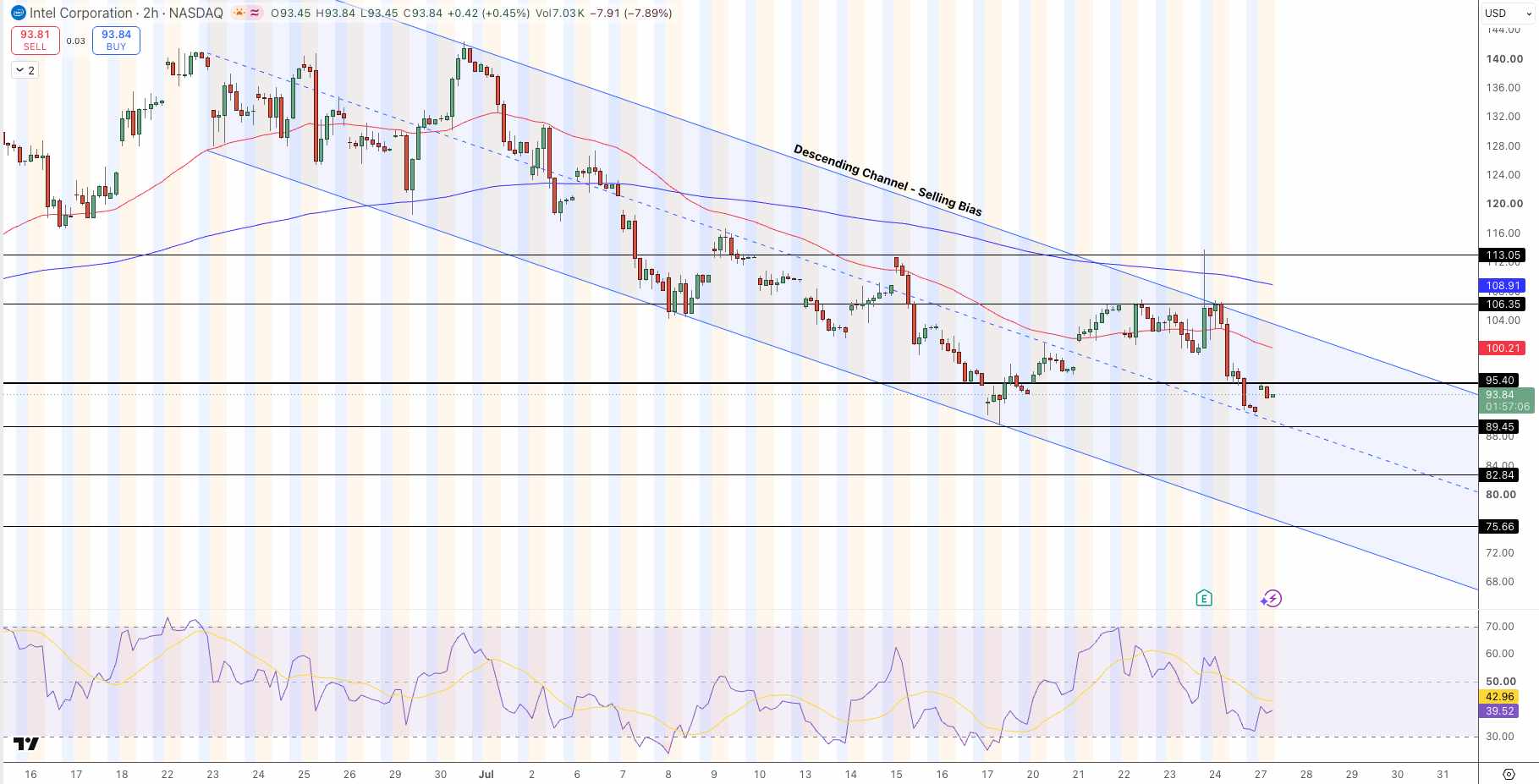
Intel (INTC) Price Chart - Source: Tradingview
Most importantly, at $89.45 support which is also the trend channel level and breakout level on demand after earnings. Above $89.45 the bulls can push price up to $95.40, and then $106.35 or at least the 200 period EMA at $108.91. A break below $89.45 will result in a slide to $82.84, and then at $75.66.
Key Levels to Watch
- Current Price: $91.52
- Q2 Revenue: $16.13 billion (+25% Y/Y)
- Adjusted EPS: $0.42 vs $0.18-0.20 expected
- 18A Yield: ~85% confirmed
- Q3 Guidance: Revenue $15.8-16.8 billion; Adjusted EPS $0.38
- Support: $89.45, then $82.84 and $75.66
- Resistance: $95.40, $106.35 and $108.91
Why Did Intel Fall After Reporting Strong Earnings?
Earnings were well above estimates but investors seemed more focused on the broader picture of high capital spending for AI stocks and their valuations. After surging more than 340% over the prior 12 months, shares saw significant profit-taking with investors selling out of their high fliers despite Intel's improved earnings and forward guidance.
Why Is Intel's 18A Process Important?
Intel's 18A process is the core of its turnaround strategy for the foundry business. With improved yields around 85%, 18A is now near commercial maturity, which would allow Intel to produce cutting-edge chips for Intel and its foundry customers. If 18A continues to capture new customers, Intel's foundry business could become a material long-term growth driver.
Bottom Line
Intel is one of its best quarters, with earnings more than 110% above expectations, raising guidance, and confirming major progress on 18A process. The subsequent selling appears to be more related to sector sentiment with regards to capital spending for AI stocks than Intel's fundamentals. As long as $89.45 is defended, there still is the potential for a rebound up to $95.40 and higher, especially if the market has a change in mood towards its AI spending.
Find out more
Comments