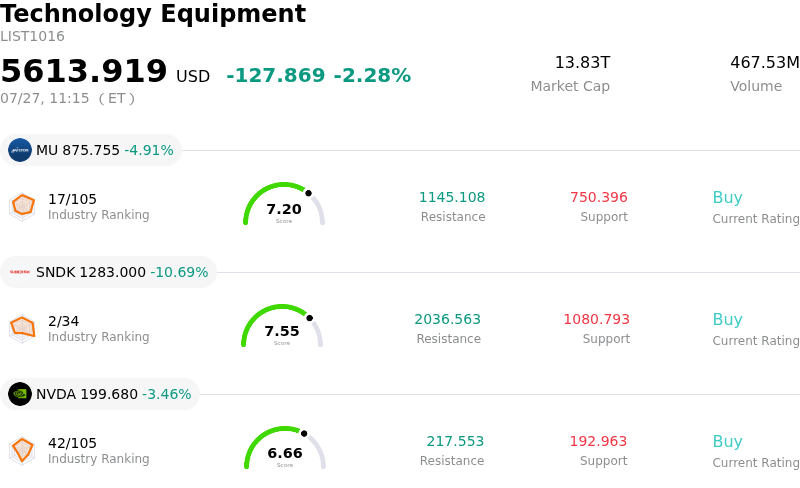
NVIDIA Corp (NVDA) moved down by 3.46%. The Technology Equipment sector is down by 2.28%. The company underperformed the industry. Top 3 stocks by turnover in the sector: Micron Technology Inc (MU) down 4.91%; SanDisk Corporation (SNDK) down 11.22%; NVIDIA Corp (NVDA) down 3.46%.
What is driving NVIDIA Corp (NVDA)’s stock price down today?
The recent decline in market valuation for the semiconductor leader reflects a broader rotation away from high-beta technology stocks as institutional investors recalibrate their exposure to the artificial intelligence sector. This intraday volatility is primarily driven by heightened sensitivity to capital expenditure trends among major cloud service providers. As these large-scale buyers approach their quarterly earnings cycles, the market is pricing in a potential transition from the initial hardware deployment phase to a more scrutinized period focused on the actual monetization of AI software and services.
Beyond sector-specific momentum, persistent geopolitical uncertainties regarding advanced semiconductor supply chains continue to weigh on the outlook. Reports suggesting tighter export restrictions on next-generation GPU architectures have triggered a defensive stance among risk-managed funds. Furthermore, whispers of renewed regulatory scrutiny into the bundling of high-speed networking hardware with AI accelerators have introduced a risk premium that is difficult for investors to ignore in the short term. This has led to a tactical liquidation of long positions as market participants move toward more defensive assets.
From a macroeconomic perspective, the resilience of long-term treasury yields has placed pressure on the discounted cash flow models of high-growth companies. Despite a generally stable economic environment, the premium placed on future earnings is being compressed, forcing a re-evaluation of current valuation multiples. The market is shifting from a period defined by chip scarcity to one defined by competitive capacity expansion, which has fostered a climate of caution. Investors are increasingly seeking evidence of sustainable, multi-year demand that extends beyond the current infrastructure build-out.
Technical factors also contributed to the downward trajectory as the stock encountered resistance near its previous highs and subsequently breached several short-term support levels during the session. This breach triggered automated sell signals and prompted de-risking among retail investors who had been heavily concentrated in high-leverage derivatives. While long-term institutional conviction in the structural shift toward accelerated computing remains largely intact, the current price action suggests a necessary cooling period as the market digests the massive gains accumulated over the preceding quarters.
Technical Analysis of NVIDIA Corp (NVDA)
Technically, NVIDIA Corp (NVDA) shows a MACD (12,26,9) value of 1.532, indicating a buy signal. The RSI at 51.069 suggests neutral condition and the Williams %R at 32.473 suggests buy condition. Please monitor closely.
Media Coverage of NVIDIA Corp (NVDA)
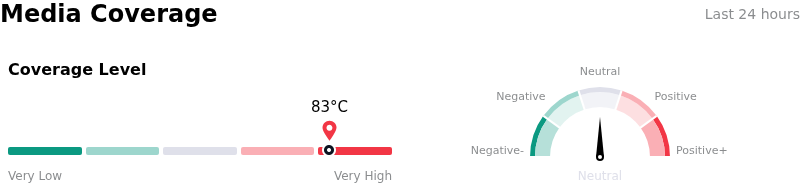
In terms of media coverage, NVIDIA Corp (NVDA) shows a coverage score of 83, indicating a very high level of media attention. The overall market sentiment index is currently in neutral zone.
Fundamental Analysis of NVIDIA Corp (NVDA)
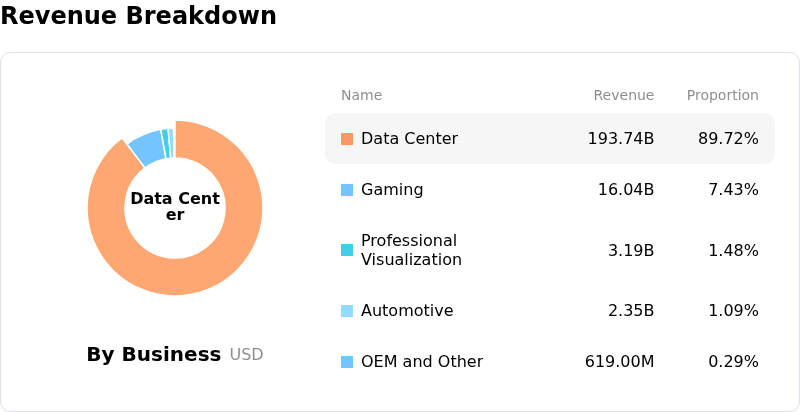
NVIDIA Corp (NVDA) is in the Technology Equipment industry. Its latest annual revenue is $215.94B, ranking 1 in the industry. The net profit is $120.07B, ranking 1 in the industry. Company Profile
Over the past month, multiple analysts have rated the company as Buy, with an average price target of $295.66, a high of $500.00, and a low of $180.00.
More details about NVIDIA Corp (NVDA)
Company Specific Risks:
- Antitrust Regulatory Probes: Recent reports of a coordinated investigation by the U.S. Department of Justice and the Federal Trade Commission into Nvidia's market dominance and potential anti-competitive software-hardware bundling have introduced significant legal uncertainty and the risk of structural oversight.
- Geopolitical Export Volatility: Renewed concerns regarding the U.S. government's intent to further tighten semiconductor export controls to China, specifically targeting the specialized H20 series, threaten to disrupt a critical international revenue stream and localized product roadmaps.
- Execution and Supply Chain Bottlenecks: Institutional analysts have flagged potential manufacturing complexities associated with the transition to the Blackwell architecture, specifically regarding CoWoS-L packaging capacity, which could lead to missed delivery windows and downward revisions to near-term guidance.
- Customer Concentration Vulnerability: Increased intraday volatility reflects market sensitivity toward "Hyperscaler" capital expenditure; the high reliance on a small group of Tier-1 cloud providers for revenue growth makes the valuation highly susceptible to any shifts in AI infrastructure spending budgets.
Find out more
Comments