TradingKey - Shares of Oracle (NYSE: ORCL) are trading near $119.77 on the four-hour chart after bouncing off the company's 52-week low of $114.75. The stock was down 9% last week, significantly worse than the Nasdaq's 2.1% loss and S&P 500's 0.6% loss, and is down about 27% in the last month. While the company reported that cloud revenues grew 77% year-over-year to $18.1 billion during fiscal 2026, and fourth-quarter infrastructure revenue grew 93%, Oracle still lost nearly a third of its market value in the last month.
The stock also saw its remaining performance obligations jump by $85 billion to $638 billion during Q4. So why has Oracle been such a laggard?
Two reasons: A $40.4 billion personal guarantee by the company's billionaire founder and majority shareholder Larry Ellison, tied to his son's Warner Bros. Discovery acquisition, and a credit downgrade that has sent Oracle's borrowing costs sky-high.
The Pentagon Deal Didn't Help
Oracle got good news earlier this month when the U.S. Department of Defense (DoD) awarded the company a deal worth up to $7 billion over the next decade. Under the agreement, Oracle will provide software, cloud services and support to various federal agencies, including military branches, the Coast Guard and the intelligence community.
According to DoD Chief Information Officer Kirsten Davies, the Enterprise Software Agreement (ESA) will consolidate contracting activities, reducing costs for the government and saving taxpayers at least $441 million. Oracle shares rallied about 3% on the news on Thursday before giving the gains back on Friday.
At $7 billion, the Pentagon deal accounts for only about 1.1% of Oracle's $638 billion in remaining performance obligations, representing a small, albeit welcome, boost to the already colossal backlogged orders. The Pentagon deal pales in comparison to the $14.5 billion in market capitalization wiped out on Friday alone. It serves to highlight how Oracle's business and contract performance isn't the main driver of its share price anymore. Instead, legal and financing risks dominate the picture.
Ellison's Personal Guarantee Weighs Heavily
Perhaps the most significant factor weighing on Oracle's valuation is a $40.4 billion personal guarantee by founder Larry Ellison related to his son David Ellison's acquisition of Warner Bros. Discovery. Ellison has signed a personal guarantee for a portion of the financing associated with the deal for his son's Skydance Media bid for the media conglomerate. The personal guarantee is unrelated to Oracle's own balance sheet, but the market views the guarantee as a tail risk on Ellison's overall wealth.
A dozen U.S. states have now sued to stop the Warner Bros. Discovery deal, citing reasons that warrant multi-state action on the scale typically associated with antitrust or other national interest disputes. The legal case against the acquisition, particularly the potential outcome, will ultimately determine whether Ellison is forced to liquidate Oracle shares to pay off his son's loan obligation, something investors appear to be factoring into ORCL's share price despite it not being guaranteed to happen.
The fallout has been devastating for Ellison's personal wealth. Ellison briefly became the world's richest man in mid-2025 when his net worth reached $400 billion. As of July 2026, his net worth had declined by approximately $213 billion to $166 billion. On Friday alone, Ellison lost $5.25 billion, leaving him with YTD losses exceeding $80.9 billion and placing him eighth on the Bloomberg Billionaires Index. Oracle’s shares have fallen from their all-time high of $345.72 to $119.77, a loss of roughly 65% from the 52-week high.
The Cloud Business Is Fine. It’s the Financing That Isn’t.
By every measure relevant to cloud investors, Oracle continues to operate profitably and grows rapidly. In FY2026, cloud revenue increased 77% to $18.1 billion. Infrastructure revenue for the fourth quarter increased 93%. RPO rose $85 billion to $638 billion. Revenue in the fourth quarter was $19.2 billion, an increase of 21% over the prior-year period. The consensus view for this quarter is $19.12 billion in revenue, up 28%. Full-year FY2027 revenue is expected to rise by approximately 33% to approximately $90 billion. These aren’t the signs of a company in trouble.
The financing side of the equation is where we see stress. On July 9, S&P Global Ratings downgraded Oracle to BBB-, its lowest investment-grade rating, because of weaker cash flows and higher business risk. Oracle produced negative free cash flow of $23.69 billion in fiscal 2026, driven by capital expenditures of $55.66 billion related to AI infrastructure spending. Management intends to raise approximately $40 billion in FY2027 through a combination of debt and equity offerings, including an already-announced $20 billion at-the-market share offering program. Oracle’s 2035 bond now trades with a yield of 6.615%, while the 2052 bond yields 8%, up from a low of 5.87% earlier this year. Those higher interest rates make borrowing more expensive.
ORCL Technical Setup
Looking at the 4-hour time frame, ORCL is currently trading at $119.77, inside a descending channel that has been its primary pattern since June. RSI at 37.94 to 42.37 (two separate readings on the chart) is nearing oversold conditions but hasn’t yet signaled a reversal.
We saw a 52-week low of $114.75 last week, which serves as the first support level. If the stock holds above that level and above $114.46 on the chart, then we can expect a potential move up to $120.33 and further to $128.07. Underneath $114.46 is another support level at $108.19. We have resistance at $128.07, which is former support that is now resistance, and $137.86 beyond that point. Moving back above $128 will be our first sign that sellers are losing control.
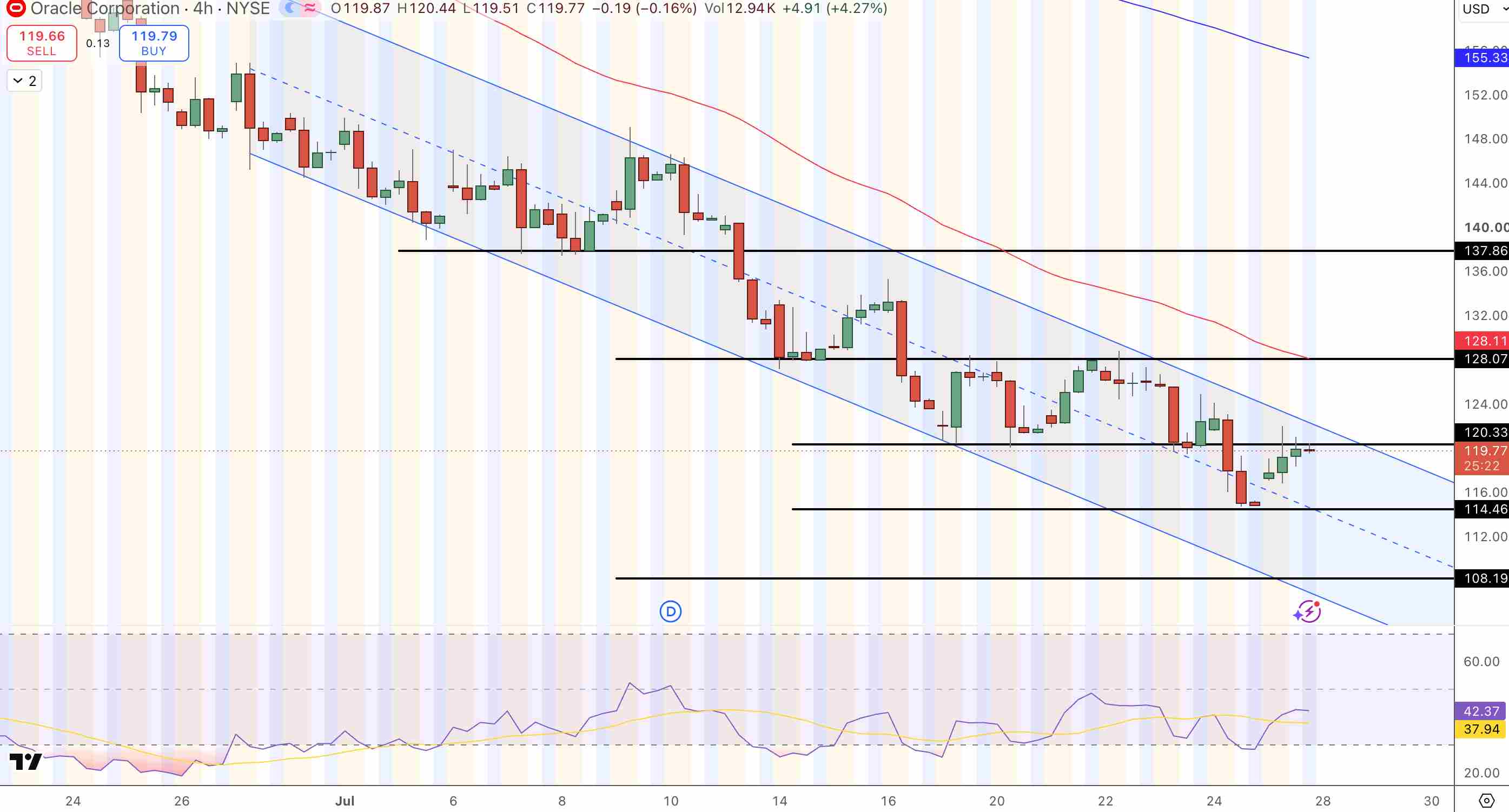
ORCL Price Chart - Source: Tradingview
Key Levels
- Current price: $119.77 (chart). $120.20 today. 52-week range: $114.75 to $345.72
- Pentagon contract: $7B over 10 years ($3.31B base, 5-year period). 1.1% of $638B RPO
- Ellison guarantee: $40.4B personal guarantee on WBD deal. 12 states suing to block
- Cloud metrics: FY2026 cloud revenue +77% to $18.1B. RPO $638B (+$85B). Q4 revenue $19.2B (+21%)
- Financing risk: FCF -$23.69B FY2026. S&P downgraded to BBB-. 2052 bond yield hit 8%
- Support: $114.46 (chart), $114.75 (52-week low), $108.19 below
- Resistance: $120.33, $128.07, $137.86
Why is Oracle stock falling despite cloud growth?
Legal uncertainty, financing and interest rates are more important to investors than Oracle’s strong cloud business right now.
In addition to Oracle’s cloud growth, Oracle founder Larry Ellison has guaranteed up to $40.4 billion of the purchase price of the Warner Bros. Discovery deal led by Ellison’s son. This guarantee has faced pushback from 12 states and creates the possibility that Ellison may have to sell some Oracle stock if he is unable to pay the guarantee.
At the same time, Oracle reported negative free cash flow of $23.69 billion in FY2026 and plans to raise $40 billion in debt or equity in FY2027, just as S&P downgraded the company to BBB- and borrowing costs rose.
What Are the Key Levels to Watch for ORCL Stock?
The biggest level to watch is the 52-week low at $114.75, which the stock tested last week and aligns with a horizontal support level at $114.46 on the 4-hour chart.
A break below $114.46 reveals $108.19 next on the chart.
The first level of resistance is $120.33, and then $128.07, which is where previous support became resistance.
A move back above $128.07 would be the first sign of technical recovery that the worst of the selling has passed.
The average analyst price target of $249 to $251 suggests that the market is pricing in a huge discount to the strength of Oracle’s cloud business because of the legal uncertainty and financing issues.
The Bottom Line
The cloud business is doing well. Cloud revenue growth of 77%, $638 billion in remaining performance obligations, and a $7 billion Pentagon contract make a compelling story.
But Oracle’s legal issues surrounding the $40.4 billion Warner Bros. Discovery guarantee from Larry Ellison, combined with negative free cash flow and higher interest rates for its planned $40 billion financing in FY2027, are what investors are pricing into the stock.
Currently trading at $119.77 with the RSI hovering around 38, Oracle is approaching oversold conditions. $114.46 is a key support level on the charts, and the 52-week low is $114.75.
Earnings from Microsoft and Amazon later this week could help provide additional clues on cloud spending. The first technical recovery level to watch is a move above $128.07.
Find out more
Comments