TradingKey - The first significant week of the 2026 earnings season had five of the Magnificent Seven reporting earnings over 72 hours, leading to notably different stock responses. Microsoft and Amazon gained nearly 9% and over 8%, respectively, while Apple was down 3% to 4%, Meta fell 9.64% after missing EPS despite reporting $784 million in free cash flow, and Alphabet was down 15% due to capital expenditure worries.
Each company reported over 10% revenue growth, and the market's reaction was solely dependent on how each company defended their AI infrastructure expenditures. The following is the scorecard with the data from July 31, 2026.
Microsoft: +8.13% - The Benchmark for How to Frame Capex
Due to the defense of capex and the argument of supply constraints, the market deemed the $41 billion Azure FY2026 Q4 capex justified and fulfilled supply constraints. Microsoft earned an 8.13% gain pushing the share price to $422.30 and the stock crossed the 200-day EMA for the first time after the May selloff. This was the clearest, and in the market's opinion, the most defensible capex request of the week with FY2027 estimated capex of $255 to $260 billion
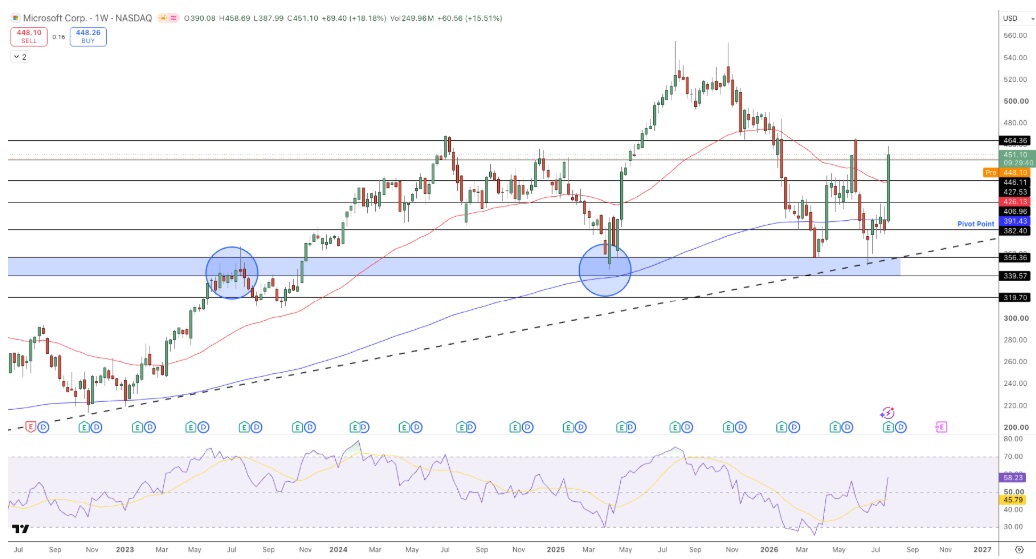
Microsoft Price Chart - Source: Tradingview
Prior to this, the market deemed the $41 billion capex as speculative. Microsoft took the market's demand as supply capex case to the logical conclusion with the statement, “Azure demand is greater than supply.”
Amazon: +8% to +10% - AWS at 37%, But the EPS Headline Needs an Asterisk
Amazon reported their challenging Q2 2026 with a 19.6% increase in total revenues, reaching record levels at $200.61 billion. AWS increased by 37% and also exceeded estimates. Although he claims to be at a $220 billion annual capex, CEO Andy Jassy commented that annual capex would not keep up with the forecasted demand for 2026 and sees strong growth for 2027. The stock rose 8% to 10% after hours from approximately $255 before coming down to approx $235.
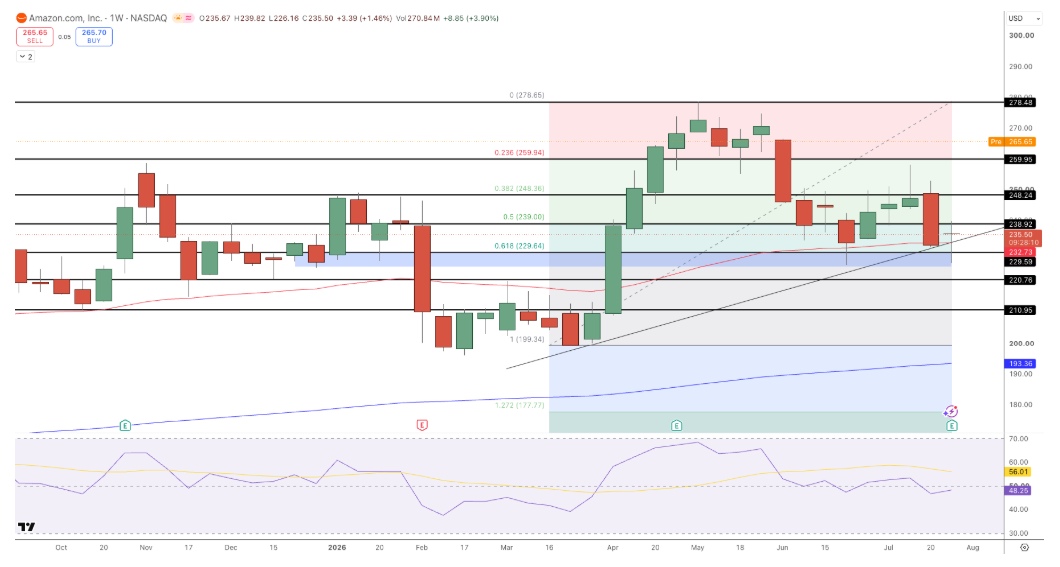
Amazon Price Chart - Source: Tradingview
The EPS of $5.75 needs the asterisk for the $53.4 billion non-cash unrealized gain from the Anthropic stake revaluation. The operational income increase was a healthy 43% with a new record of $27.5 billion.
Q3 revenue was guided down to $159 billion to $163.5 billion due to Prime Day being shifted to June to avoid the Sports and the Holiday season. In absence of the Sports and Holiday season, the revenue growth is projected at 400 basis points higher. The market is looking past the accounting gymnastics.
Apple: -3% to -4% - Record Revenue, Services Miss, and the Memory Crunch
Apple reported record revenues of $109.42 billion (+16%) for fiscal Q3 2026, a 29% increase in EPSto $2.02, and double-digit growth in all regions and sectors. Despite the positives, the stock fell 3% to 4% after hours to approximately $319. The stock fell mainly due to a Greater China revenue miss of $18.8B vs the expected $19.6B, and a miss in high-margin Services, which were reported at $30.74B vs the expected $31.22B.
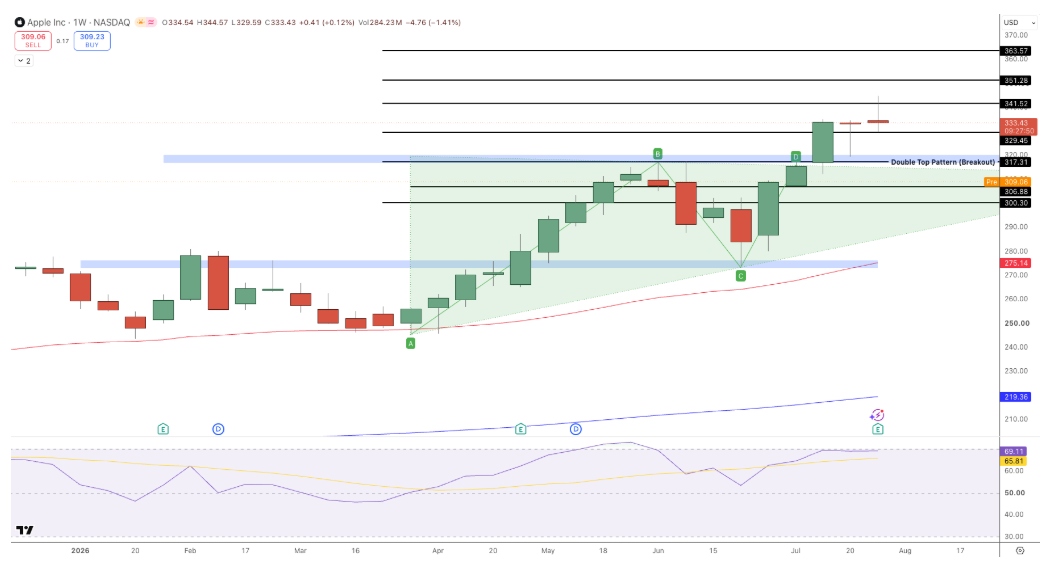
Apple Price Chart - Source: Tradingview
Further, the one-time $0.11 tariff refund benefit that resulted in an EPS of $1.91 (higher than the expected $1.88) and 50.1% gross margin, caused a beat to the estimates. There is a global crunch on memory, and CEO Tim Cook stated that the Mac and iPad prices will increase due to the shortage and that the prices for the iPhone may increase in the future. Cook’s last product launch will be the Google-powered Siri AI.
Meta: -9.64% - Revenue Beat, Everything Else Disappointed
Meta reported its Q2 2026 results on July 29, showing revenues of $60.8 billion, a year-on-year increase of 28%. The results were unfavorable for all other metrics compared to estimates. EPS of $6.18 was 13.8% below the $7.17 estimate. The shortfall was a result of $2.4 billion in legal expenses, $1.18 billion in severance related to 8,000 layoffs, and higher than expected depreciation.
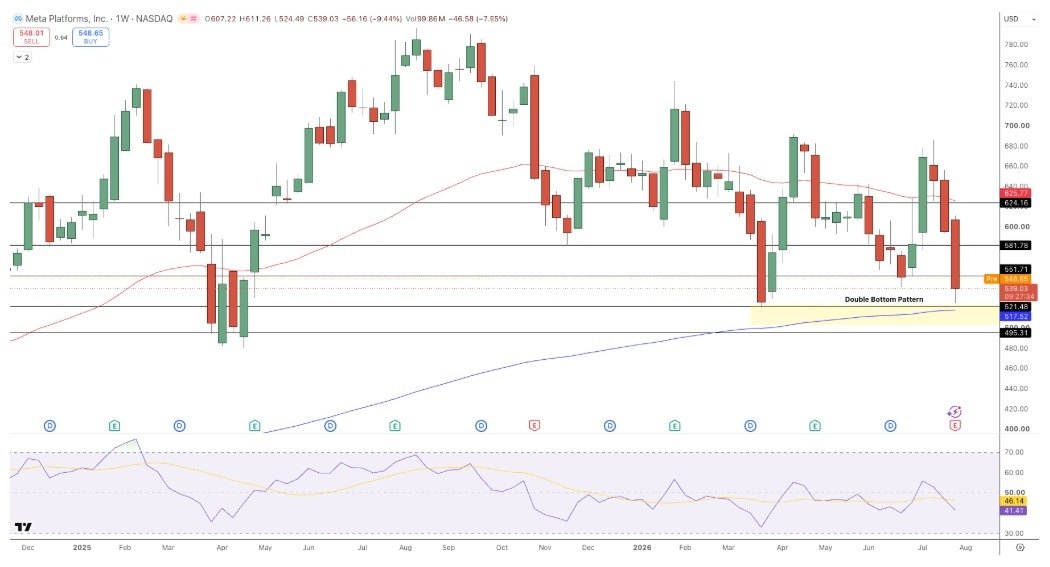
Meta Price Chart - Source: Tradingview
Free cash flow plummeted from $8.5 billion to $784 million. $31.1 billion in capital expenditures utilized nearly all the $31.9 billion in operating cash flow. Full year guidance for capital expenditures increased to $130 to $145 billion. The Q3 guidance midpoint of $62.5 billion was below the $63.2 billion average estimate. The stock price fell to $529 after hours trading, a 9.64% decline. The RSI of 16 was the lowest recorded value since 2022.
Alphabet: -15% (Two Days Earlier) - The Template Others Were Judged Against
Alphabet was the first to report on July 22 and set the template for others during the week. They reported revenues of $119.8 billion with a growth rate of 24%, Cloud revenues of $24.8 billion (up 82%) with a margin up to 36%, and an EPS of $9.11 (all-time highs). However, their stock dropped 15% in two days. Investors noticed that the reported EPS of $9.11 included $6 to $7 of unrealized gains from Anthropic and SpaceX, with an operating EPS of $2.90 (in-line with expectations), an annual capex of $44.9 billion (up 100%), and an annual revenue guidance of $195 to $205 billion.
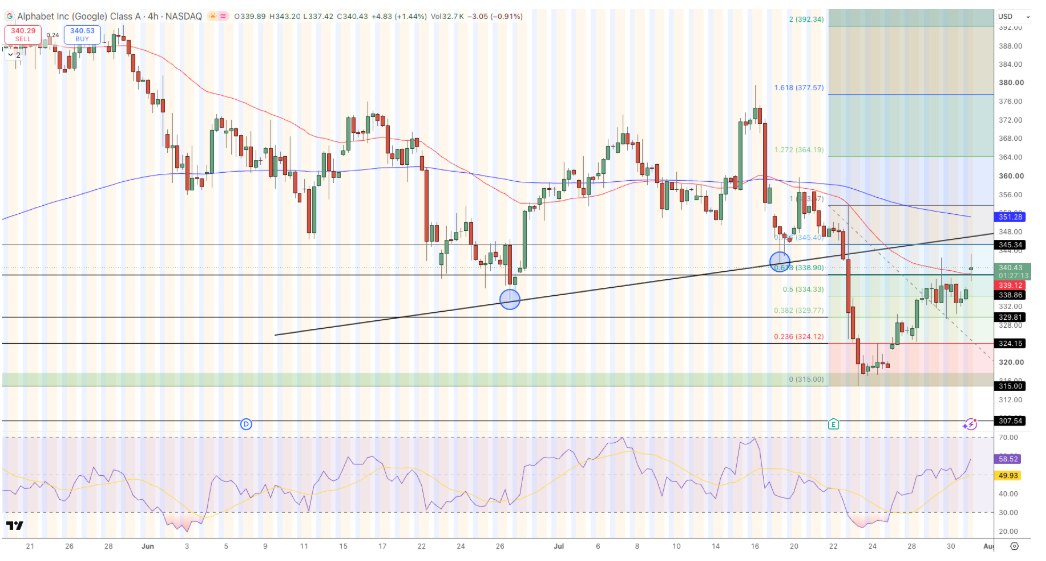
Alphabet Price Chart - Source: Tradingview
The penalty was because of the gap between the reported numbers and the operational realities, and the lack of detail on the demand side compared to the guidance given by Microsoft. By the end of the day on July 31, Alphabet reached $335 (from a low of $315), with some analysts estimating a target of $445 and $515.
What Traders Do Next
Five weekly patterns dictate positioning. First, the capex narratives are for the most part permanently bifurcated: Microsoft and Amazon were rewarded for indicating spending was demand-constrained, while Meta and Alphabet were penalized for indicating it was investment-first. Future standards will require evidence of demand before capex is approved.
The second is that the Anthropic mark-up is a known quantity. Both Amazon and Alphabet reported large headline EPS beats because of non-cash stake revaluations and are expected to have a negative surprise premium.
Third, regarding Apple's Services miss (expected was $31.22B vs. actual $30.74B), the miss reflects a critical deceleration, and given the high multiple, makes the 44x P/E expensive as China underperforms, and as memory costs put pressure on the installed base.
Fourth, the global rally on Friday confirmed the selloffs to be repricing events rather than a collapse in demand, and is further evidenced by a Samsung confirmation of chip shortages, and an Amazon report of AWS being at 37%. The AI boom is alive and well with a tighter capex. Finally, Amazon showing 2028 demand is the most optimistic forward looking executive statement of the week.
The Week's Scorecard
- Microsoft gained 8.13% to $422. Azure up 43%. 30M seats of Copilot. RPO at $678B. Capex normal. Template for the week
- Amazon gained 8-10% to ~255. AWS up 37% (fastest growth since 2021). Revenue up to $200.6B for the first time. Capex at $220B, demand justifies.
- Apple down 3-4% to ~319. Revenue at $109.4B, a record for the June quarter. Services and China down. Memory crunch.
- Meta down 9.64% to $529. Revenue up 28% and beat, but EPS missed 14%. FCF up again and Capex raised.
- Alphabet down 15% (July 22-24), recovering to $335. Cloud up 82%. EPS up due to unrealized gains. Capex penalty applied.
- Digital Markets Trading Friday Rally: STOXX up 0.94%, KOSPI up 15%, Nasdaq futures up 1%. Samsung confirmed shortages. Repricing done.
Bottom Line
The Magnificent Five's 2026 earnings week demonstrated that the market can no longer accept capex as demand unproven, and that the standard for gaining market cedit has permanently risen. Microsoft and Amazon proved that demand justified capex, and both earned rewards. Meta and Alphabet did not, and both earned punishment.
Apple fell somewhere inbetween, with a revenue beat but a miss in Services. Friday's global tech rally confirmed that the tech boom remains, and the most earnings week proved that the standard for gaining market credit has permanently risen.
Find out more
Comments