Record Deliveries and Revenue as Free Cash Flow Beats Estimates; Profit Pool Overhaul and Shareholder Installment Bills for FSD, Robotaxi, and Optimus Drive Repricing
After the market close on July 22, Tesla delivered an earnings report that, by all accounts, should have been celebrated: single-quarter deliveries reached 480,126 vehicles, up 25% year-over-year; revenue was $28.236 billion, up 26%, with trailing twelve-month revenue topping $100 billion for the first time; and global days of supply fell from 24 days to 15 days. Judging by demand, there is no sign of any collapse for this company.
Then, the stock price fell.
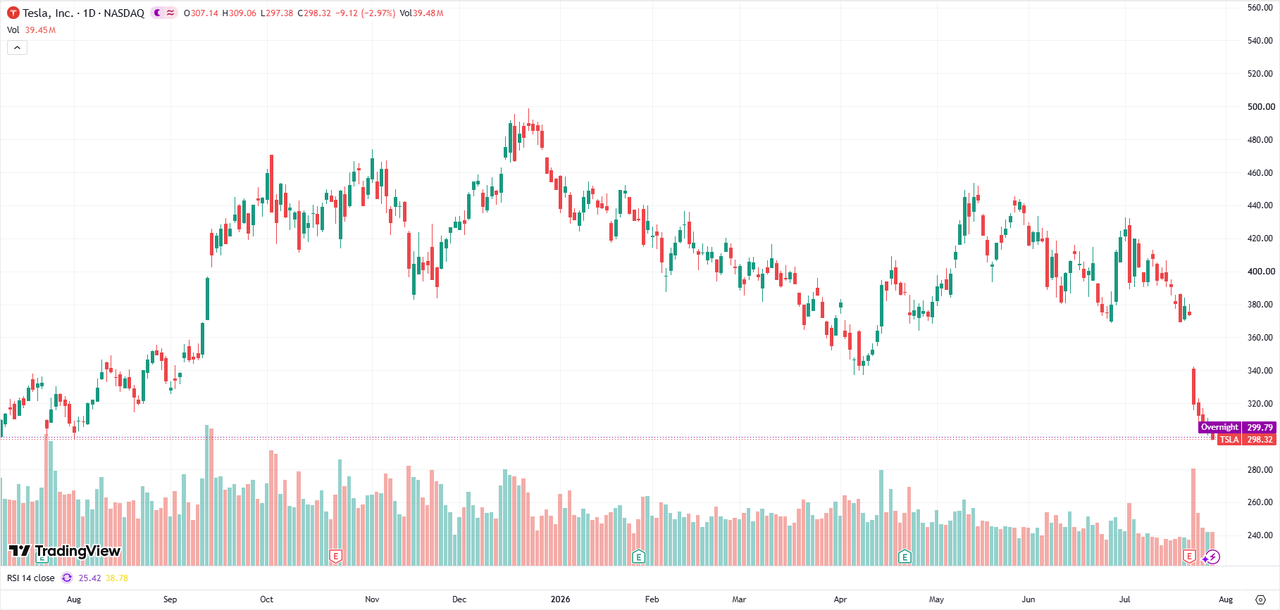
Source: TradingView
The reason is written in the bottom half of the income statement. Operating expenses (OPEX) increased 47% year-over-year to $4.353 billion; operating income was left at just $398 million, down 57% from the same period last year. Operating cash flow stood at $4.697 billion, but capital expenditures (CapEx) surged to $5.789 billion, squeezing free cash flow (FCF, i.e., operating cash flow minus capital expenditures) to negative $1.092 billion.
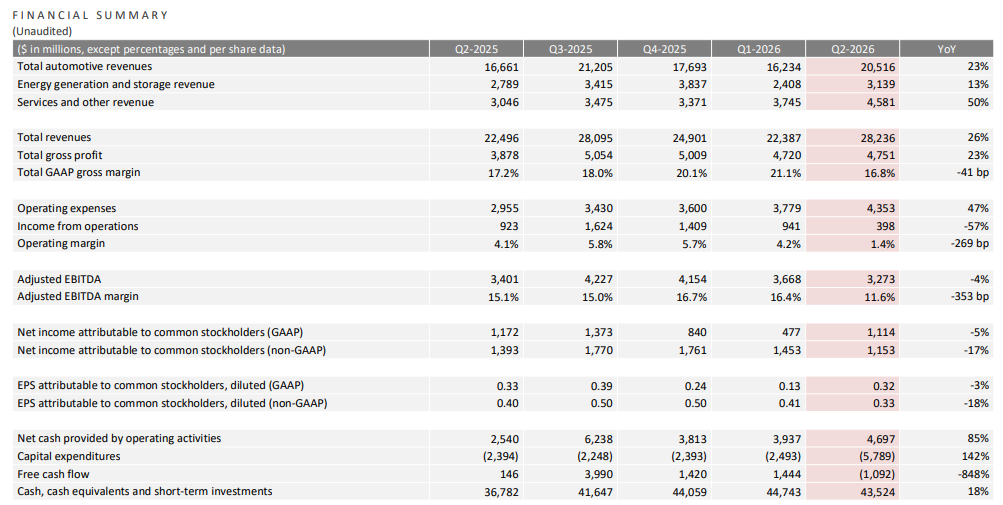
Source: Tesla
The real issue this quarter is not whether Tesla can still sell cars, but how much money is left over for every additional car sold and every additional energy storage system installed to pay for the next phase of its AI bill. Demand has not disappeared; what has disappeared is the transmission of revenue growth into profit growth. Where is the disconnect, and where did the profits go? That is the real story of this earnings report.
What the market pays for is not visible on the income statement
Of the $28.236 billion in quarterly revenue, automotive accounted for 72.7%, energy accounted for 11.1% (mainly Megapack utility-scale energy storage), and services and other accounted for 16.2% (used cars, maintenance, collision repair, and paid Supercharging; percentages calculated based on company-disclosed data). However, the most important information on this statement is actually absent: FSD (Full Self-Driving, Tesla's supervised driver-assist software) revenue is hidden under the automotive segment, while Robotaxi (robotaxis) and Optimus (humanoid robots) do not even have their own revenue line items yet. Almost none of the three things the market pays for when giving Tesla a valuation premium are visible on the income statement.
Business | Revenue | Percentage of Total Revenue |
Automotive | $20.516 billion | 72.7% |
Energy | $3.139 billion | 11.1% |
Services and other | $4.581 billion | 16.2% |
This is also the starting point for understanding this stock. In an industry where Chinese automakers supply 60% of sales volume and price wars have become the norm, selling cars alone cannot sustain Tesla's valuation premium. Its income statement is still that of an automotive, energy, and services company, its balance sheet is starting to look like an AI infrastructure company, and its valuation depends on whether it can become a physical AI platform. All the contradictions in this earnings report stem from the time lag among the three.
Where Did the Profits Go?
Where the market went wrong this time is stated most clearly by the consensus of 23 sell-side analysts compiled by Tesla itself (published on July 17):
Second Quarter ($100 million) | Consensus | Actual | Difference |
Revenue | 275.84 | 282.36 | 6.52 |
Gross Profit | 53.78 | 47.51 | −6.27 |
Operating Expenses | 38.74 | 43.53 | 4.79 |
Operating Income | 15.03 | 3.98 | −11.05 |
Non-GAAP EPS ($) | 0.55 | 0.33 | −0.22 |
Revenue was $652 million higher, yet operating income was $1.105 billion lower. About 57% of the shortfall came from gross profit missing expectations, and about 43% came from expenses exceeding expectations—the market simultaneously underestimated two things: the pressure on gross margins, and the speed at which this company is spending money.
Interestingly, the market's interpretation does not align with the numbers. This quarter's free cash flow turned negative, which sounds alarming, but the market consensus was originally expecting it to be around negative $3.25 billion, whereas the actual figure was only negative $1.092 billion; capital expenditures were also lower than the consensus of about $6.7 billion. If you interpret this decline as 'cash flow blowing up,' you are missing the point—cash flow was actually better than expected. What is truly being re-priced is the quality of earnings and the timeline of future investments.
The year-over-year comparison is even more telling. Gross profit was $873 million higher than the same period last year, showing that Tesla has not lost its ability to generate incremental gross profit; the problem is that operating expenses increased by $1.398 billion over the same period—R&D rose 49%, and SG&A expenses rose 45%, of which stock-based compensation increased by about $471 million year-over-year, accounting for one-third of the total expense increase. The new gross profit was entirely consumed by the new expenses, leaving a shortfall of $525 million. The so-called operating leverage (the mechanism where profit margins rise with scale) worked in reverse this quarter.
As a side note, the $1.114 billion GAAP net income this quarter should not be taken too seriously: $1.005 billion of it consists of unrealized valuation gains on SpaceX equity, and another $274 million comes from a one-time tax benefit. To analyze this financial report, focusing on operating income, gross profit, and cash flow is sufficient.
The profit pool is undergoing a transition
What deserves a few more minutes of study than expenses is the gross margin side: Tesla's profit sources are undergoing a transition, and the direction is contrary to most people's intuition.
First to exit are regulatory credits—the points that other automakers buy from Tesla to meet emissions regulations. This revenue dropped from $439 million in the same period last year to $146 million; because it has virtually no associated costs, the lost $293 million essentially vanished directly from gross profit, equivalent in scale to more than half of this quarter's year-over-year decline in operating profit. As of the end of June, unearned credits in long-term contracts stood at just $287 million.
This is not a cyclical fluctuation, but a bottoming out of the balance. As traditional automakers continue to increase their electric vehicle sales, they can more easily meet emissions requirements on their own, so the gap filled by purchasing credits from Tesla will gradually shrink. If regulatory standards loosen, overall credit demand and prices will face further pressure. Although a rebound due to policy tightening or new contracts cannot be ruled out in the future, the probability of returning to the previous scale of over $1 billion annually is low.
The automotive business, by contrast, is more stable than it appears. The automotive gross margin excluding credits was 16.3%, down 2.9 percentage points sequentially, which looks jarring, but it actually improved by 1.3 percentage points year-over-year. Management explained that the first quarter had about $230 million in warranty reserve reversals and tariff benefits, and excluding those, the two quarters were roughly flat—an explanation I am willing to accept halfway, as it cannot be verified externally, while the other half awaits validation in the third quarter. I calculated a cleaner account myself: looking only at automotive sales revenue and cost (excluding credits and leasing), the gross margin rose from 14.1% in the same period last year to 15.7%, and gross profit per vehicle rose from about $5,882 to $6,645. While this is mixed with FSD, model mix, and exchange rates, and can only serve as a directional indicator, at least in the second quarter, there is no evidence of 'trading margins for volume.'
The most surprising figure in the entire financial report came from the services business. Revenue rose from $3.046 billion to $4.581 billion, gross profit rose from $166 million to $648 million, and the gross margin surged from 5.4% to 14.1%. According to the company's disclosed data, this business contributed about 55% of the company's incremental gross profit, more than automotive and energy combined. Credit for this goes to used cars, non-warranty repairs, collision repair, and paid Supercharging, with management expecting continued growth as the fleet expands. Of course, a single-quarter jump cannot be directly extrapolated into a stable margin, but the direction is clear: a business once regarded as a cost center is now the first to step up as the profit pool undergoes a transition.
Energy, however, fell behind, and the way it fell behind is worth analyzing closely: the problem is not demand, but the misalignment among deployment, revenue, and gross profit. Energy storage deployment was 13.5 GWh, up 41% year-over-year, yet revenue only grew by 13%; the gross margin dropped sequentially from 39.5% to 20.4%, which management attributed to Megapack price cuts, a warranty accrual of about $240 million for supplier battery cells, and the non-recurrence of first-quarter tariff benefits.
There is also another structural layer that most people missed. This quarter, $318 million of energy revenue came from Megapack sales to SpaceX (disclosed as a related-party transaction in the 10-Q); excluding this transaction, energy revenue grew only about 1.1% year-over-year. While this revenue is real, it indicates that growth on the third-party customer side is temporarily narrower than it appears. The unearned amount in long-term contracts is still $10.05 billion, so visibility is not lacking—the orders are there, but margins may not necessarily keep pace.
Three AI stories, each at a different distance from monetization
Among the three AI stories, FSD is closest to monetization, Robotaxi is being validated on the road, and Optimus is the furthest away.
FSD's adoption data this quarter is solid: active paid users grew from 950,000 a year ago to 1.48 million, a net increase of 200,000 in a single quarter; over 55% of new vehicle deliveries in North America came with an FSD subscription, setting a historical record; European approvals are progressing, with Lithuania, Estonia, Denmark, and Belgium granting approval following the Netherlands. A former aftermarket add-on is now becoming a core configuration in new vehicle transactions.
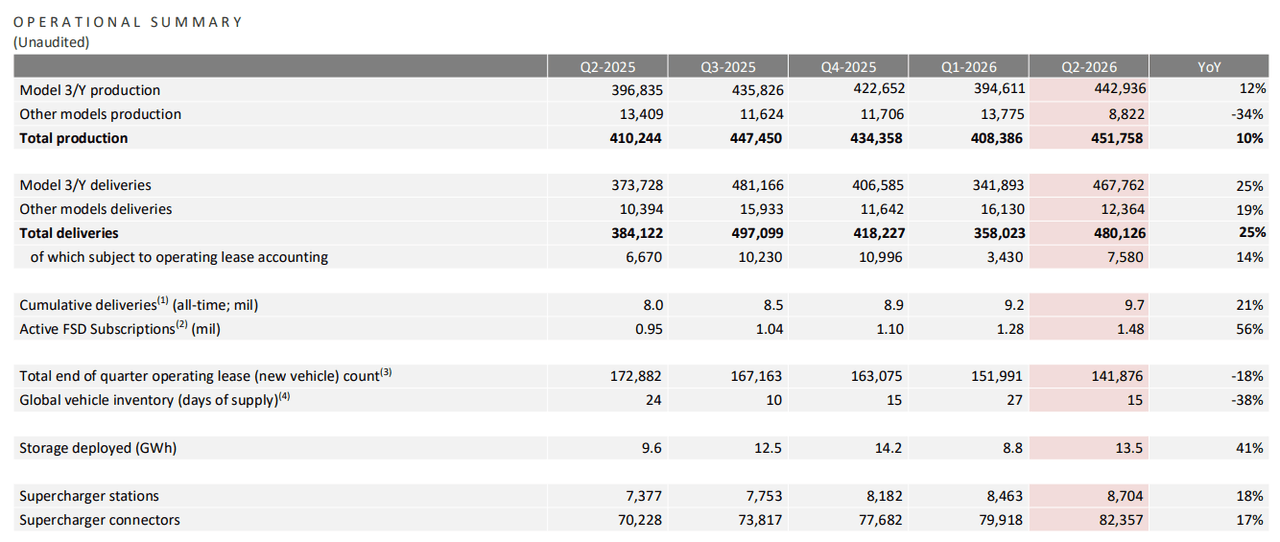
Source: Tesla
But the quality of the 1.48 million figure must be examined closely: it includes both one-time purchases and monthly subscriptions (management stated about 55% purchased upfront and 45% subscribed monthly) and excludes free trials, so it cannot be multiplied by the monthly fee to estimate 'annualized subscription revenue.' The product also still requires continuous driver supervision. More crucially, Tesla has yet to disclose FSD's recognized revenue, average revenue per user (ARPU), or churn rate. Its clearest footprint on the financial statements is merely the $4.05 billion in deferred revenue on the 10-Q, a line item that is also mixed with connectivity, free Supercharging, and software updates. In a quarter when the company most needed to prove that AI can generate revenue, this disclosure gap is information in itself.
The inflection point for adoption has arrived, but the inflection point on the income statement has not.
Robotaxi, at least, is no longer just a PowerPoint presentation. Cumulative paid miles are now close to 2.5 million miles, with management claiming over 380,000 miles of fully unsupervised operations across six cities in two states, resulting in 'zero notable accidents'—according to the company's self-reporting, without third-party auditing. The service is currently live in seven metropolitan areas, with safety drivers still required in the Bay Area under California permits, while unsupervised services in three Florida cities only began in July.
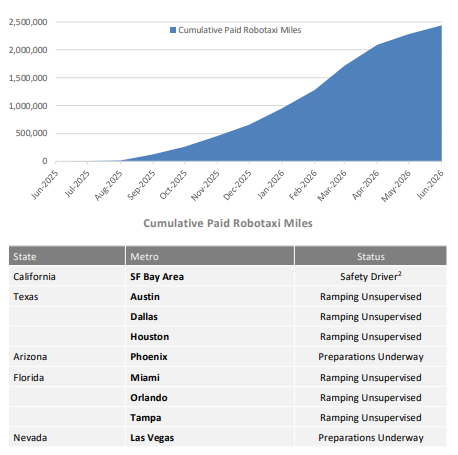
Source: Tesla
The strategy is also different from what the outside world imagined. Instead of scaling up a massive fleet in a single city, Tesla is deploying smaller fleets across more cities. According to management, this is to validate whether the technology stack can generalize across cities and whether the cost of entering each new city can be reduced. I believe this choice is correct—replicability is closer to the essence of this business than single-city revenue density—but it comes with a cost that investors must accept: the actual unit economics data that can be modeled, such as daily paid miles per vehicle, utilization rate, cost per mile, and human intervention rate, will arrive much later.
The sense of scale requires a benchmark. As of March this year, Waymo's cumulative fully driverless miles had reached 220.6 million miles. The metrics of the two are different, so safety cannot be directly compared, but a rough calculation based on these two figures shows a gap of around 580 times—Tesla's driverless operations are still in their infancy. There is no shortage of research endorsing the market potential; Goldman Sachs projected in April this year that the global Robotaxi market revenue would reach approximately $415 billion by 2035, with vertically integrated operators potentially achieving gross margins of 30% to 50%. However, this is an industry-wide figure, and there are currently no numbers to support how much of that Tesla can capture. The Cybercab (a dedicated vehicle with no steering wheel) that just began production in Texas illustrates the same point: Tesla's head of AI stated it can directly run the V15 model used by Model Y without retraining; Musk also admitted that test vehicles equipped with steering wheels and pedals are still needed to calibrate the new chassis. The brain is ready, but the body still has to learn.
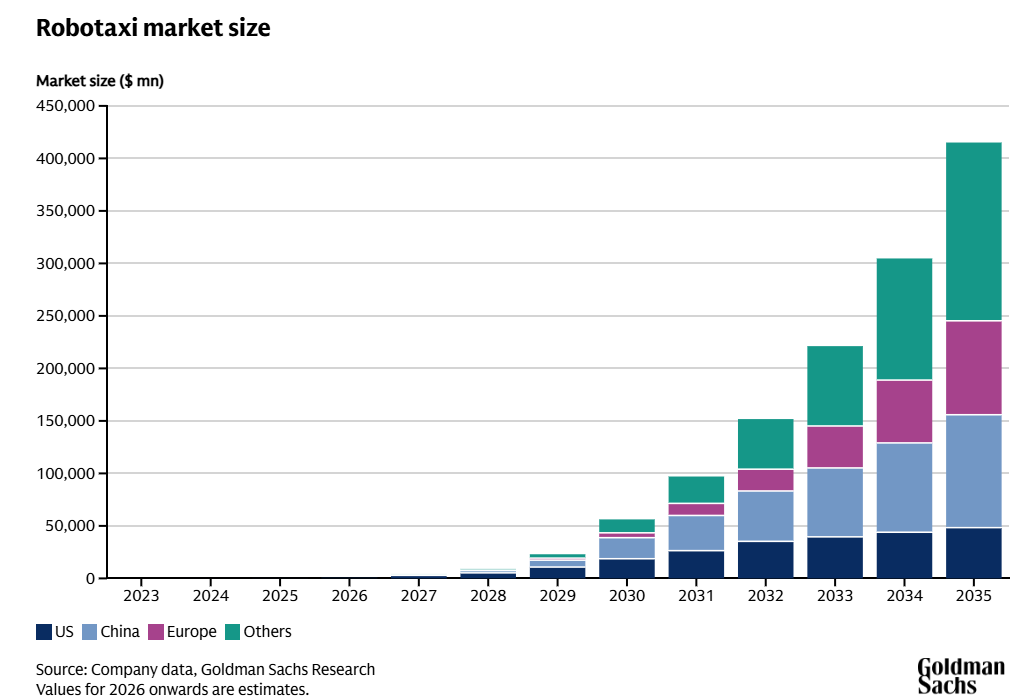
Source: Goldman Sachs
Optimus has the longest horizon. The Model S/X production lines at the Fremont factory have been dismantled and retrofitted into Optimus production lines, which are expected to start production within the year. However, initial robots will be used internally by the Optimus Academy to collect training data and will not be sold externally on a large scale. Morgan Stanley (2025) expects the humanoid robot ecosystem to reach approximately $5 trillion by 2050, but the same study also admits that mass adoption will not happen until the late 2030s—this set of figures merely illustrates the long duration of this option.
The bills arrive first, the revenue comes later
All three AI stories are progressing, but the progress itself requires payment, and these costs will enter the financial statements at different times.
The first to appear are current expenses. Research and development and pre-mass-production investments for FSD, Robotaxi, Cybercab, and Optimus directly weigh on operating income, with R&D expenses increasing 49% year-over-year this quarter. An even larger portion goes into capital expenditures: CapEx reached $8.282 billion in the first half of the year, with the company expecting the full-year figure to exceed $25 billion, and the CFO indicating it could continue to increase over the next two to three years. The former pressures profits, while the latter first pressures free cash flow.
The impact of capital expenditures does not end once the cash is paid out. These investments will first remain on the balance sheet and then gradually flow into the income statement through depreciation as data centers, production lines, and fleets are put into service. Within half a year, the gross value of Tesla's AI infrastructure assets rose from $6.816 billion to $10.823 billion, and quarterly depreciation of fixed assets also increased from $1.15 billion to $1.37 billion. Cash flow pressures have already emerged, and the fuller impact on earnings may still lie ahead.
Stock-based compensation is another type of cost. While it does not directly consume cash, it drags down GAAP profits and can dilute existing shareholders. This quarter, Tesla recognized $1.151 billion in stock-based compensation, of which $267 million was related to the 2025 CEO performance award. For milestones currently deemed relatively probable to be achieved, there is still $9.82 billion in related expenses to be recognized over the coming years. Even if the AI investments ultimately succeed, shareholders may continue to bear dilution costs while sharing in the growth.
However, this is not an imminent liquidity crisis. At quarter-end, cash and short-term investments stood at $43.524 billion, principal debt was approximately $9.08 billion, and an additional $5 billion credit facility remained unused; operating cash flow in the first half of the year still managed to cover capital expenditures. The company's preparation of up to approximately $30 billion in potential borrowing capacity is more akin to preserving flexibility for subsequent investments. What truly remains hanging in the balance is not whether Tesla can continue spending, but when this capital will generate revenue and whether it will ultimately achieve a sufficiently high return.
A valuation that prepays for 85% of the future
So we return to the final question: how much success is already prepaid in today's stock price?
Based on the closing price of $307.44 on July 28: market capitalization is approximately $1.21 trillion; subtracting $43.5 billion in cash and short-term investments and adding back $9.1 billion in debt principal yields an enterprise value of approximately $1.18 trillion; trailing twelve-month free cash flow is $5.762 billion, corresponding to a multiple of approximately 205 times.
The figure of 205 times itself does not tell the whole story; the reverse calculation does. Here is a calculation I performed myself: if this investment is required to provide an annual return of approximately 8%, and is priced at a terminal multiple of 25 times free cash flow, Tesla would need to achieve approximately $66 billion in sustainable free cash flow by 2030 and approximately $97 billion by 2035. Meanwhile, the existing business, even if valued at 30 times, can only account for about 15% of the enterprise value. The remaining 85% is entirely bet on option values with no revenue disclosures yet—such as FSD's overseas penetration, Robotaxi, Optimus, and AI chips. Furthermore, since FSD and Robotaxi share the same autonomous driving platform, their success or failure is highly correlated, and they cannot be treated as two independent probabilities of success in valuation.
Tesla is indeed one of the very few end-to-end physical AI companies that simultaneously possesses real-world data, AI models, inference chips, vehicle and robotics hardware, manufacturing, energy, and deployment channels, and this quarter's attachment rates and mileage have added more empirical evidence—which is the most defensible part of the bull case. However, bears do not need to prove that these will never succeed; if just one of the following holds true—arriving later, costing more, capturing less market share, having poorer unit economics, or competitors establishing an operational advantage first—the math simply does not work out. At an 8% required rate of return, the same cash flow arriving three years later is worth only about a 20% discount today; for a stock that bets 85% of its value on the future, 'ultimate success but three years late' could in itself be a failure.
This is also my biggest contradiction regarding this earnings report: it has provided more evidence of the vision—FSD paid users, unsupervised miles, and the Cybercab rolling off the line are all real—but it has simultaneously made the bill for waiting thicker. In the past, Tesla was a business where automotive operations generated cash and AI options came free of charge; now, with limited incremental profits from automotive, the exit of credits, services stepping up, and energy in wait-and-see mode, shareholders are paying for options in installments through expenses, capital expenditures, depreciation, and dilution. The dream is still massive, but it has started to charge.
In the next quarterly report, I will be watching four things, because the trigger for the next re-rating will only be quantifiable returns, not a grander story:
- Automotive: normalized gross margin excluding regulatory credits, revenue per vehicle, and promotional costs;
- FSD: growth rate of paid users, progress of overseas rollout, and whether it starts disclosing revenue and churn rate;
- Robotaxi: unsupervised mileage, daily paid miles per vehicle, utilization rate, and human intervention rate;
- Return on capital: whether incremental gross profit can begin to outpace the growth of expenses, depreciation, and capital expenditures.
In my view, the first true re-rating signal will be the quarter in which Tesla first separately discloses FSD revenue.
Disclaimer: The analysis in this article only represents a research framework based on existing publicly available information and does not constitute any investment advice.
Find out more
Comments