TradingKey - Intel (NASDAQ: INTC) rose 10.84% to $100.86 on Tuesday, outperforming the semiconductor industry by more than four percentage points. The stock closed at $91.00 on Monday, making Tuesday's gain one of its best sessions in recent months and increasing the company's market value by about $50 billion.
The surge was triggered by chip stocks moving higher on the back of Palantir's blockbuster earnings report, but Intel also had its own positive momentum after reporting solid second-quarter results. But early Wednesday trading had shares slipping back toward $98.41, indicating that some investors were taking profits from the wild ride. Trading volume also failed to confirm the breakout, as 124.4 million shares were traded, which was less than the stock's 65-day average.
Revenue Beats Expectations
Intel's quarterly revenue was $16.1 billion, 25% higher than it was a year ago and about $1.7 billion higher than Wall Street estimates. Adjusted earnings were at $0.42 per share.
The Data Center and AI business segment was the strongest, growing 59% to $6.3 billion. Client Computing and Physical AI reported $8.9 billion of revenue, reflecting ongoing strong demand in Intel's core businesses.
Despite the success, Intel is still behind a number of its most significant competitors. During the same quarter, AMD posted 50% revenue growth to $11.5 billion, while its data center business surged 107% to $6.7 billion. The comparison implies that Intel's turnaround is picking up steam and yet has a long way to go.
Foundry Business Is Improving, But Challenges Remain
Intel's foundry business continued to show progress.
Intel Foundry revenue rose 31% to $5.8 billion, while operating losses in the segment fell to $2.1 billion, from $3.17 billion a year ago. While losses are decreasing, they are still substantial and continue to have a negative effect on profitability.
Foundry revenue from external customers amounted to only $293 million, representing 5.1% share of the foundry segment. A large portion of that revenue was generated from the “deconsolidated” Altera business, not new third-party manufacturing contracts.
Management still says it expects to achieve high-volume production with its 14A process by 2028, which means investors may have to wait several years for the foundry business to prove itself with some big outside customers.
Profit Margins Still Trail AMD
Intel also continues to lag AMD when it comes to profitability.
The company's GAAP gross margin was 40.4% and GAAP operating margin was 11.1%. In comparison, AMD posted a 54% gross margin and a 17% operating margin during the same time.
Valuation wise, Intel is still much cheaper. The stock is valued at approximately 7.8 times sales based on the annualized revenue guidance, while AMD is valued at approximately 16.5 times sales. The lower valuation, however, is mostly due to Intel's less dynamic growth profile and margins, not a sure deal.
Capital Spending Continues to Rise
Intel also continues to make significant investments in its production capacity.
The company's capital spending is projected to hit $20 billion in 2026, up from $18 billion, with spending on new fabrication facilities expected to rise again in 2027, CFO Dave Zinsner said.
Intel had $29.7 billion in cash and investments at the end of June, compared with $50.5 billion in debt. The cash flow of the first half of the year was a little better, at $8.1 billion.
The company isn't currently authorized to issue new shares, but Zinsner declined to rule that out in the future, meaning investors should be aware that this option may occur if funding requirements grow.
Valuation Paints a Mixed Picture
Intel's stock is up almost 394% in a year, which means there are mixed feelings on valuation.
Some discounted cash flow models have suggested that the stock is approximately 13% overvalued, primarily because there is a negative free cash flow. Conversely, Intel is priced at 8.9 times sales, up from the semiconductor industry average of 7.2 times, but still well below the peer average of 27.1 times.
Investors are already reflecting a massive future uptick in Intel, as at Tuesday's price the stock trades at about 68 times the company's 2026 earnings estimate and 49 times its 2027 earnings forecast, per FactSet.
Intel (INTC) Analyst Targets and Key Levels to Watch
Wall Street has become more optimistic following Intel's earnings report, although opinions remain divided.
The average price target from analysts is $118, which represents around a 17% potential appreciation from the current price, according to FactSet. The7 analysts who rate the stock Buy or Overweight, and 24 who rate it Hold, give the stock an average rating of Buy. Only 2 recommend the stock Sell.
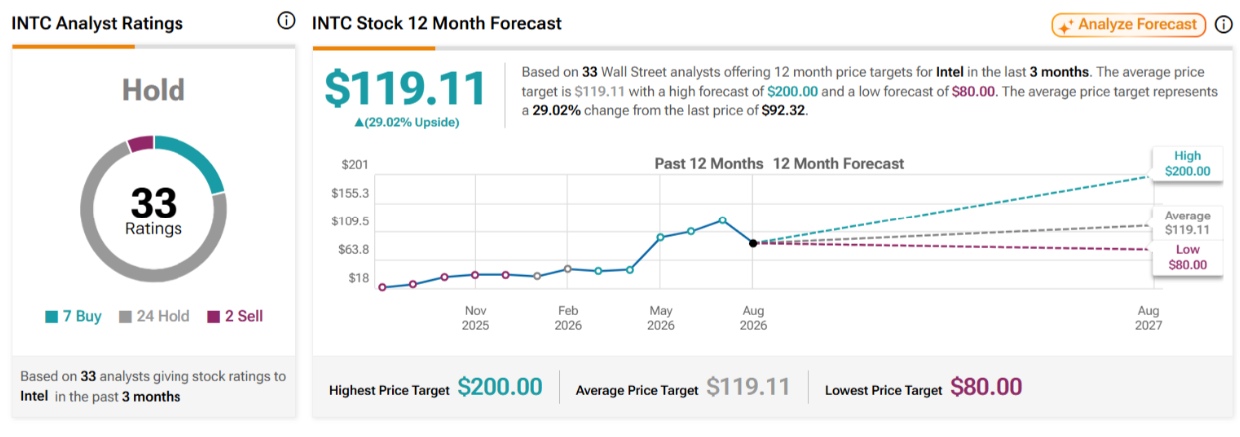
Source: Tipranks
Susquehanna analyst Christopher Rolland has raised the price target to $115 on Intel's server processors, which he believes are seeing better demand. Meanwhile, Kevin Cassidy, head of Rosenblatt's equity research team, has maintained an "outperform" rating on the stock, but believes manufacturing yield concerns may help limit the company's long-term growth prospects.
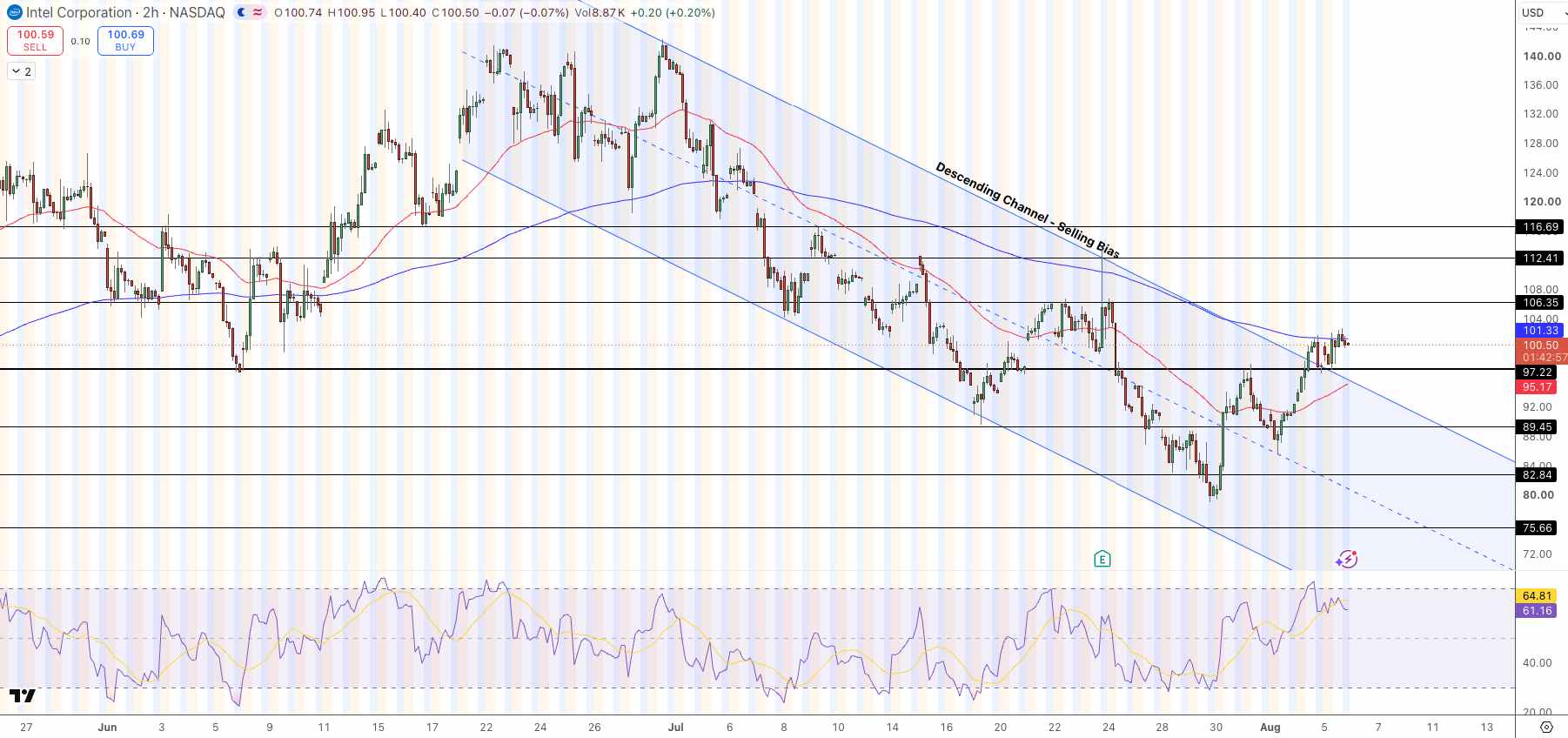
Intel (INTC) Price Chart - Source: Tradingview
Technically, $100 is now the big figure to keep an eye on.The price has been an area of support in June before it broke down in July and is now an area of resistance.
A convincing move above $100, backed by stronger trading volume, could pave the way for a rally toward the $107-$109 range.But if the stock drops back from its $95-$98 range, it may reflect that Tuesday's run was more of a market story than a company story.
Intel's next major catalyst will be its earnings report in late October, ahead. Investors will be keen to see if the company has landed a big outside client for its 18A manufacturing process, which many expect to be a big step to prove Intel's foundry business strategy.
FAQs
1. Why did Intel (INTC) stock rise nearly 11%?
The second-quarter results from Intel showed a significant positive revenue surprise along with good growth in the company’s Data Center and AI business and upside in the company’s Foundry results. Because of the better-than-expected results, there was a boost in the confidence of the investors.
2. What is the next catalyst for Intel stock?
Intel’s third-quarter earnings will be released in late October, and revenue updates will provide insight on AI demand, Foundry, and potential external 18A manufacturing customers.
Bottom Line
Intel's strong rally shows how upbeat investors are after Intel delivered a blowout quarter, particularly its improving AI and Foundry performance. Add to that a more constructive Wealth Street outlook and you’ve got a perfect scenario. There are still, of course, plenty of risks. High capital spending, weak margins vs AMD, and a lack of 3rd party foundry adoption are key risks. Attracting major customer partners will first require significant evidence that Intel's manufacturing strategy is persuading external partners. Until then, Intel will need to continue executing at a higher level (with improved profitability, of course) in order to reach the $100 level. Sustaining gains at those levels will require the same.
Find out more
Comments