TradingKey - HubSpot (HUBS) beat Wall Street earnings estimates for revenue and for adjusted earnings published on August 5, 2023, for Q2. Despite this, HubSpot suffered a 20% stock value loss in after-market trading, which is the worst stock value loss in a single trading day since HubSpot became a public company 12 years ago. Stakeholders were not concerned with performance for Q2, but were extremely concerned with performance outlook for the remaining quarters. Stakeholders were most disappointed with Q4 expected earnings, which HubSpot projected would be significantly lower than HubSpot's previous forecast.
Most concerning was that HubSpot expected to grow their customer base by a significantly lower amount than their targets for that quarter. Missing customer growth targets is concerning for a software company, and indicates serious issues beyond a quarterly target miss.
The Quarter Beat, The Outlook Fell
HubSpot projected Q2 2023 revenue would be $898 million, but actual revenue was $911.7 million (20% growth year-on-year). HubSpot's adjusted earnings for Q2 2023 were $3.26, which is an earnings beat when compared to the estimate of $3.02. HubSpot posted a beat for revenue and earnings for the quarter, and disappointed on the outlook. HubSpot expected for full year revenue to be $3.68 billion, down from the previously expected $3.70 billion. For the upcoming third quarter, HubSpot expected revenue would come in at $924.5 million to $925 million, expected growth of 14% (less than the Street expected revenue of $942 million). For the third quarter, HubSpot's expected adjusted EPS was $3.25 to $3.27, which is significantly lower than the expected EPS of $3.45.
The Real Issue: Fewer Customers
Customer retention is the number one headline miss that should be focused on. Most concerning is that HubSpot’s net new customers for the quarter was 7,000, below the target of 9,000 – 10,000. Even worse, the management stated that only 5,000 – 6,000 customers are anticipated for the third quarter, which is almost half of the target for the quarter. A software-as-a-service firm’s growth numbers are clearly reflected in its customer numbers. A decline in customers raises several important questions:
- Is the demand in the market for the company’s product services saturated?
- Has the company’s value proposition not kept pace with its pricing?
- Are customers reducing their overall corporate software expenditures?
HubSpot, unlike several other companies, stated the reason for the decline: the company is resetting its pricing model in AI to offer outcome-based contracts that will include a trial heavily and that will take longer to close. They also cited that there are tighter overall corporate software budgets that have forced a higher level of scrutiny for approvals of the contracts at the C-suite and board level instead of departmental approvals.
The Analyst Reaction Was Severe
Three firms slashed their price targets. Piper Sandler lowered the stock's rating, and its target dropped to $220 in line with the Neutral rating, down from an Overweight rating. Barclays dropped their target from $270 to $240. Bernstein dropped their target from $381 to $220, a drop of over 40%, with a downgrade from Outperform to Market Perform.
Bernstein’s downgrade of $381 to $220, given that that target referenced implied upside, shows a significant change in belief for the expected performance of the company to the downside. Analysts typically alter their outlook by the same degree as the expected incoming customers when they see incoming customers not signing up at the expected rates.
Why Extended Sales Cycles Matter
The change in HubSpot's pricing to an outcome-based, trial-heavy format, which likely implements pricing that is more defensive against AI based competition, will likely result in a slower sales cycle, giving competitors an easier time entering the market. HubSpot's management is betting that the larger slow-to-close deals will be more sustainable over time.
The market is not likely to easily side with management, given the market expects fast customer growth, but management has a deliberate slowdown on growth as a defensive mechanism against demand dropping.
Adding the current demand tightening for software, deals are pushed to close at the higher levels, giving HubSpot's management a quarter that beats on the number at the cost of a greater slower growth outcome
The Buyback and Long-Term Conviction
A share buyback of $1 billion was announced by management. CEO Yamini Rangan stated that the company was doing what was best for long-term growth by moving to outcome-based pricing. It was also stated that customers of the Data Agent increased by 80% sequentially, now at 16,000. The tough conditions of the near term are acknowledged, but the AI transformation is stated to be real. Wall Street disagreed.
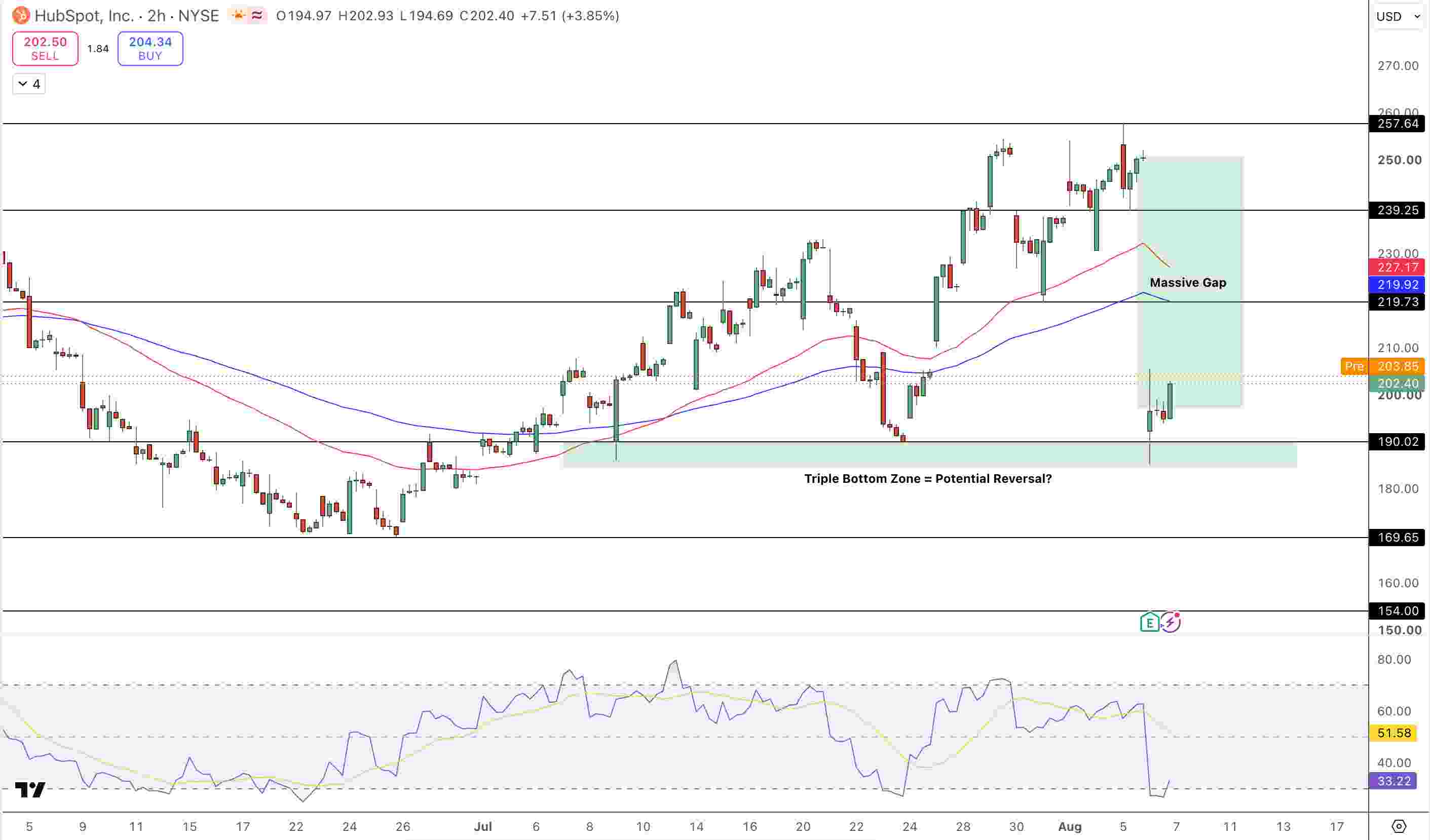
HubSpot Price Chart - Source: TradingviewHubSpot now joins Datadog, Cloudflare, and other software companies, whose stocks were obliterated, just recently, who also reported a positive earnings surprise, while the stock was obliterated, since the market is convinced that the worst is to come.
Key Levels
- Resistance will be seen at $219.73 then $239.25 and then $257.64.
- Support will be found at $190.02, then $169.65, and then $154.00.
- The 50 EMA is at $227.17, on the move up. The 100 EMA is above current price at $219.92.
- The post-earnings gap is ~250to~202 (gap down to fill).
- The RSI is at ~33, which is considered deeply oversold, but does not predict a direction. An oversold condition may cause a price increase.
Why did HubSpot stock fall if it beat earnings?
After HubSpot reported its quarterly earnings, its stock fell despite beating estimates for quarterly revenue and EPS because it lowered its full-year guidance, guided Q3 below consensus, and most notably, HubSpot added only 7,000 new customers compared to its guidance of 9,000 – 10,000. Additionally, HubSpot stated it expects customer additions will further decline in the coming quarter. For software companies, cutting guidance and adding customers at a declining rate signals demand is declining and/or customers are less responsive, and for HubSpot, the situation has been exacerbated by the extension of its sales cycle due to its price model structure, which is based on the customers’ use of AI. Thus, demand for HubSpot is slowing.
Is HubSpot stock a buy after the 20% drop?
Whether buying HubSpot after the decline is worthwhile depends on what HubSpot’s AI centric business model and use case of AI for HubSpot’s business and proprietary software in addition to HubSpot’s $1 billion buyback say about the future of HubSpot and its business model. While HubSpot is likely to be in buy territory for some time based on its technical indicators, it will not be returning to where it was until guidance for customer growth increases.
Bottom Line
HubSpot's share value dropped not because of a bad financial quarter, but because of a growing imbalance between delivered results and what Wall Street anticipates. Typical market pressures consider a double beat on earnings to be good news, but in this market a 30% customer growth miss, providing a below average guide, and providing weak forecasts, is considered negative even.
HubSpot is currently in the middle of a strategic transformation centered around AI. The transformation is requiring HubSpot customers to sign longer contracts with new payment structures, which may be strategically correct, but for now the transformation is making investors believe there are better opportunities elsewhere.
HUBS is currently trading around $202, having partially satisfied the earnings gap, going back to the $219 - $227 range would be the first level of support for buyers, with support levels of $190 and $170 for long term buyers, is believed to be a good price target.
Find out more
Comments