In late July, the foreign exchange market saw a rare instance of joint intervention.
On July 30, USD/JPY approached 164 at one point, a new high since 1986, meaning the yen had fallen to its lowest level in nearly four decades. Signs then emerged that Japanese authorities were intervening in the market, and USD/JPY quickly retreated to around 158. On July 31, according to reports from the Financial Times and other media outlets, the U.S. Treasury also participated in coordinated action to support the yen through the New York Fed, which sold euros and bought yen on behalf of the United States. This marked the first time since 1998 that the U.S. and Japan jointly bought yen to support its value. In early August, after the U.S. officially confirmed the action, the market further digested the policy signal, and USD/JPY briefly fell to around 155 intraday, a cumulative rebound of over 4% from the late-July low.
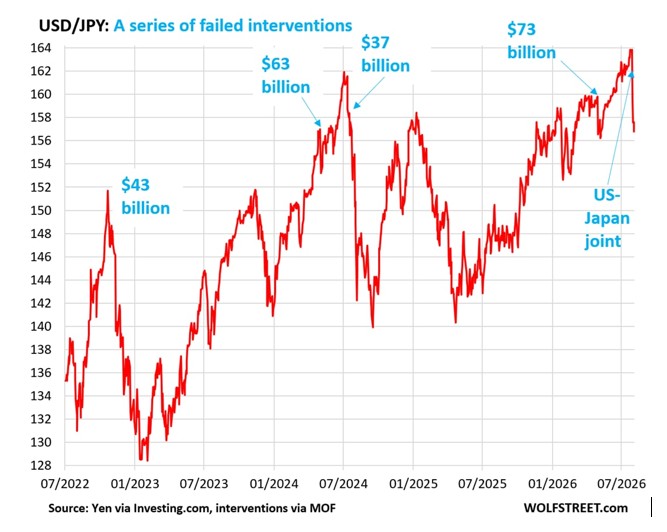
Source: Naked Capitalism
To most gold investors, this might seem like nothing more than a foreign exchange headline. The yen is Japan's currency, and it's understandable that Japan would want to stabilize its own exchange rate. But why would the United States get involved? Why would yen fluctuations affect U.S. Treasuries and tech stocks? And why would this eventually spill over into gold?
The answers don't lie in how much the yen moved on any given day, but in the funding chain behind it.
Macro analysis of gold is often reduced to two simple rules: when the dollar falls, gold rises; when rates fall, gold rises. These rules sometimes hold, but they're insufficient to explain real markets. Gold prices are influenced not only by the dollar and interest rates, but also by global funding patterns, investor leverage, bond supply and demand, and policy responses.
The yen is a window into these dynamics. It's both a currency and one of the world's most important funding vehicles. When the yen is stable and cheap to borrow, capital can flow from Japan into U.S. Treasuries, stocks, and other risk assets; when the yen suddenly reverses, that capital may retreat along the same path. Gold sits at the end of this chain, but it can react very differently depending on the stage.
Understanding the yen, therefore, isn't about predicting another currency pair — it's about answering a more important question: when global funding conditions shift, is gold really trading the dollar, interest rates, or liquidity risk?
I. Why Did the Yen Become a Global Funding Currency?
Japan's prolonged low interest rates are the starting point for the yen's influence on global markets.
After the asset bubble burst in the 1990s, Japan went through a long period of balance-sheet repair. Companies and households preferred saving and debt repayment over expanding borrowing and consumption, and the economy faced persistent low growth, low inflation, or even deflation. To stimulate the economy, the Bank of Japan began implementing a zero-interest-rate policy in 1999, followed by quantitative easing, large-scale asset purchases, negative interest rates, and yield curve control (YCC), keeping funding costs among the lowest in the world for a long period. It wasn't until March 2024 that the BOJ formally exited negative rates and YCC and began normalizing monetary policy, but overall rates remain notably below those of major economies like the U.S.
These policies were meant to serve Japan's domestic economy, but they produced a global consequence: the yen became a low-cost, highly liquid, and deep-market liability instrument.
Investors choosing a funding currency don't require high returns from that currency itself. Instead, an ideal funding currency typically has three traits: low interest rates, a relatively stable exchange rate, and a sufficiently deep funding market.
The yen has long met these conditions. On July 31, 2026, the BOJ kept its policy rate at 1%, a result of years of policy normalization, but still clearly below the U.S. federal funds target range of 3.5% to 3.75%. The BOJ voted 8-to-1 to hold rates steady this time, with only one member advocating an immediate hike to 1.25%. In other words, even as Japan has entered a rate-hiking cycle, the gap between U.S. and Japanese policy rates remains more than 2.5 percentage points.
Suppose an investor can borrow yen at close to 1%, convert it into dollars, and hold short-term dollar assets yielding over 3% — the carry trade still has room to exist. If the funds flow further into U.S. Treasuries, credit bonds, or equities, the investor could gain additional asset-price returns.
This is the most basic form of the yen carry trade.
Notably, Japan entering a rate-hiking cycle doesn't mean the yen has lost its status as a funding currency. The direction of monetary policy and its absolute level are two different things. Japan can gradually raise rates from zero, but as long as Japanese rates remain significantly below U.S. rates, the spread from borrowing yen and holding dollar assets persists.
The yen therefore has a seemingly contradictory trait: it has been persistently weak, yet remains extremely important to global markets. The reason is that the yen's persistent selling is often precisely because so many investors have first borrowed it. Once yen is borrowed, investors must sell yen and buy dollars or other currencies to deploy the funds into higher-yielding markets.
So yen depreciation doesn't necessarily mean the yen is insignificant. On the contrary, it may indicate that the yen is being heavily used as a funding source. This is the biggest difference between the yen and an ordinary weak currency.
II. Why Is the Yen Both Weak and Considered a Safe Haven?
A second common question is: if the yen has depreciated for so long, why does it often rally when markets panic?
The answer again lies in the carry trade.
When a yen funding trade is established, the capital flow generally looks like this:
Borrow yen → sell yen → buy dollars → buy overseas assets.
When markets are stable, the yen depreciates slowly, and overseas assets keep rising, this trade can persist.
But once clear risk appears, the capital flow reverses:
Sell overseas assets → obtain dollar cash → sell dollars, buy yen → repay yen debt.
So yen buying during a crisis doesn't entirely come from investors actively believing Japan is the safest place to be. A significant portion of the demand may simply come from investors who previously borrowed yen being forced to buy it back to repay debt.
This passive buying can push the yen up rapidly, giving it the appearance of a safe-haven currency.
A textbook case occurred in August 2024. Research from the Bank for International Settlements showed that as U.S. macro data weakened and market volatility rose, the deleveraging of yen carry trades amplified the move. Around August 5, unwinding of yen shorts and equity position cuts occurred simultaneously, triggering sharp global stock market swings. The BIS considers FX carry trades to have been among the most severely affected leveraged trades in that selloff.
This explains an important phenomenon: a rising yen doesn't always mean market risk is falling — sometimes it means market risk is rising.
This is crucial for gold investors. If yen strength stems from a normal narrowing of the U.S.-Japan rate gap — say, the Fed cutting rates and U.S. yields falling — it may signal dollar weakness and lower real rates, which tends to favor gold. But if yen strength stems from concentrated carry-trade unwinding, it may signal global deleveraging, where investors need to sell liquid assets to meet margin calls — and gold could actually be sold off in the short term.
The same yen appreciation, driven by different underlying capital dynamics, can produce very different reactions in gold.
III. What Does a Carry Trade Actually Earn?
Borrowing cheap yen to buy higher-yielding dollar assets is just the first layer of a carry trade.
A complete trade's return consists of at least four components: the performance of the overseas asset itself; the spread between the overseas yield and the yen funding cost; changes in the yen exchange rate; and hedging, leverage, and transaction costs.
This can be simplified as:
Carry trade return ≈ overseas asset return + rate spread − losses from yen appreciation − funding and hedging costs.
Suppose an investor borrows 100 million yen when the exchange rate is 150 yen per dollar. They convert this into about $667,000 and buy U.S. Treasuries.
If the dollar asset yields 4% and the yen funding cost is 1%, the apparent spread is about 3%.
If a year later USD/JPY rises from 150 to 160 — meaning the yen weakens further — the investor only needs about $625,000 to buy back the 100 million yen. Beyond the rate spread, they also gain extra FX profit from yen depreciation.
But if USD/JPY falls from 150 to 135 — meaning the yen strengthens — buying back 100 million yen would require about $741,000. Compared with the initial $667,000, that's roughly an 11% FX loss, enough to wipe out several years' worth of rate-spread gains.
This shows that the biggest risk in a carry trade usually isn't the BOJ hiking rates by 25 basis points — it's a sharp yen appreciation over a short period.
A hike from 1% to 1.25% in Japan only adds 0.25 percentage points to funding costs, but a 4% yen rally in one week already exceeds a full year's typical rate-spread gain. If the exchange-rate move reaches 10%, the loss would far exceed the spread itself.
An unleveraged investor might be able to wait for the market to recover; a highly leveraged one may face yen appreciation, falling overseas assets, and rising margin requirements all at once, forcing an immediate reduction in positions.
So what a yen carry trade truly depends on isn't just low rates — it's several conditions holding steady simultaneously: Japanese rates staying relatively low; dollar asset yields staying relatively attractive; no rapid yen appreciation; low exchange-rate and asset volatility; and stable collateral prices in stocks and bonds.
A single changed condition may not immediately end the trade, but if exchange rates, asset prices, and volatility reverse together, unwinding can easily cascade.
Moreover, the true scale of these trades is hard to measure precisely. It may be hidden within bank loans, FX forwards, cross-currency swaps, hedge fund leverage, corporate financing, and Japanese institutions' overseas investments. The BIS notes that while statistics can track the scale of yen borrowing and FX derivatives, they can't precisely identify how much of that capital ultimately funds carry trades.
This is also why sharp unwinding can occur even without an identifiable total size for carry trades. What truly matters is whether large amounts of capital have built positions at similar price levels based on similar assumptions of low volatility.
IV. Why Can't Japan Simply Hike Rates to Stabilize the Yen?
Since one of the main reasons for the yen's persistent pressure is the U.S.-Japan rate gap, the most direct solution would seem to be for Japan to keep raising rates. But Japan can't hike as freely as a low-debt economy could.
The IMF's latest 2026 assessment projects Japan's general government debt to still exceed 200% of GDP, remaining among the highest of any major developed economy. Meanwhile, Japan's 2026 economic growth is projected at about 0.6%, with consumer price growth around 2.2%. This combination of high debt and low growth means Japan must balance fiscal funding costs and economic resilience while pursuing policy normalization.
High debt doesn't mean Japan faces an imminent fiscal crisis. Japan's debt is mostly issued in its own currency, held largely by domestic financial institutions, and the BOJ itself has long held a large share of Japanese government bonds. So Japan doesn't face the kind of sudden foreign-currency debt repayment crisis typical of emerging markets.
But high debt does limit how fast rates can rise. Government debt doesn't get instantly repriced the day the central bank hikes rates, but as old debt matures and new debt is issued, higher rates gradually feed into fiscal interest costs. At the same time, rate hikes push down Japanese government bond prices, affecting banks, insurers, and pension funds that hold large bond portfolios. Household mortgage costs and corporate financing costs would also rise.
This puts the BOJ in an unavoidable bind. Continuing to hike rates could narrow the U.S.-Japan rate gap, support the yen, and curb import-driven inflation — but hiking too fast could strain public finances, bond markets, and the real economy. Keeping rates low protects government funding and the domestic economy, but the yen may keep weakening, pushing up prices for energy, food, and other imports and eroding real household purchasing power.
The BOJ legally has policy independence. Article 3 of the Bank of Japan Act explicitly states that the BOJ's autonomy over currency and monetary control should be respected. But legal independence doesn't mean policy is unconstrained. The government needs to manage fiscal funding costs, sustain economic growth, and would prefer the yen not weaken too quickly. The U.S., meanwhile, watches whether Japan's policy shifts might shake U.S. Treasuries and global markets. While the BOJ can vote independently, it can't ignore these consequences.
So while the BOJ formally holds decision-making authority, its actual policy room is constrained by fiscal conditions, bond markets, economic growth, and external financial relationships. This also explains why Japan often relies on FX intervention rather than solely on aggressive rate hikes.
V. Why Did the U.S. Get Involved in the Yen Intervention?
The U.S. intervening in the yen market is, first and foremost, about protecting itself. Japan has roughly two ways to stabilize the yen: keep hiking rates and use FX reserves to buy yen, or tolerate continued yen weakness. Both options could affect the U.S.
If Japan hikes rates rapidly, yen funding costs rise, potentially triggering concentrated carry-trade unwinding. Investors might sell some U.S. stocks, bonds, and other dollar assets to buy back yen and repay debt.
If Japan keeps using FX reserves for intervention, markets may worry that Japanese official and private institutions are reducing dollar-asset allocations.
As of end-June 2026, Japan's official FX reserves totaled about $1.287 trillion, including roughly $1.091 trillion in foreign-currency reserves, of which about $928.6 billion was in overseas securities and about $161.9 billion in foreign-currency deposits.
Japan is also the largest foreign holder of U.S. Treasuries. U.S. Treasury data shows that as of May 2026, Japan held about $1.143 trillion in U.S. Treasuries — down from about $1.210 trillion just a month earlier. Monthly changes can reflect valuation, maturities, and trading activity, but such a massive holding means Japan's allocation direction alone can influence market expectations.
Japan doesn't need to immediately or proportionally sell long-term Treasuries with every intervention. It can use foreign-currency deposits, short-term securities, or repo facilities to obtain dollar liquidity.
But what truly moves markets isn't the accounting mechanics of a single intervention — it's future marginal demand. If domestic Japanese yields rise, or yen exchange-rate risk increases, Japanese banks, insurers, and pension funds may find that the yield advantage of continuing to buy Treasuries is shrinking. Japanese institutions allocating to Treasuries must weigh not just the headline yield, but also the cost of hedging dollar returns back into yen. Since FX hedging costs are closely tied to the U.S.-Japan short-term rate gap, a wider gap generally means higher hedging costs for Japanese investors managing dollar exposure.
As Japanese rates rise and domestic bond yields improve, some institutions may prefer holding domestic bonds rather than bearing dollar exchange-rate and hedging costs to buy Treasuries. This could bring capital back to Japan and reduce marginal demand for U.S. Treasuries. For the U.S., the bigger concern isn't whether Japan will sell Treasuries in any single instance, but whether Japan's capital allocation direction is shifting. With the U.S. still needing to issue large amounts of debt and long-term funding costs staying elevated, if one of its largest foreign investors starts persistently reducing Treasury allocations, the supply-demand balance of the U.S. bond market could be affected.
At the same time, the U.S. also doesn't want the yen to keep falling in a disorderly way. The weaker the yen, the greater the pressure on Japan to intervene more aggressively or hike rates more sharply — but if the yen suddenly surges, carry trades could unwind en masse, shaking U.S. risk assets.
So the ideal outcome for the U.S. isn't unlimited yen appreciation, nor letting it keep crashing — it's keeping the adjustment orderly. The U.S. buying yen this time was essentially risk management: reducing the need for Japan to take more drastic measures while lowering the odds of the yen funding system suddenly spiraling out of control. What the U.S. is protecting isn't the yen itself, but Treasury demand, dollar-asset valuations, and global funding stability.
VI. How Does the Yen Step by Step Affect Gold?
The yen doesn't directly determine gold prices. It must first pass through three intermediate variables: the dollar, U.S. Treasury yields, and liquidity.
Layer 1: The Dollar
When the U.S.-Japan rate gap widens and the yen keeps weakening, capital typically sells yen and buys dollar assets, reinforcing dollar demand. A stronger dollar tends to pressure dollar-denominated gold — non-dollar investors face higher local-currency costs to buy gold, and high-yielding dollar assets become more attractive relative to non-yielding gold. But if yen strength stems from Fed rate cuts and falling U.S. yields, naturally narrowing the U.S.-Japan gap, the dollar tends to weaken against multiple currencies, typically benefiting gold.
It's important to distinguish: USD/JPY falling doesn't necessarily mean the broad dollar is weakening. The yen's weight in the dollar index is about 13.6%, while the euro's weight exceeds 57%. So even if the yen appreciates sharply against the dollar, the dollar index may not fall much if the dollar remains strong against the euro.
If yen strength mainly comes from Japanese intervention or short covering, the dollar may weaken only against the yen, not necessarily against the euro, pound, and other currencies. USD/JPY alone can't determine gold's direction.
Layer 2: U.S. Treasury Yields
Japanese capital is a major participant in the U.S. bond market. If Japanese rates rise and capital flows back home, domestic institutions may reduce Treasury holdings, pushing bond prices down and yields up. Generally, rising U.S. real yields pressure gold since the opportunity cost of holding it increases. But gold investors shouldn't just look at whether yields rose — they need to ask why.
If yields rise because of strong economic growth and improving real returns, gold typically faces pressure. If yields rise because of bond supply pressure, fewer overseas buyers, or repricing of fiscal risk, gold may not necessarily fall. In that case, the market isn't worried about a higher risk-free rate — it's worried about whether Treasuries, once seen as the safest asset, are taking on more term and fiscal risk.
In such an environment, Treasury prices and gold may both deviate from the traditional model — bonds fall, yields rise, yet gold stays strong.
So when analyzing gold, a more important question than "did yields rise" is: does the rise reflect a stronger economy, or weaker bond demand and credit conditions?
Layer 3: Liquidity
If a rapid yen appreciation triggers carry-trade unwinding, gold may fall alongside stocks in the short term.
This is where many gold investors get it wrong. Gold has safe-haven properties, but it's also one of the most liquid assets globally. When funds need to meet margin calls, repay financing, or reduce overall risk, gold can be sold off quickly.
During a liquidity shock, investors first need cash — not a long-term view.
During the most severe phase of the COVID shock in March 2020, spot gold also fell more than 10% from its early-month high before recovering after massive global central bank liquidity injections. This pattern shows that gold can serve as a cash source early in a crisis, only reclaiming its currency-and-credit-hedge role after policy responds.
So gold falling early in a crisis doesn't necessarily mean the safe-haven logic has failed — it may just be getting sold to cover losses elsewhere.
What truly determines gold's subsequent direction is the policy response. If carry-trade unwinding causes only brief volatility and markets quickly stabilize, gold may not see a sustained rally. If deleveraging further hits Treasuries, banks, or credit markets, policymakers may be forced to slow tightening, inject liquidity, or even expand balance sheets again. At that point, gold's trading focus shifts from cash demand to falling real rates, rising money supply, and declining policy credibility.
So gold may fall first during a liquidity shock and then rise as policy pivots — but "fall first, rise later" isn't a fixed script. What really needs judging is whether the market has moved from ordinary FX volatility into genuine financial-system stress.
Conclusion: Why Should Gold Investors Watch the Yen?
Looking at this intervention alone, I don't think it's a direct catalyst for gold to rally.
In the short term, the joint U.S.-Japan action to stabilize the yen reduces the risk of disorderly deleveraging and eases pressure from rapid capital flight out of dollar assets. In this scenario, demand for gold as a safe haven may not increase meaningfully. As long as U.S. real rates stay elevated and there's no clear financial-market stress, gold is more likely to trade sideways than to start a new rally purely because of this intervention.
What really deserves attention isn't how much the yen rebounded from around 163, but why the U.S. was willing to personally participate in stabilizing it.
If the yen were purely Japan's own problem, the U.S. wouldn't need to get involved. What the U.S. truly fears is that if the yen spirals further out of control — whether Japan responds with more rate hikes, continued FX intervention, or reduced overseas asset allocation — it would ultimately affect the U.S. Treasury market, global funding conditions, and dollar-asset stability.
This action eased market volatility but didn't change the underlying problem. Japan still needs to balance exchange-rate stability, fiscal cost control, and economic growth; the U.S. still faces massive Treasury funding needs and a high-rate environment. These structural tensions won't disappear because of one FX intervention.
So the impact of this event on gold needs to be viewed across different time horizons.
In the short term, it's roughly neutral, perhaps slightly negative. The intervention lowers the risk of disorderly deleveraging and financial-market breakdown, leaving gold temporarily without a fresh safe-haven catalyst.
In the medium to long term, it actually reinforces gold's investment case. Not because of the yen's rise itself, but because this episode again demonstrates that when tensions between exchange rates, bonds, and funding markets widen, policymakers increasingly lean toward intervention to maintain market stability rather than letting markets self-correct.
This is why, when gold investors see a yen headline, they shouldn't rush to judge whether gold will rise or fall. Instead, they should first ask three questions: why is the yen changing? Is it altering the dollar, interest rates, or global liquidity? Is it just a one-off FX fluctuation, or has it started to affect global funding conditions?
Because it's only when funding conditions actually shift that gold's long-term logic truly changes.
Exchange rates affect prices; funding conditions determine trends. The yen won't directly tell us whether gold rises next week, but it can tell us whether the low-cost capital chain underpinning global assets is starting to loosen. And that's the signal gold investors truly need to watch.
Disclaimer: This article is for investment education and market analysis reference only and does not constitute investment advice. Markets carry risk; investment decisions should be based on one's own financial situation, risk tolerance, and independent judgment.
Find out more
Comments