TradingKey - NVIDIA (NVDA) is expected to release its second quarter results on August 26. Analysts have begun moving expectations above the company's revenue guidance of $91 billion. Bank of America's Vivek Arya expects revenue of $94-95 billion, which would mean a $3-4 billion beat. Arya also expects the company plans to guide revenue of $107-108 billion for the third quarter, which would be above the $104 billion consensus estimate.
Vera Rubin production and construction looks like it will continue to drive growth in networking. Arya sees no meaningful limit to H200 shipments to China. From an outsider's perspective, Jackson Hole on August 21-22 will be the biggest determinant of technology valuations as the company hasn't released its earnings yet. However, NVIDIA will likely dictate its own valuation based on its impressive customer spending plans and great execution.
Q1 Established a High Starting Point
NVIDIA set a precedent for Q1 revenue by growing an astounding 85% to reach $81.6 billion from $44.7 billion the year prior. Data center sales reportedly increased 92% and resulted in $75.2 billion of total sales.
It is very impressive to maintain such high margin profitability as a hardware company. GAAP gross margin was 74.9% and non-GAAP gross margin was reported as 75%. GAAP operating margin was reported at a very enviable 53.5% and adjusted earnings per share was $1.87.
For the current quarter, guidance was set at $91 billion with a +/- 2% margin. The midpoint would represent a 11.5% increase from the previous quarter. The Wall Street consensus estimate has been set at about $91.9 billion, while the Bank of America estimate of $94-$95 billion is the current ceiling for analyst expectations.
Bank of America Expects Another Upgrade Cycle
Considering NVIDIA hit well over expected revenue targets, an additional $4 billion in revenue is a considerable margin. Bank of America projects that NVIDIA will set a revenue target of $107 billion - $108 billion for Q3, while the rest of the market stands around $104 billion. For NVIDIA to have a strong Q2 and be seeking additional revenue targets of $107 billion - $108 billion, it suggests an earnings surge for NVIDIA.
This could also indicate that NVIDIA will have an upswing period in the multiple earnings upgrade cycle, rather than having a single surge period.
There is also the possibility that after the announcements of how well NVIDIA is doing, expectations have been adjusted higher in the market, so it is possible that proceeding $91 billion guide will be unimpressive to investors as they position for $95 billion revenue. Thus, the quality of advanced revenue guidance is important, even over the surprise reported for Q2.
Vera Rubin Expands NVIDIA’s Revenue per Data Center
Vera Rubin is expected to be in production by the second half of 2026. It will introduce accelerators from AWS, Google, Azure, and Oracle. It will give NVIDIA a new opportunity to expand their business from selling accelerators to offering more comprehensive systems. The Vera Rubin platform includes integrated Spectrum-6 Ethernet, NVLink switches, BlueField-4 Building blocks, NVIDIA software, and Rubin GPUs and Vera CPUs.
NVIDIA offers customers a fully integrated system in place of having to purchase and integrate processors and software from other vendors. From this perspective, NVIDIA's revenue grows exponentially with the deployment of AI data centers. It also improves switching costs as customers would incur more than just a GPU replacement to switch vendors.
In the meantime, the competition that offers only processors must play catch up with NVIDIA in all other dimensions of the infrastructure, including software and systems. Execution matters and investors will be interested in learning about production volumes, deployment schedules, and the expected timing of revenues.
Networking Has Become a Second Growth Driver
Networking revenue was $14.8B in Q1 for Data Center Networks and grew by 199% y-o-y. This revenue includes Spectrum-X Ethernet, InfiniBand, NVLink and BlueField.
Large AI clusters require a fast connection to thousands of accelerators. Networking performance becomes a critical factor as clusters grow, because processors become idle if data cannot be moved efficiently.
From this perspective, networking becomes a complementary business to accelerator sales. It also provides revenue comparable to large semiconductor companies, thus decreasing the reliance on GPU-related revenues.
Financing Programs Could Expand AI Capacity
By working with Apollo, BlackRock, Blackstone, Brookfield, Goldman Sachs, and KKR, NVIDIA is looking to create financing structures that could mobilize over $500 billion for AI Infrastructure, with NVIDIA standing ready to provide up to $125 billion. However, it is expected that all other institutional investors will carry the burden of the financing.
The good news is that computing power needed to develop AI technologies is now an infrastructure asset that is more financially viable. Cloud services and data center operators can now continue financing the installation of NVIDIA technologies without adding the entire brunt to their balance sheets.
The bad news is that more and more of the demand for AI may be generated by financing made available by some parties. NVIDIA's exposure in the financing and the resulting impact on free cash flow must be evaluated. The impact of these financing arrangements will also be highlighted in the earnings calls.
Hyperscaler Spending Remains High
It is estimated that combined spending on AI by top tech companies will cross $730 billion for the current financial year. The major tech companies, inclduing Microsoft, Meta, Alphabet, Amazon, Oracle, etc., will continue to invest heavily in computing.
Developing customer demand appears to be limited by advanced packaging, high bandwidth memory, power supply, and financing, over interest. NVIDIA will only have a material impact on earnings if there is a significant drop in China's spending by several major customers. So far, spending appears to continue at high levels.
China Provides Limited Upside
China must continue to be treated as incremental revenue. Export controls are not stable, and there is no guarantee regulations will continue to be the same. Approval of low volume shipments can still help meet quarterly goals, but that should not give us false confidence to think we will have consistent access to the Chinese market.
NVDA Holds Above $221 Support
NVIDIA ($225.18) is consolidating after the recovery from $189.93 in late July. The stock broke above the down trend line and recovered the levels of $209.21 and $214.41 and also cleared the 127.2% Fib extension at $221.07. The next level of resistance is at $229.51-$229.54 and is composed of horizontal resistance and the 161.8% Fib extension zone. A confirmed two-hour break above would expose $234.51, $238.89, $245.51 and $254.01.
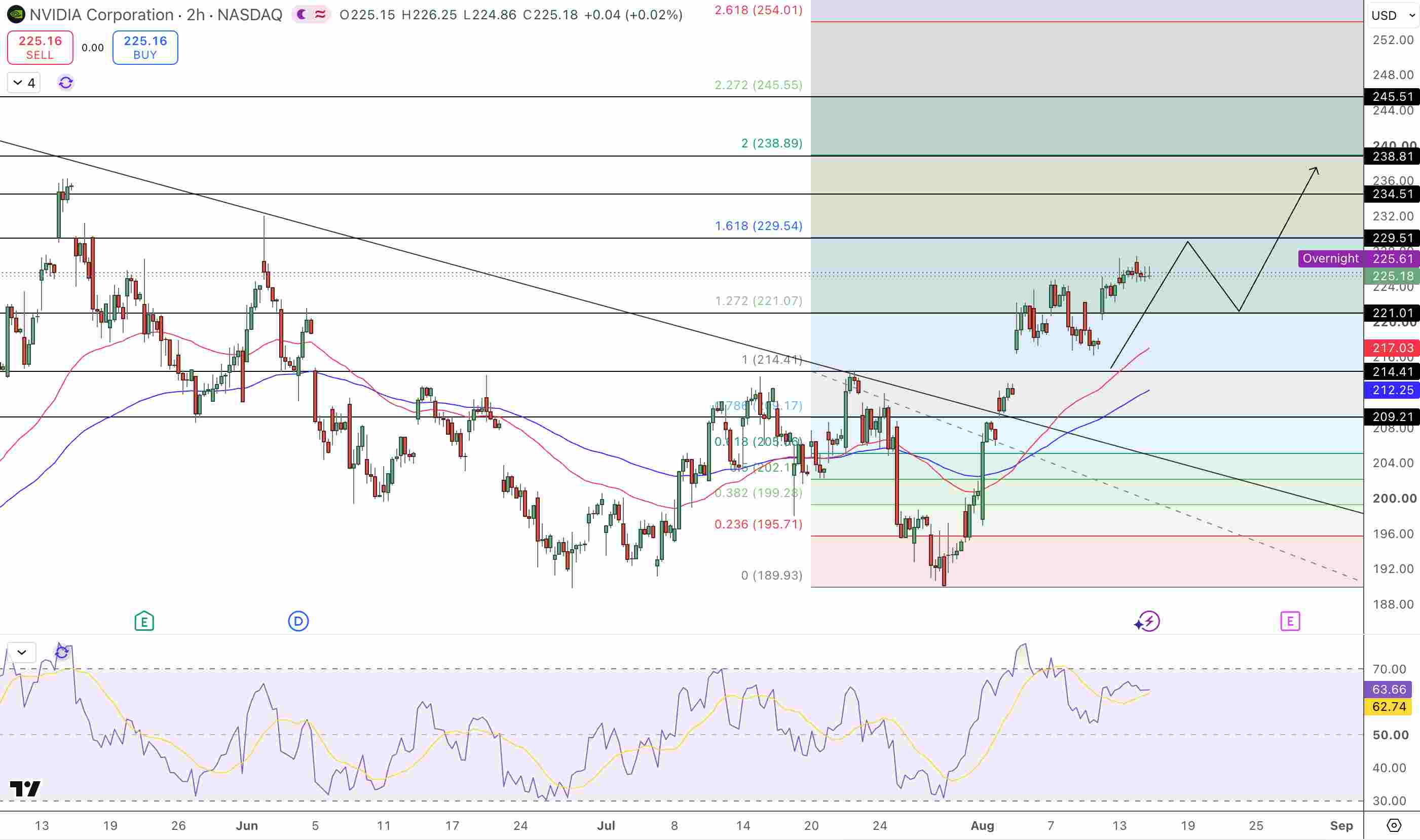
NVDA Price Chart - Source: Tradingview
Momentum is positive as RSI sits at 64. Price has consolidated and has low pressure, but is still sitting at the highs. Primary support is at $221.01. Below that support lies a cluster of support at $217.03, $214.41 and $212.25.
What Matters Before and During Earnings
Movement in bond yields due to Jackson Hole may influence growth stock valuations. Market expectations for analyst revisions will be of interest, particularly in the wake of other companies moving in the direction of Bank of America’s earnings expectations.
On earnings day, the focus will be on the following: Q2 revenue, Q3 guidance, gross margin, the timing of Rubin deployment, China revenue and the obligations of NVIDIA under the $500 billion financing deal.
Bottom Line
NVIDIA is approaching earnings with an $81.6 billion Q1 revenue, $75.2 billion Data Center revenue, and a 74.9% GAAP gross margin. Management has set a goal of $91 billion Q2 revenue, while Bank of America has a goal of $94 billion to $95 billion and Q3 guidance of $107 billion to $108 billion.
Prior to the earnings call, Vera Rubin, networking growth, and sustained hyperscaler spending support higher estimates. The main risks include financing exposure, China restrictions, and the current elevated market expectations.
Technically, $221.01 is the key support. To play the upside, one must wait for a close above $229.54. Above $229.54, one can look for $234.51 and $238.89 before earnings. The report needs to show more than just a revenue beat. The report needs to show significant demand far enough out to justify the estimates moving and continuing to move above management’s guidance. This is analysis, not investment advice.
Find out more
Comments