TradingKey - SpaceX (SPCX) shares recently reclaimed their IPO price, closing at $146.23 on August 17, up 4.45%. However, as market sentiment rebounds, Wall Street's outlook on this space and AI giant shows a clear divide.
Phillip Securities analyst Glenn Thum recently reaffirmed his "Sell" rating on SpaceX with a target price of $75. Based on the current stock price of $146, this forecast implies that SPCX could face a downside of approximately 50%.
SpaceX Revenue Surges 92%: Why Are Analysts Still Bearish on SPCX?
From a performance standpoint, SpaceX's current growth momentum is by no means weak. The company's second-quarter revenue grew 92% year-over-year to $7.8 billion, with AI business revenue surging 247% year-over-year, becoming a key driver behind overall revenue expansion. Approximately $1.6 billion of the AI revenue came from new cloud service agreements signed during the quarter, indicating that market demand for SpaceX's computing power resources is growing rapidly.
However, in Thum's view, high growth does not equate to high-quality growth. Some cloud computing contracts operate on a monthly billing model, allowing customers to terminate the partnership with just 90 days' notice after completing initial deployment. Compared with multi-year long-term contracts that offer higher revenue predictability, these agreements still carry significant uncertainty.
In addition, rising customer concentration is another issue worth noting. In the second quarter, a single AI customer contributed approximately 19.5% of SpaceX's total revenue, up from less than 10% in the same period last year.
Therefore, Thum believes that to justify a higher valuation, SpaceX needs to further prove that its existing AI orders can be converted into longer-term, more stable contracts. In other words, what the market truly cares about right now is no longer whether SpaceX can win AI orders, but whether these orders can consistently translate into stable cash flow.
Meanwhile, SpaceX is committing massive capital to its AI expansion. The company's second-quarter capital expenditures reached approximately $18.4 billion, with about $15.8 billion allocated to AI-related projects, far higher than the $10.1 billion in the first quarter and significantly above its revenue for the same period.
This means that while the AI business has become SpaceX's fastest-growing segment, it continues to consume a large amount of cash in the short term. The company plans to further expand its computing capacity, and if revenue growth fails to keep pace, massive capital expenditures could become a major factor dragging down its valuation.
SpaceX Analyst Forecasts Diverge Widely?
Glenn Thum's $75 price target represents a relatively pessimistic view in the market, but most analysts remain bullish on SpaceX's medium- to long-term prospects.
UBS analyst John Hodulik maintained a "Buy" rating on SpaceX with a price target of $210. Deutsche Bank analyst Edison Yu also assigned a "Buy" rating and set a price target of $235, believing that growing AI demand and enterprise customer expansion are expected to further broaden the company's growth potential.
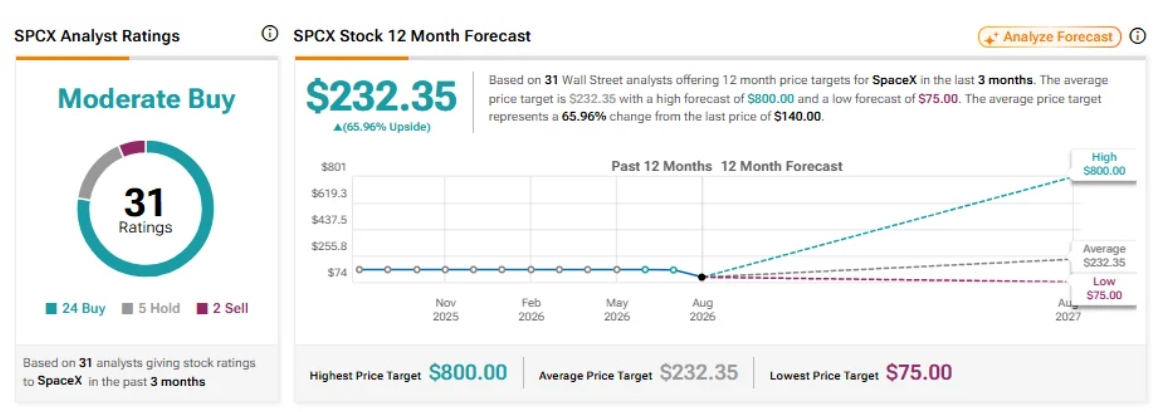
Looking at overall market views, the valuation divergence on SpaceX is very pronounced. TipRanks data shows that among the 31 analysts covering SPCX, 24 give a "Buy" rating, 5 recommend "Hold", and only 2 suggest "Sell", making the overall consensus rating a "Moderate Buy". Meanwhile, analyst price targets range from $75 all the way to $800, a span of more than 10 times.
Source: TipRanks
This means that the market's true debate at present may not simply be whether SpaceX can continue to grow, but rather how high a valuation investors should assign to its AI business, and whether this rapid growth can continue to materialize.
SpaceX Stock Technical Analysis
Source: TradingView
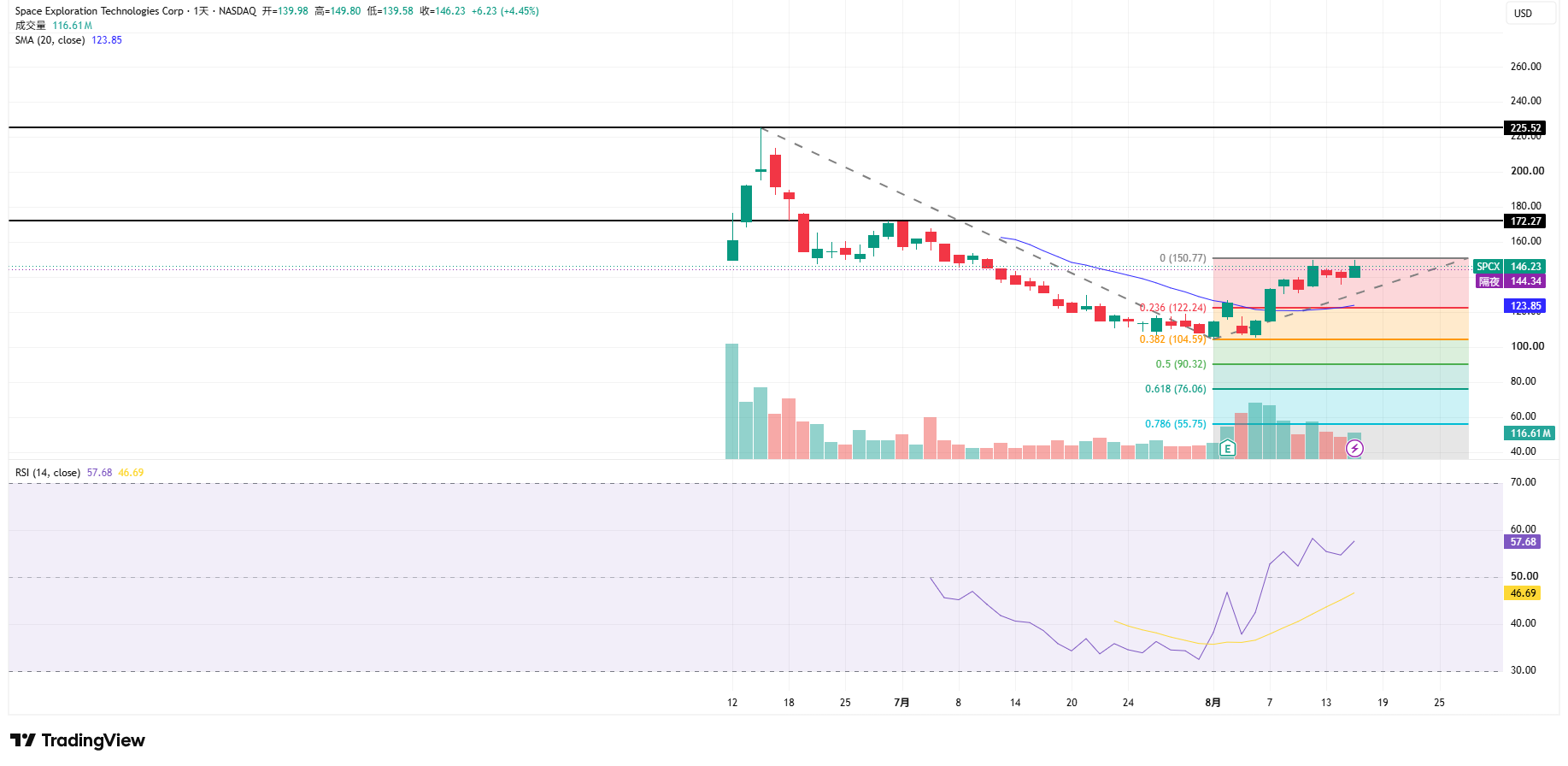
From a technical perspective, SPCX's recent performance has improved significantly. The stock once rose to $225 after its listing before steadily falling back to a low of $108. Recently, the stock price rebounded sharply from this low, reclaiming its 20-day moving average of $123.85 and breaking above the previous downtrend line, indicating that the short-term downside structure has been somewhat repaired.
Momentum indicators are also tilted to the bullish side. The 14-day RSI has risen to 57.68, above its signal line of 46.69, indicating strengthening buying power while remaining comfortably below the overbought territory above 70. This suggests that the short-term rally shows no clear signs of overheating.
However, the area around $150 remains the most critical resistance zone for SPCX at present. The stock price recently peaked at $149.80 but has yet to convincingly break through $150.77, indicating strong selling pressure near this level.
If it can break above $150.77 on heavy volume and hold above that level, the next target to watch would be $172.27. Only with a further breakthrough above this level might the market reconsider the all-time high of $225.52.
On the downside, $140 to $144 serves as the first line of short-term support. If the stock holds this range after a pullback, the current movement can still be viewed as a normal consolidation following a breakout. A more crucial support zone lies between $122.24 and $123.85, which aligns with both the 0.236 Fibonacci level and the 20-day moving average. A decisive breakdown below this region would significantly weaken the rebound structure, and the stock price could retest its previous low of $104.59.
From a technical projection perspective, $75 is not entirely groundless. If SPCX falls below its previous low of $104.59 and continues the downtrend initiated from the high of $225.52, the next target could shift down to near $90, and potentially reach the Fibonacci extension level around $76, which is fairly close to the $75 target given by Thum.
However, this remains a bearish scenario that has not yet been confirmed by price action. For now, SPCX remains above its 20-day moving average with the RSI trending upward, and the short-term focus remains on whether $150 to $151 can be convincingly breached.
Find out more
Comments