TradingKey - The U.S. will release the U.S. July Personal Consumption Expenditures (PCE) Price Index on Wednesday, August 26, Eastern Time. As a key inflation indicator closely watched by the Federal Reserve, this data will serve as an important basis for the market to assess whether a rate hike will occur in September.
Core Inflation May Remain at 3.3%: Will Fed Rate Hike Expectations Cool?
In terms of market expectations, US core PCE in July is expected to rise 3.3% year-over-year, flat from June, and increase 0.2% month-over-month, while headline PCE is expected to edge down slightly from 3.7% in June to around 3.6% year-over-year.
By comparison, US headline PCE rose 3.7% year-over-year in June, while core PCE rose 3.3%, with the latter edging down slightly from 3.4% in May. Although inflation has cooled from previous highs, core PCE remains well above the Federal Reserve's 2% long-term target, indicating that underlying US price pressures have not fully vanished. For investors, it is worth paying attention to whether this PCE reading will exceed the market expectation of 3.3%.
Recently released US CPI and PPI data for July showed no significant re-acceleration of inflation, with July PPI flat month-over-month, further lowering market bets on a Fed rate hike in the near term. However, the July meeting minutes showed that many officials believed further rate hikes might still be necessary in the future if inflation remains elevated.
It should be noted that energy price increases caused by the Middle East situation remain a potential risk. The situation in the Strait of Hormuz has already pushed up energy costs significantly, and whether energy prices ultimately pass through further to goods and services prices will determine whether US inflation can smoothly cool down. Reuters pointed out that US core PCE has been above the Fed's 2% target for 65 consecutive months, meaning policymakers currently still lack sufficient reason to declare victory in the fight against inflation.
How Did US Stocks, the Dollar, and Gold React in the Short Term After July PCE Data Release?
For US stocks, if core PCE comes in lower than 3.3% YoY, especially below 0.2% MoM, it will reinforce expectations that US inflation continues to cool, and the market may further lower the probability of a Fed rate hike in September. If US Treasury yields fall accordingly, it will benefit tech stocks, AI concept stocks, and other high-valuation growth stocks, with the Nasdaq and S&P 500 likely gaining support. Conversely, if core PCE is higher than 3.3% YoY and reaches 0.3% or higher MoM, expectations for a September Fed rate hike will heat up significantly, and rising US Treasury yields will increase valuation pressure on tech stocks.
For the US dollar, if core PCE comes in higher than 3.3% YoY, it will signify that US inflation remains sticky, strengthening the rationale for further Fed rate hikes. If the market subsequently raises rate hike expectations for September or by year-end, US Treasury yields may rebound, thereby driving the US dollar higher. Conversely, if core PCE falls below 3.3%, Fed rate hike expectations may cool, further weighing on the US dollar and dragging it lower.
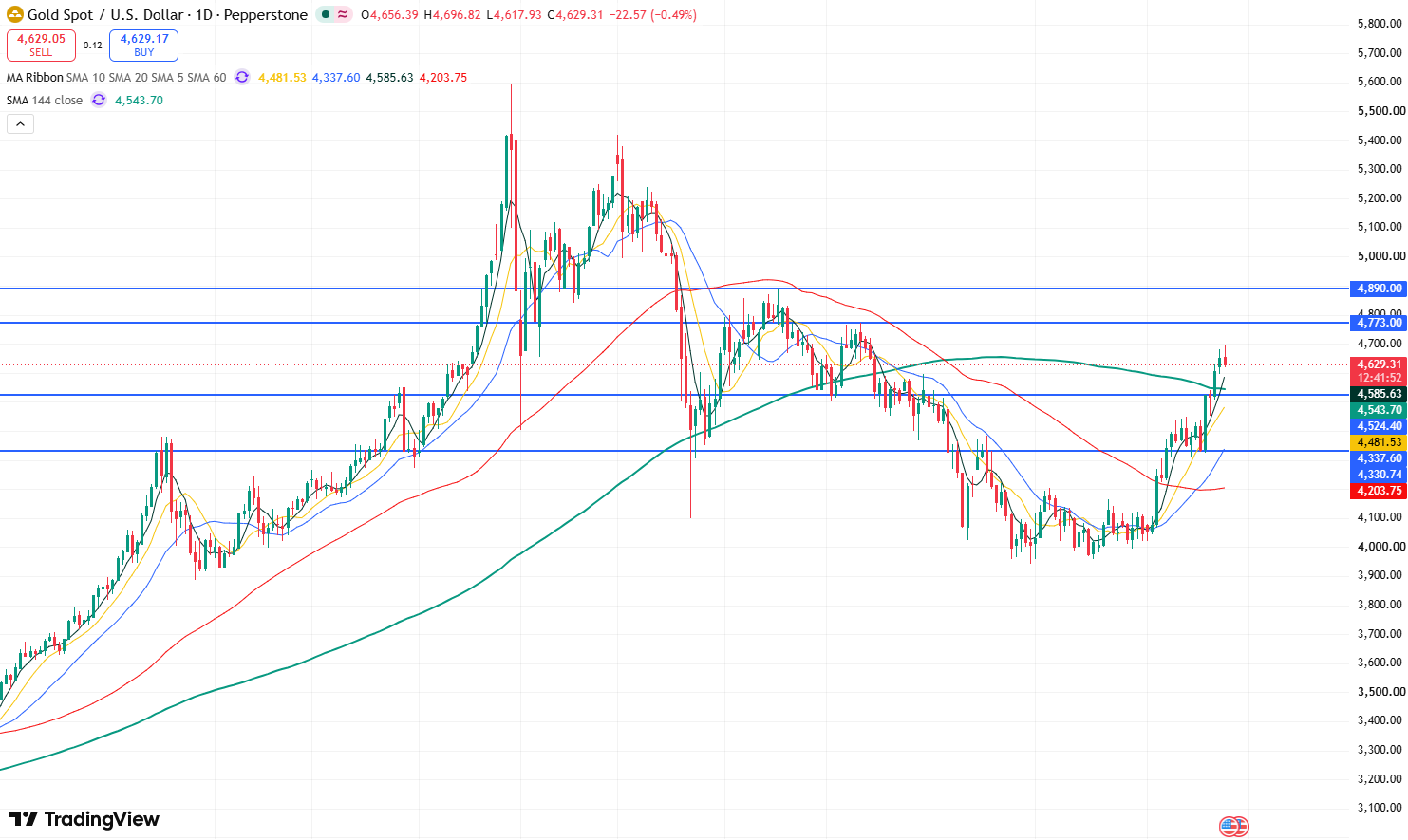
Gold price daily chart, Source: TradingView
For gold (XAUUSD), lower-than-expected PCE data will serve as a direct positive. If core PCE comes in below 3.3% YoY and below 0.2% MoM, falling Fed rate hike expectations may drive down the US dollar and real US Treasury yields, lowering the opportunity cost of holding gold. Gold prices, currently at high levels, may once again challenge $4,700 upward and even further test the $4,800 mark. Conversely, if core PCE is higher than 3.3% YoY and higher than 0.2% MoM, the US dollar and Treasury yields may rebound in tandem, leaving gold facing profit-taking pressure at high levels, potentially testing the $4,600 mark downward or even falling further toward the support level of $4,530.
Find out more
Comments