TradingKey - After seven consecutive trading days of losses, Nvidia (NVDA) is approaching a crucial earnings report that could determine the direction of the AI trade.
Nvidia will report its second-quarter fiscal 2027 results after the market close on August 26, Eastern Time. From August 14 to 24, the company's stock fell by a cumulative total of approximately 7.5%, marking its longest losing streak since 2022. Its market capitalization shrank by about $407 billion, pulling back to near $5 trillion. As of the close on August 24, Nvidia's stock fell 2.91%, with its year-to-date gain compressed to around 11%.
This stands in sharp contrast to the company's still rapidly expanding business performance. In the previous fiscal quarter, Nvidia's revenue reached $81.6 billion, up 85% year-over-year, with data center revenue coming in at $75.2 billion, up 92% year-over-year. The midpoint of the company's second-quarter revenue guidance was $91 billion, representing a near-doubling within a year.
Against the backdrop of its stock falling on the day after earnings releases for four consecutive quarters, Nvidia may need to deliver results that far exceed consensus expectations this time to reverse its current weakness.
Nvidia Earnings Bar Rises to $95 Billion
Wall Street currently expects Nvidia's fiscal second-quarter revenue to be around $92 billion, with adjusted earnings per share of approximately $2.09. Among this, data center revenue is projected to reach about $85.4 billion to $85.7 billion, representing year-over-year growth of over 100%.
This forecast is already higher than Nvidia's official guidance of $91 billion, but the market's true bullish bar may be even higher. Jefferies (JEF) projects that Nvidia's quarterly revenue could reach $95 billion, nearly $3 billion above consensus estimates; the firm also expects the company's revenue guidance for the next fiscal quarter could reach $108 billion, compared with current market expectations of around $103.7 billion.
This means that if Nvidia only reports revenue of around $92 billion, even if it technically beats the company's guidance, it may fail to satisfy investors who have already raised their expectations in advance.
Nvidia Earnings Are Stronger, Why Does NVDA Stock Still Lag Micron?
Also benefiting from AI data center investments, Micron Technology (MU)'s stock price has risen by more than 200% cumulatively this year, significantly outperforming Nvidia. Why then has Nvidia, with its larger revenue scale, higher profit margins, and stronger industry position, lagged behind Micron in stock performance?
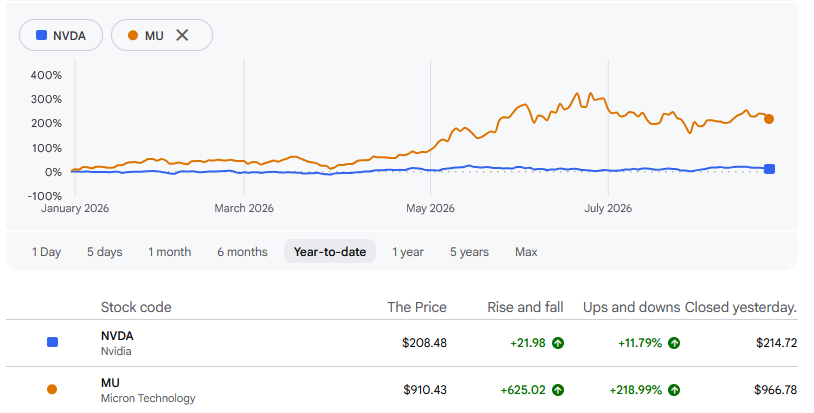
Source: Google Finance
The key lies in who has seen a larger upward revision in earnings expectations.
AI servers have rapidly increased the demand for HBM, DRAM, and enterprise solid-state drives (SSDs), while new memory capacity is difficult to bring online in the short term. Micron's HBM capacity for 2026 is virtually sold out, and DRAM and NAND prices continue to rise due to tight supply. This enables the company to benefit simultaneously from higher sales volumes, product price hikes, and margin expansion.
Micron was previously viewed as a highly cyclical memory chip maker, but the market has now begun re-rating it as a scarce supplier in AI infrastructure. More importantly, its earnings expectations have been revised upward rapidly from a lower base, while its forward P/E ratio stands at approximately 6 to 15 times depending on different metrics, leaving substantial room for simultaneous expansion in earnings and valuation.
Nvidia faces the exact opposite situation. The company's high profit margins, CUDA ecosystem, and AI accelerator advantages have long been a market consensus, and consecutive major beat-and-raises have gradually become standard performance in the eyes of investors. When expectations are already elevated, even if financial results continue to grow, the marginal boost to the stock price diminishes.
Although Nvidia's forward P/E ratio of about 18 to 21 times is not expensive relative to its own historical levels, a market capitalization exceeding $5 trillion poses a higher hurdle for further upside. Every 10% increase in NVDA's stock price requires an additional $500 billion in market value; therefore, an upward earnings revision of the same magnitude typically provides less noticeable momentum to its stock price than to Micron, which has a lower market cap and baseline expectations.
Capital flowing from Nvidia to Micron does not mean investors believe GPU demand is about to vanish; rather, the market is searching within the AI supply chain for segments with tighter supply, faster earnings growth, and lower valuations.
Whether Rubin Can Succeed Blackwell Will Determine the Next Wave of Growth
Demand for Blackwell remains strong, but on this earnings call, the mass production timeline for Vera Rubin may draw even more attention than Blackwell itself.
Jefferies expects Vera Rubin-related products to contribute about 12% of Nvidia's GPU revenue in the third quarter of fiscal 2027, rising to over 40% in the fourth quarter, and becoming the primary revenue source by the first quarter of fiscal 2028. Since Rubin inherits the rack architecture, liquid-cooling systems, and data center deployment foundation established by Blackwell, its production ramp may be faster than the early stages of Blackwell.
The new-generation rack design also reduces manual cabling and plumbing installation. According to institutional forecasts, the assembly time for compute trays is expected to drop from roughly two hours to five minutes.
The significance of this improvement extends beyond reducing installation time. Nvidia is working to transform complex AI server construction into a more standardized and replicable "AI factory" delivery model. The higher the deployment efficiency, the faster cloud computing companies and large enterprises can scale their compute capacity, expanding the revenue potential for Nvidia's full-stack systems.
Beyond GPUs, the Vera CPU could also become a new source of growth. Nvidia projects CPU-related revenue could reach about $20 billion this year, with a total addressable market of around $200 billion. Although the absolute scale of the CPU business cannot compare to GPUs, it helps Nvidia integrate GPUs, CPUs, networking, storage, and CUDA software into a unified platform, making it more difficult for customers to switch to AMD, Intel, or custom in-house chips.
Wall Street Sees $350 Price Target: Can NVDA End Its Losing Streak?
Despite Nvidia's consecutive stock declines, major Wall Street institutions generally maintain a bullish outlook.
In the ratings updated on August 24, JPMorgan (JPM) maintained a $280 price target, Rosenblatt set its target at $325, KeyBanc at $330, while Cantor Fitzgerald gave a $350 target price.
Based on the stock price after a seven-day losing streak, $350 implies potential upside of about 68%. Cantor analyst CJ Muse believes investors are currently underweight on Nvidia, and the market appears to be pricing in a scenario where the company loses its leading position in the AI race.
Broader analyst stats are similarly positive. TipRanks data shows that all 28 analysts covering Nvidia over the past 12 months have assigned Buy ratings, with an average 12-month target price of approximately $304.73 and a high target of $425.
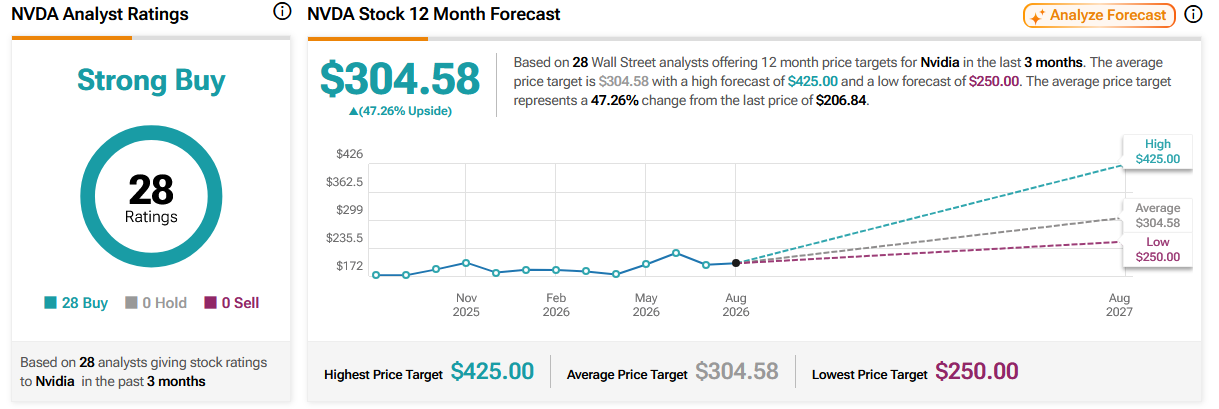
Source: TipRanks
Find out more
Comments