TradingKey - On August 25, Eastern Time, international oil prices fell sharply, with both WTI crude and Brent crude falling more than 3%. Rich Privorotsky, head of Goldman Sachs' hedge fund business, pointed out in his latest note to clients that the importance of oil prices this week could very well surpass the Jackson Hole annual symposium. One of the market's current focus points is the latest developments regarding U.S. Treasury sanctions on Iran.
As of press time, WTI crude was down 3.4% at $82.07, while Brent crude fell 3.42% to $87.41.
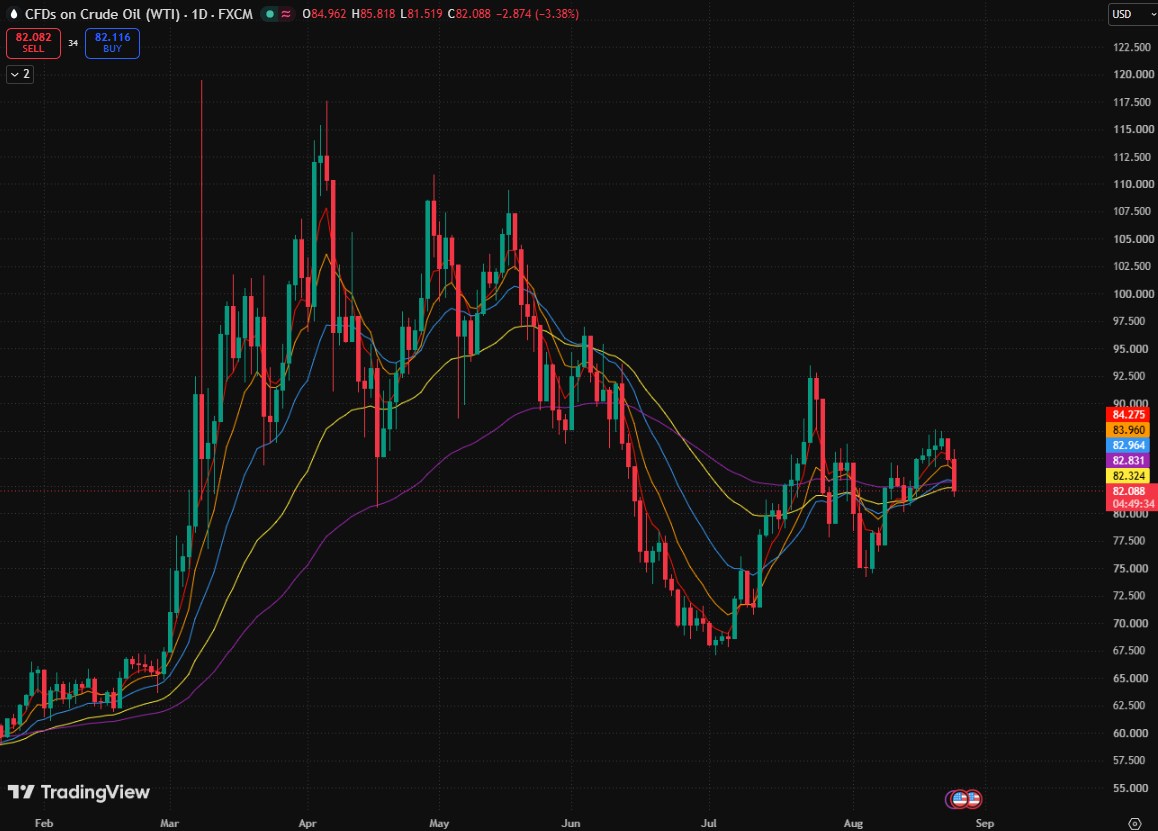
WTI crude oil prices, Source: TradingView
Privorotsky warned that if U.S. sanctions directly target Asian refiners, it could further increase trade friction and bring new uncertainty to energy markets and global risk assets.
Against this backdrop, a joint statement between Iran and Oman regarding the restoration of safe navigation through the Strait of Hormuz has also drawn market attention.
The joint statement showed that Omani Foreign Minister Badr Albusaidi held constructive consultations with Iranian Foreign Minister Abbas Araghchi during his visit to Iran. The two sides focused on restoring safe navigation through the Strait of Hormuz while maintaining their respective sovereignty and sovereign rights.
According to the statement, Iran and Oman discussed a phased framework to establish a temporary joint maritime corridor in the Strait of Hormuz and implement a joint project to clear mines in the strait. The two sides will also continue technical-level discussions to seek agreement on establishing a permanent maritime corridor, future management of the strait, traffic management information exchange, and related maritime and security service mechanisms.
In addition to energy and geopolitical news, market sentiment has also shifted significantly. Since last week, the Nasdaq has continuously underperformed the broader market, tech stocks have faced large-scale position reductions, and the AI narrative faces valuation re-assessment pressure.
Privorotsky believes that falling prices themselves are reinforcing the market's bearish narrative. He noted, 'Prices drive narrative; once prices fall enough, old arguments about price deflation, saturation, and competition suddenly start sounding very convincing.'
On the macroeconomic level, he pointed out that the combination of rising energy prices and weakening economic growth has driven stagflation-basket assets significantly higher. Meanwhile, the labor market is softening, consumer performance is mediocre, and tailwinds from fiscal policy and inventory are gradually fading.
Privorotsky stated that if the U.S. wishes to stabilize the bond market, pushing down energy prices may be the most practical path. He estimated that every $10 drop in oil prices would help improve inflation expectations, boost consumer confidence, lower long-end yields, and provide support for the stock market.
Find out more
Comments