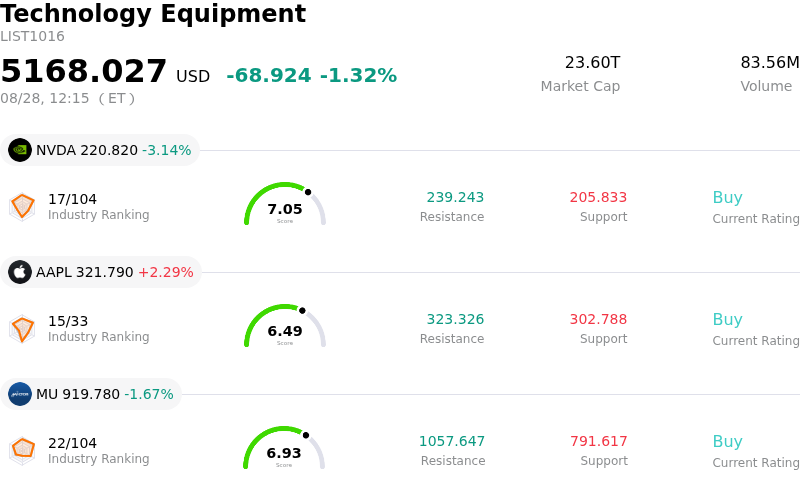
NVIDIA Corp (NVDA) moved down by 3.14%. The Technology Equipment sector is down by 1.32%. The company underperformed the industry. Top 3 stocks by turnover in the sector: NVIDIA Corp (NVDA) down 3.14%; Apple Inc (AAPL) up 2.15%; Micron Technology Inc (MU) down 1.75%.
What is driving NVIDIA Corp (NVDA)’s stock price down today?
Nvidia experienced a downward retracement following a period of strong upward momentum, largely driven by post-earnings profit taking and technical consolidation. Following the company's fiscal second-quarter financial release—which featured significant top-line outperformance and optimistic multi-year revenue projections—the stock underwent a natural pullback as short-term market participants locked in capital gains. Technical indicators had reached overbought levels during the initial surge, creating an environment ripe for institutional profit harvesting and short-term price stabilization.
Beyond technical profit taking, market scrutiny focused on near-term gross margin trajectory. Although data center revenues and overall customer demand continued to demonstrate robust expansion, management's forward-looking margin commentary highlighted mild sequential compression. Higher costs associated with critical inputs, particularly advanced memory components required for complex artificial intelligence infrastructure and server racks, introduced slight margin headwind expectations. This margin reset prompted analytical models to adjust peak-profitability timelines, weighing on near-term buyer enthusiasm despite strong revenue growth.
Broader macroeconomic conditions and sector-wide sentiment also contributed to the intraday weakness. Investor sentiment across high-beta growth stocks turned defensive ahead of key central bank communications and monetary policy updates at the Jackson Hole symposium. As treasury yields and broader market volatility fluctuated, market participants trimmed risk exposure across the semiconductor landscape, causing a broader pullback among mega-cap technology leaders following an extended sector-wide rally.
Technical Analysis of NVIDIA Corp (NVDA)
Technically, NVIDIA Corp (NVDA) shows a MACD (12,26,9) value of -0.559, indicating a neutral signal. The RSI at 54.838 suggests neutral condition and the Williams %R at 41.688 suggests buy condition. Please monitor closely.
Media Coverage of NVIDIA Corp (NVDA)
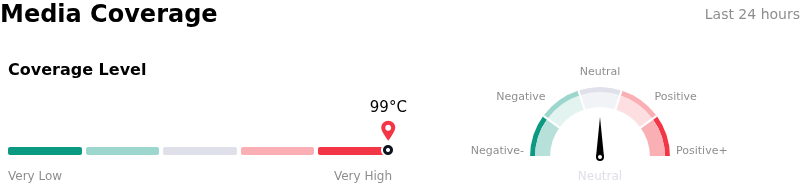
In terms of media coverage, NVIDIA Corp (NVDA) shows a coverage score of 99, indicating a very high level of media attention. The overall market sentiment index is currently in neutral zone.
Fundamental Analysis of NVIDIA Corp (NVDA)
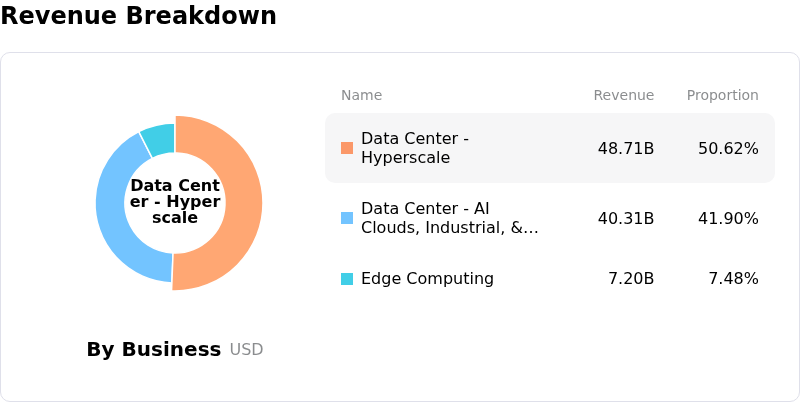
NVIDIA Corp (NVDA) is in the Technology Equipment industry. Its latest annual revenue is $215.94B, ranking 1 in the industry. The net profit is $120.07B, ranking 1 in the industry. Company Profile
Over the past month, multiple analysts have rated the company as Buy, with an average price target of $313.29, a high of $515.00, and a low of $180.00.
More details about NVIDIA Corp (NVDA)
Company Specific Risks:
- Gross Margin Compression from Escalating Memory Costs: Nvidia guided Q3 gross margins down to 74.0% (with analysts anticipating near-term pressure toward 71%–72%), driven by surging high-bandwidth memory costs and rising component prices across the AI supply chain.
- Severe Supply Bottlenecks and Inflated Purchase Commitments: Production capacity remains heavily supply-constrained through fiscal 2028, while Nvidia's long-term supply chain commitments more than doubled quarter-over-quarter to $279 billion, exposing the company to inventory and valuation risks if component prices decline.
- Credit Risk and Financing Exposure in Frontier AI Labs: Institutional analysts highlighted growing financial risk associated with Nvidia's expanding balance sheet exposure, including roughly $50 billion invested in frontier AI labs, specialized cloud providers, and complex data center lease structures.
- Geopolitical Headwinds and Chinese Market Loss: Q3 guidance continues to exclude Data Center compute revenue from China due to U.S. export control restrictions, while domestic Chinese competitors and AI startups are accelerating the development and deployment of local hardware alternatives.
Find out more
Comments