TradingKey - Driven by the AI wave, memory chip prices continue to rise, boosting profits significantly for manufacturers such as Samsung, SK Hynix (SKHY), and Micron (MU). However, Micron Technology, the world's third-largest memory chipmaker, is facing a labor dispute at its plants in Taiwan, China.
On September 1 during Asia-Pacific trading hours, Micron's two major labor unions in Taiwan, China—the "Micron Wafer Union" and the "Micron Memory Union"—stated that they will push for strike action unless the company agrees to reform its current bonus system. Affected by the strike news, Micron fell over 2% at one point in US pre-market trading.
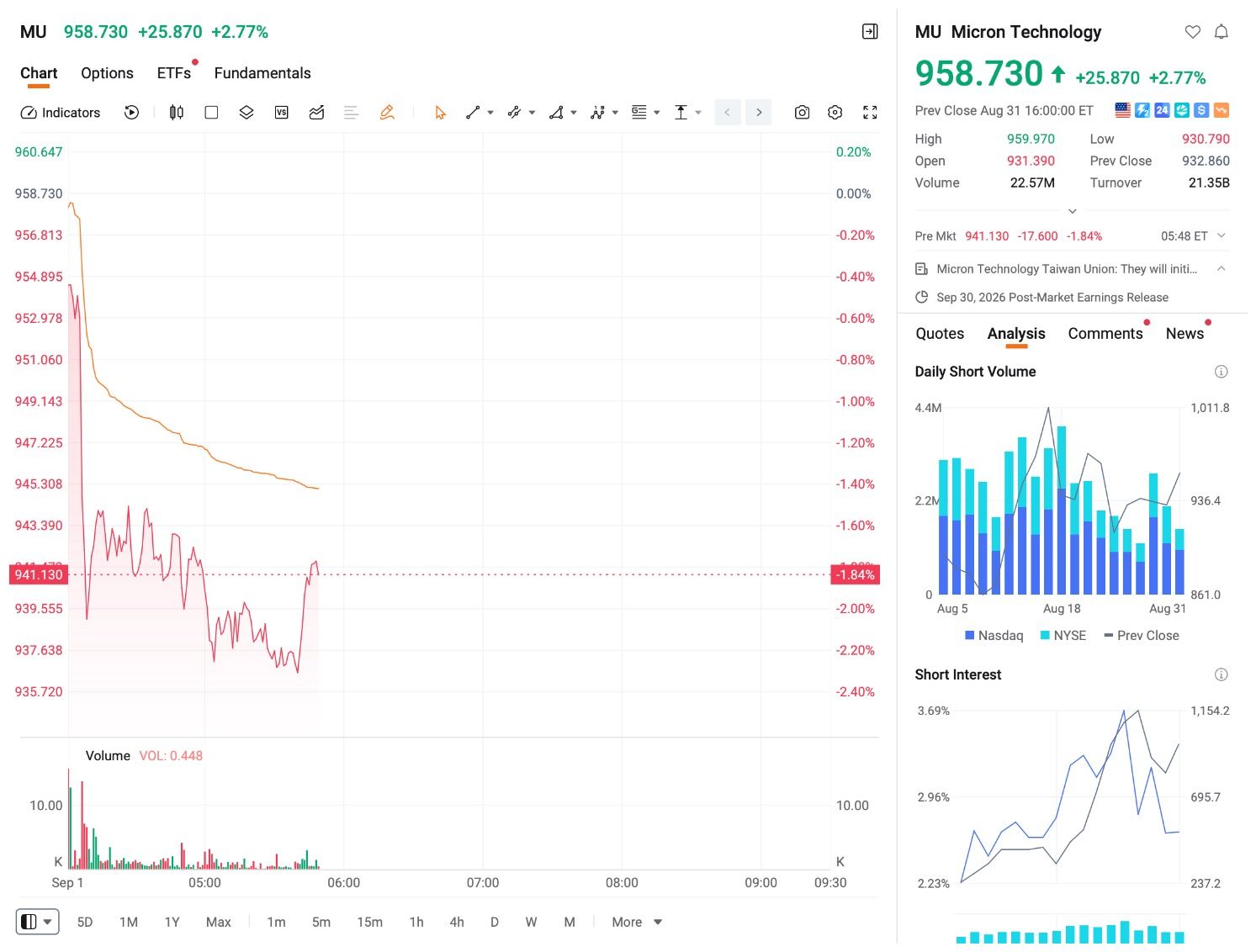
[Source: Futu]
Together, the two major labor unions have nearly 10,000 members, accounting for roughly two-thirds of Micron's approximately 15,000 employees across Taoyuan and Taichung in Taiwan, China. The unions stated that in an internal survey conducted in August, over 80% of participating members supported strike action.
At the core of this dispute is the allocation between company profits and employee compensation against the backdrop of growing AI memory demand. Micron's fiscal third quarter 2026 revenue reached $41.46 billion, a year-over-year increase of 346%; GAAP net profit was $28.24 billion, and Non-GAAP gross margin reached 84.9%.
The unions contend that the calculation method of Micron's current individual performance bonus system is insufficiently transparent and features a bonus cap, leaving employee bonuses mismatched with the company's profit growth.
The unions also cited Samsung and SK Hynix as benchmarks, demanding that the current system be reformed into a profit-sharing mechanism more closely tied to corporate profits. For reference, Samsung Electronics previously reached an agreement with its union to set aside 10.5% of its chip division's operating profit for a special bonus pool, while SK Hynix implements a 10% profit-sharing scheme linked to annual operating profit.
Micron Taiwan responded that performance bonus payouts this year will hit a record high in the company's history, stating that it will continue communicating with employees through existing channels while abiding by applicable local legal procedures.
According to Taiwan, China's "Act for Settlement of Labor-Management Disputes", industrial actions cannot be conducted before mediation fails, so the unions must undergo statutory mediation procedures prior to any formal strike action. Micron Taiwan's two major labor unions have currently scheduled mediation sessions for late August and mid-September; if mediation fails, a formal strike vote could be initiated as early as September.
The reason this dispute has drawn market attention is closely related to Micron's production footprint in Taiwan. Taiwan is Micron's largest manufacturing base globally, where the company has invested approximately NT$1.4 trillion (around $43.9 billion) and produces products such as DRAM and HBM.
If an actual strike occurs, it could disrupt part of Micron's production and further impact global memory product supplies such as DRAM and HBM; however, the exact extent of the impact depends on the scale and duration of the strike, as well as whether the company can reallocate production capacity.
Find out more
Comments