TradingKey - Microsoft (MSFT) finished at $516.17 on 9/25, up 3.66% from the previous day’s close. Revenue and growth for Microsoft’s cloud product, Azure, continues to surge. Additionally, Microsoft 365 Copilot has reached more than 30 million paid users. As if that were not enough, the company has expanded Microsoft 365 Copilot to include additional features, to include apps and software development.
The question now becomes how quickly will revenue and profit margin from these products and services grow? Will Microsoft, like other AI firms, become so focused on growth that they lose sight of profit? That remains a risk as Microsoft accelerates AI infrastructure spending, although the company continues to generate substantial operating profit and cash flow.
The New Copilot Expands Microsoft’s AI Revenue Opportunity
The newly announced Copilot, introduced on September 25, is not generally available on October 2. Home and Code are beginning rollout through Microsoft’s Frontier program over the coming weeks, while Autopilot is expanding to private preview at the end of September. It is built on top of AI and will integrate delegated work and other features to automatically code apps and run tasks. A persistent agent will allow it to perform work and tasks beyond the normal boundaries of the software.
More AI features can be sold to enterprises. The inclusion of usage-based billing also means Microsoft has another way to make money beyond its core business of selling software licenses. However, its focus is on the enterprise, and Microsoft is still in the early stages of this business.
Copilot Already Has a Large Paid Base
It's worth noting that Copilot already has thousands of customers and has exceeded 30 million paid seats for Microsoft 365 Copilot. Clearly, there is strong commercial interest for these AI products, and we should expect further product enhancements.
Product enhancements may increase the average revenue per user via the sale of more premium features. Microsoft may also realize economies of scale via increased compute and usage of AI features. It's important to note that Microsoft may eventually invest heavily in data centers to offset the cost of increased customer usage of its AI features.
Azure Remains the Core Growth Engine
For the quarter ending June 30, 2026, revenue was $90.0 billion, up 18% from the prior year. Operating income increased 18% to $40.6 billion. Revenue from Azure and other cloud services increased by 43%.
It is worthwhile to break down the Azure growth numbers, as reported numbers from last quarter will no longer be reported in this way going forward. Under Microsoft’s new FY2027 reporting definitions, the comparable Q4 Azure growth rate is 42%. Management guides approximately 45% constant-currency Azure growth for fiscal Q1 2027.
Commercial Backlog Gives Microsoft Long-Term Visibility
Microsoft has $678 billion of performance obligations that it has won but has not yet fulfilled, up 84% from the previous year. Management said the balance grew 25% year over year excluding OpenAI, and all sequential Q4 commercial RPO growth came from customers outside frontier model companies.
Regardless, positive revenue growth is always a good sign for investors and helps justify further investment in the company.
The $50 Billion CapEx Test Is the Main Risk
In fiscal Q4, Microsoft’s capital spending was $41 billion. Roughly two-thirds of that Q4 spending, or about $27 billion, went to shorter-lived assets, primarily CPUs and GPUs. Microsoft separately expects fiscal Q1 2027 capital expenditures to exceed $50 billion.
Risks associated with Microsoft's capital spending are the primary financial constraints for the company going forward.
I’m focusing on the outpacing of infrastructure spending relative to revenue growth.
Although Microsoft is reporting healthy profitability and cash flows, the margin is thinning. I’m expecting proof that recently expanding the capacity of the Cloud is yielding improvements in profitability.
Cloud Margins Are Already Feeling AI Costs
AI is getting expensive. Microsoft Cloud gross margin shrank to 65% from 68% a year earlier. Management attributed the compression to shifting mix toward more expenses being allocated to AI and other cloud infrastructure.
AI is Eating Into Margins
If Azure growth continues at breakneck pace and infrastructure obligations are managed prudently, the margin impacts of AI should be more than offset by operational improvements. If this proves true, expansion in the Cloud business will improve profitability.
Headline EPS Needs Normalization
Recently, Microsoft reported Q4 GAAP diluted EPS of $4.81 and adjusted EPS of $4.74. Microsoft reported other non-recurring items and gains, including a $3.2 billion gain from Microsoft's investment in Anthropic. Microsoft’s reported $4.74 non-GAAP EPS adjusts for the impact of its OpenAI investment; it does not separately exclude the $3.2 billion Anthropic gain and the other discrete items discussed by management.
On a going forward basis, I am more interested in analyzing trends in the revenue, operating income and cash flow of Microsoft's cloud business, rather than analyzing trends in reported EPS.
FY27 Guidance Sets a High Bar
Microsoft forecasts total revenue in the range of $89.85 billion to $90.95 billion for the first quarter of fiscal 2027.
For the full fiscal 2027, management expects revenue and operating income to increase by a double digit percentage and the operating margin to decrease by less than 1 percentage point.
As part of the recent organizational restructuring, the business has been further consolidated into two business segments, 'Agents and Infra' and 'Devices and Consumer'.
Although the names of the reporting segments have changed, the new structure also reclassifies product and service revenue across Azure, Microsoft 365, developer and security cloud services, Industry Solutions, Windows, Xbox and advertising; it is not only a cost-allocation change.
The recent investment by the company in AI infrastructure, requires management to provide additional insight into the returns being generated by that investment. The new structure should provide investors better insight into the costs associated with Microsoft's cloud business.
Microsoft Technical Analysis: MSFT Breaks Triangle as $519.44 Resistance Comes Into Focus
Microsoft’s (MSFT) latest close was $516.17, occurring on a breakout from the symmetrical triangle. I will discuss the potential direction of the price of MSFT, based on recent price action.
After MSFT broke the descending trend line and the resistance at $507.41, I would say that the break was legitimate. Additionally, the price action showed that the $513.99 level was support.
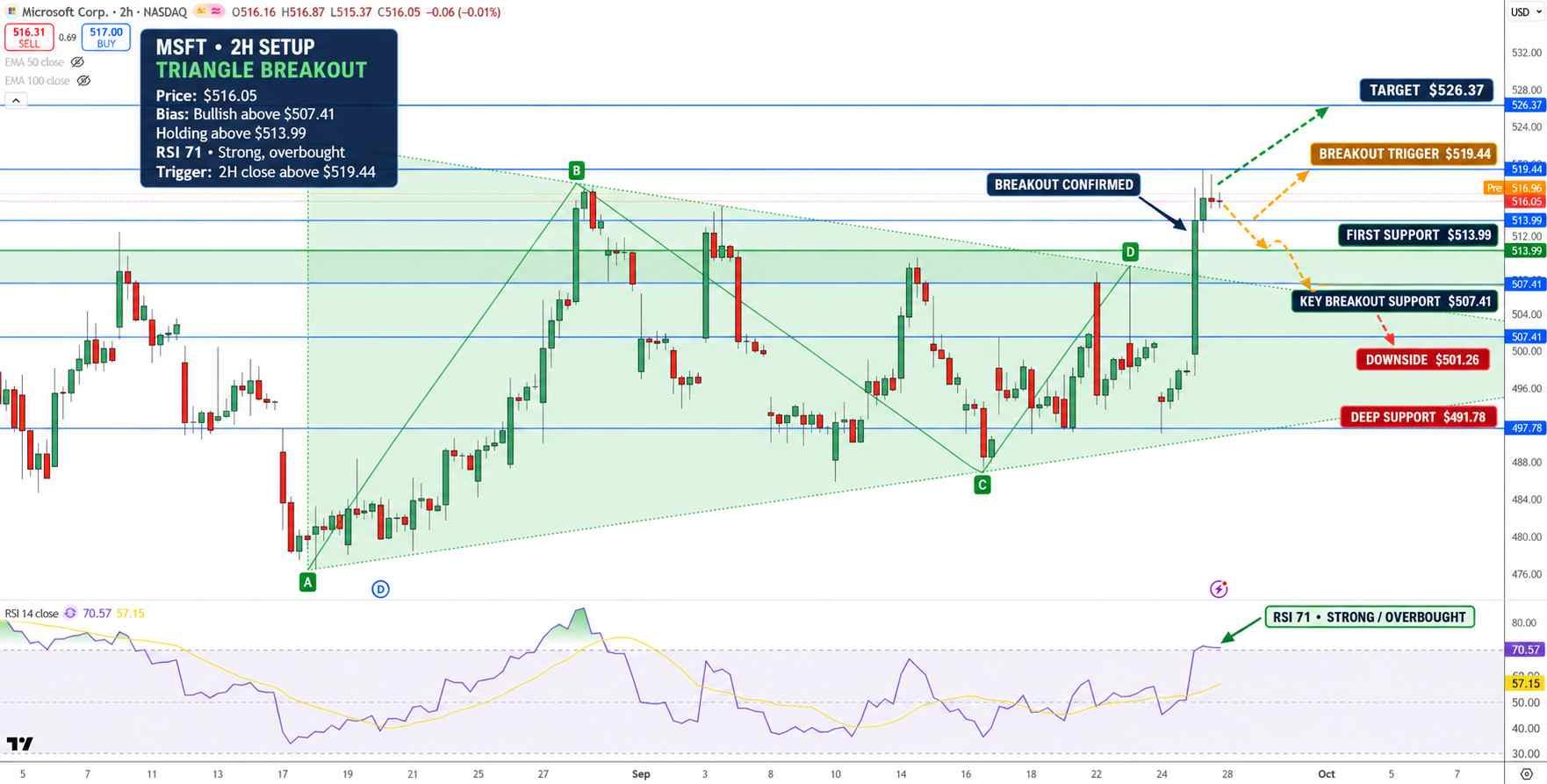
Microsoft Stock Price Chart - Source: Tradingview
The RSI reading was 71. A reading this high shows that MSFT may be overbought in the short-term.
One potential trade idea could be to sell MSFT with a 2-hour time horizon, and place a stop loss above the $519.44 level. This idea assumes that MSFT will test resistance at the $519.44 level, and possibly reverse, or consolidate.
If the $519.44 resistance level holds, and MSFT tests the $513.99 level, I would still consider it a bullish sign. The $513.99 level would represent support. The $507.41 level would represent the more important breakout support.
If the support at the $507.41 level holds, I would consider it bullish. If MSFT breaks support at the $507.41 level, it would be slightly bearish, as it would validated the $501.26 level as support. The $491.78 level would be an even stronger, bearish, long-term target.
As long as MSFT holds the $507.41 level, I would agree that the longer-term trend is bullish. The $519.44 level would be the first level of major resistance.
Why is Microsoft stock in focus now?
Microsoft is in the spotlight for multiple reasons at the moment. First, Azure is a rapidly growing cloud business. Second, Microsoft 365 Copilot is growing and has already reached 30 million users. Third, Copilot is being further developed to include personal use and other areas. The main question is if there is growing demand for these products to justify Microsoft’s projected more than $50 billion of fiscal Q1 2027 capital expenditures.
What level confirms a stronger MSFT breakout?
The target price for Microsoft is approximately $526.37. To reach this price, Microsoft first needs to break $519.44. If Microsoft breaks $519.44, $526.37 becomes the next upside target. A later pullback that holds $507.41 would keep the breakout structure intact. If $507.41 is broken, the breakout would weaken and $501.26 would come into focus.
Bottom Line
While Microsoft continues to be one of the leading AI-focused companies, with a growing suite of AI products and services, the growing investments to further AI-focused infrastructure may push the limits on profitability. Microsoft will have to demonstrate that AI investments are going to further catalyze and expand their current markets.
From a technical standpoint, as long Microsoft is above $507.41, the trend will be bullish. Additionally, if MSFT breaks $519.44, then the stock could be headed toward $526.37. However, if the stock breaks below $507.41, then the bearish trend may resume.
Find out more
Comments