TradingKey - Microsoft (MSFT) closed October 12 at $541.15, up 1.14% with a market cap above $4 trillion. The latest move was October 12’s announcement of Maia 300, signaling a larger role for Microsoft’s AI accelerators.
Earnings for Fiscal Q1 2027 are scheduled for October 28 after the close. I'm interested to learn if the growth in Azure and the monetization of AI will justify the significant investment in Azure infrastructure.
Maia 300 Targets Better AI Unit Economics
According to Microsoft, multi-gigawatt Azure Maia deployments will begin in 2027, and Maia will be the primary inference platform. Maia 300 is expected to achieve 40% more tokens per megawatt than the top GPU-based systems and up to seven times the rack-scale token throughput of Maia 200. These are expected performance improvements and not achieved costs savings.
Reports suggest that more than one million chips may be deployed in 2027. What attracts my attention is the potential to architect the hardware for Microsoft’s AI workloads, beyond Nvidia. Actual margins will depend on deployment costs, chip yields and utilization.
Azure and Cloud Growth Support the Thesis
Microsoft’s fiscal fourth quarter revenues were $90.0 billion, up 18%, and operating income was $40.6 billion, up 18%. GAAP EPS was $4.81, up 32%. Revenues from Azure and other cloud services were up 43% and were reported on a quarter that ended in June.
Microsoft’s Cloud generated $59.3 billion in revenue in the last quarter and $214 billion in revenue for fiscal year 2026. Remaining performance obligations for the commercial business hit $678 billion, a 84% increase. The backlog represents contracted revenue not yet recognized, including unearned revenue and amounts to be billed later. It is anticipated that about 30% of this backlog will be recognized as revenue in the next 12 months.
Copilot Adoption Creates a Revenue Opportunity
At the end of the fiscal year, Microsoft reported more than 30 million paid seats for Microsoft 365 Copilot and quarterly net additions more than doubled. Enterprise customer adoption, along with strong AI and Azure, positions Microsoft strongly for AI monetization.
Additionally, Copilot and Microsoft’s other AI products can fuel growth for Microsoft through Microsoft 365, GitHub, Dynamics, and Azure. I would look at paid seat expansion, along with retention and usage, rather than speculate on adoption becoming revenue.
Windows and Local AI Expand the Platform
Microsoft and Nvidia announced the Surface Laptop Ultra, powered by RTX Spark, on October 7. Microsoft also introduced Execution Containers, designed to separate AI agents from sensitive data. Processing data locally might enhance privacy and speed, though the commercial impact is unclear.
Q4 Consumer Performance Mixed
Windows OEM and Devices revenue for Q4 declined 7%, and Xbox content and services declined 10%. Search advertising, excluding traffic-acquisition costs, rose 10%. The strength in advertising was in search advertising excluding traffic-acquisition costs, which rose 10%. Azure and other cloud services revenue grew 43%.
Capital Spending Is the Key Financial Risk
Management projected more than $50 billion of capex in fiscal Q1, including the lease reclassification impact from an update to useful lives. Reuters reported projected capital spending for calendar 2026 at more than $175 billion. The reports cover different accounting periods, so they can't be compared directly.
Free Cash Flow Improved, But Spending Worrisome
Q4 free cash flow was $19.6 billion despite strong operating cash flow. Spending is rising, and returns need to be more durable. Further increases in capex without corresponding improvement in profitability from the Cloud would erode confidence.
Labor Restrictions and Shareholder Returns
Microsoft returned $10.2 billion in fiscal Q4 through dividends and repurchases. The recent increase in Microsoft's dividend to $0.98 per share signals the financial capacity of the company, however, the risks associated with investments and the growth of AI remain.
October 28 Earnings Will Test AI Returns
Microsoft expects fiscal Q1 revenue to be about $90.4 billion and about 45% growth for Azure in constant currency. Investors should focus on Copilot adoption, Azure results, and overall cloud computing and capital spending results including free cash flow on October 28.
I would place a greater weight on profitable demand than on artificial and temporary accounting gains, including subsequent period adjustments. Perhaps an update on deployment of Maia, which could help rein in risks from investing in AI, may help Microsoft hit its goals for the quarter.
Microsoft Technical Analysis: MSFT Tests $542.74 Resistance
MSFT closed at $541.15 on October 12 after reaching an intraday high of $542.74. The stock’s bounce from the October 8 close of $522.61, to a close of $535.07 on October 9 indicates developing short-term buy interest. The next reference point above the high is the cited 52-week high at $553.72.
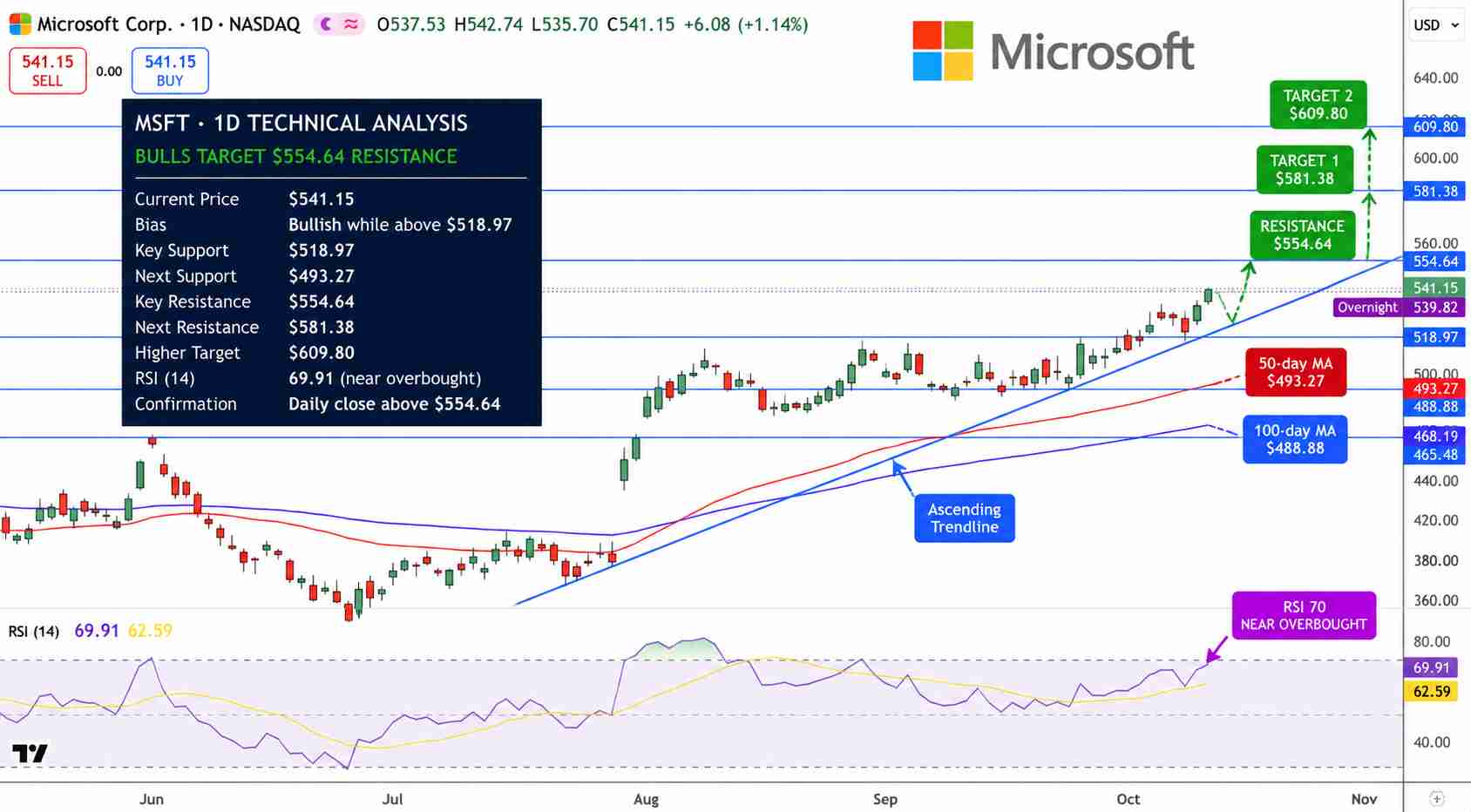
Microsoft Stock Price Chart - Source: Tradingview
As stated, the chart’s indicators, and the asserted upward trendline, cannot be validated based on the available historical price data. Therefore, in the published report, I would not consider those indicators established. Values of the RSI and 50-day and 200-day moving averages should be taken from a matching daily chart, and published, if desired.
Until the stock trades below $535.07, my bias will be to the upside. A close above the current high of $542.74 would strengthen the case for a retest of the 52-week high at $553.72. A decline to the $522.61 and $518.79 levels would be possible with a breakdown below $535.07. Failed breakouts can often reverse sharply before earnings, and the $535.07 level is the October 9 close, so momentum would be key.
Key Levels
Latest completed close: $541.15, October 12
Major support: $535.07; then $522.61; and $518.79
Major resistance: $542.74; then $553.72
RSI: not independently verified; no numeric reading asserted
Recovery trigger: close above $542.74
Breakdown trigger: move below $535.07
FAQ:
Why Is Microsoft Stock in Focus?
What the Street is Already saying: The Maia 300 announcement creates an opportunity to enhance AI infrastructure efficiencies ahead of Microsoft’s confirmed October 28th earnings.
What Is MSFT's Main Breakout Level?
The October 12 intraday high at $542.74 is the immediate verifiable resistance. Sustained trading above here would target $553.72.
Bottom Line
In the near term, my bias is bullish above $535.07 with additional confirmation above $542.74. Given recent increases to Azure’s infrastructure and Microsoft’s commitment to proprietary silicon, I see the bullish case as the more likely scenario over the longer term. That said, valuation and rapid capex leave little room for error.
Find out more
Comments