Tracking the Market Trend
TradingKey - On October 14, Eastern Time, U.S. September CPI data came in higher than market expectations, fueling expectations of a Fed rate hike in October and dampening market sentiment, causing U.S. stocks to decline. AI hardware, technology, and banking stocks led the declines.
At the close, the Dow Jones Industrial Average fell 0.09% to 51,621.48; the Nasdaq Composite Index fell 1.88% to 26,692.87; and the S&P 500 Index fell 1.11% to 7,718.94.
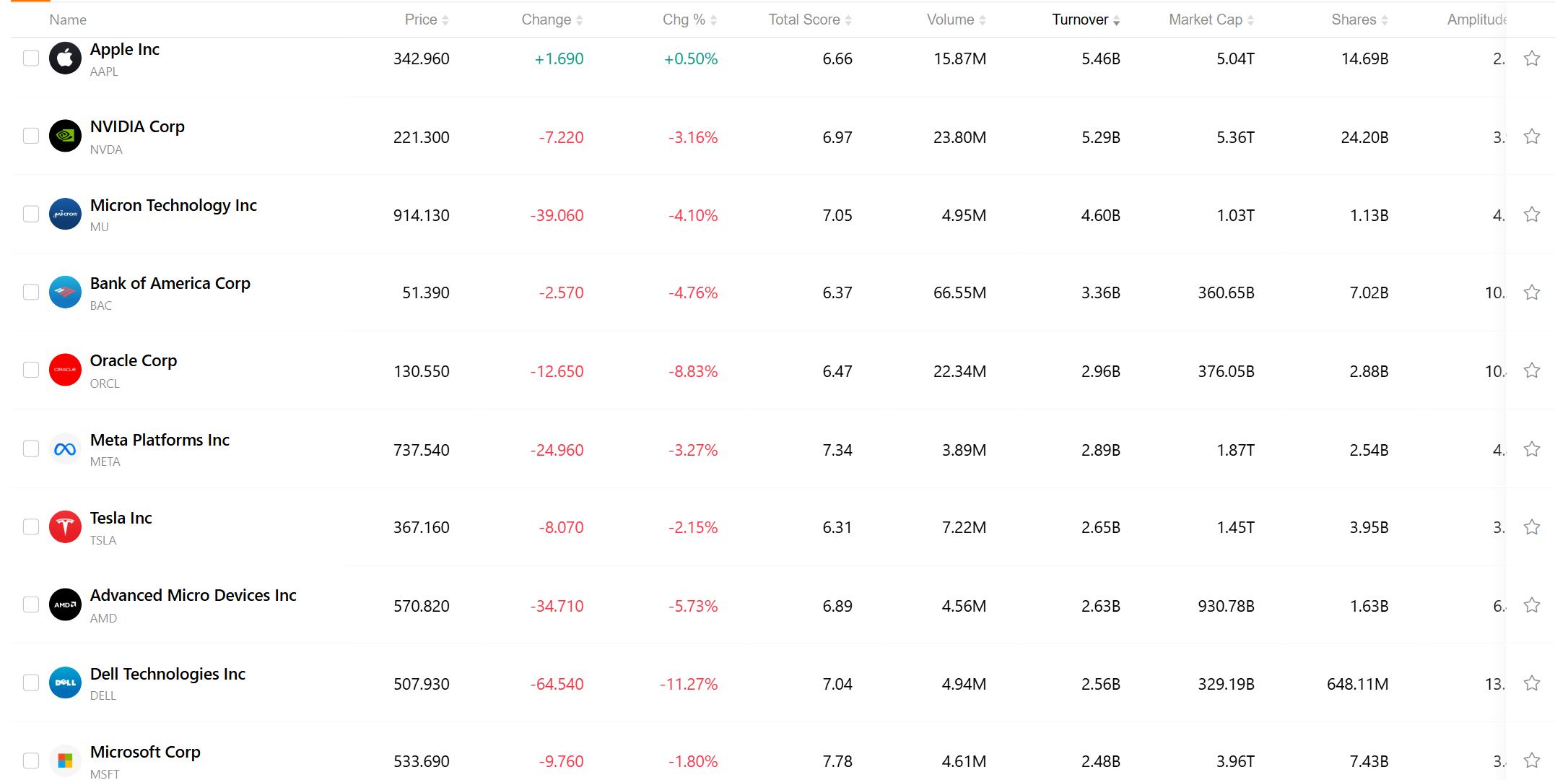
Among individual stocks, Oracle (ORCL) plunged 8.82% to $130.57; Nvidia (NVDA) fell 3.16% to $221.3; Apple (AAPL) bucked the trend, rising 0.50%. Among memory stocks, SK Hynix (SKHY) fell 6.06%, SanDisk (SNDK) fell 5.33%, Seagate Technology (STX) fell 4.50%, Western Digital (WDC) fell 4.36%, and Micron Technology (MU) fell 4.08%.
In the crude oil market, the WTI November contract rose 1.01% to $95.09 per barrel, while the Brent December contract gained 0.35% to $106.06 per barrel. Oil prices were supported by the risk of attacks on ships in the Strait of Hormuz and the IEA’s data showing low inventories.
In the precious metals market, COMEX gold futures fell 1.46% to $4,121.90 per ounce; spot gold dropped 1.37% to $4,103.80, falling below the $4,100 level during the session; COMEX silver futures fell 6.20% to $55.70 per ounce, breaking below a key technical support level.
Bitcoin fell below $82,000, dropping nearly 2% over the past 24 hours.
Market Headline
U.S. CPI rose 3.7% year-over-year in September, while core CPI rose 2.6%, both exceeding expectations. The September CPI rose 0.6% month-over-month, in line with expectations, and 3.7% year-over-year, higher than the expected 3.6%; core CPI rose 0.3% month-over-month, higher than the expected 0.2%, and 2.6% year-over-year, higher than the expected 2.5%, marking the fastest pace of growth in five months for both. Within core inflation, service prices saw a sharp jump; as this component is more sticky, it suggests that price pressures cannot be entirely attributed to energy volatility. Following the release of the data, the U.S. Dollar Index rose by about 30 points in the short term, while gold prices fell by about $30.
Bank of America’s Q3 Earnings Miss: $1.2 Billion Fine, Two Major Trading Segments Underperform. Bank of America reported third-quarter revenue of $29.96 billion, 2.6% below market expectations, and adjusted EPS of $1.08, lower than the expected $1.10; even excluding the impact of a $0.17-per-share fine, earnings still fell 1.8% short of expectations. The Treasury Department had issued a fine of over $1.2 billion the previous day for anti-money laundering violations, involving the failure to promptly report $5 billion in suspicious transactions. Fixed-income trading revenue fell 17% year-over-year to $2.55 billion, while equity trading, despite a 10% increase, still fell short of expectations; the stock closed down nearly 4.8%.
Morgan Stanley’s third-quarter net revenue of $20.34 billion exceeded expectations. The bank’s third-quarter net revenue rose 12% year-over-year to $19.89 billion, surpassing the expected $19.89 billion. Net income was $4.909 billion, or $3.03 per share, and the return on tangible equity of 22.6% also exceeded expectations. The institutional securities business was the standout segment, with net revenue rising from $8.523 billion in the same period last year to $10.02 billion, and equity trading revenue surging 41%. Chairman and CEO Ted Pick said wealth management posted record revenue.
CoreWeave suffered losses across both stocks and bonds, with its bonds falling into distress territory. This AI cloud stock plummeted more than 15% on Wednesday—marking its third-largest single-day decline on record—while the yield on its bond maturing in 2032 surpassed 15%. CEO Intrator issued an internal memo attributing the plunge to “irrational” market behavior, stating that the backlog of orders was sufficient to cover debt obligations; D.A. Davidson analyst Luria, however, warned that if the company were unable to repay its high-cost debt, the equity value would drop to zero.
Trump Announced GlobalFoundries and Alaska LNG Investment Plans; Japan and South Korea to Provide Funding. U.S. President Trump announced that GlobalFoundries will invest $21 billion in Malta, New York, to build two large-scale semiconductor manufacturing facilities, with funding to be provided by Japan under a previously reached trade agreement. The project is expected to create 27,000 construction and supply chain jobs, as well as more than 1,000 high-skilled manufacturing jobs. Trump also announced that the U.S. government will acquire a stake in GlobalFoundries, and the Department of Commerce will provide an additional $955 million in investment for silicon photonics, silicon germanium, and advanced packaging, bringing the cumulative investment to $1.63 billion. The value of the government’s current stake is reportedly over $2 billion.
Netflix is cutting approximately 6% of its global workforce. According to The Wall Street Journal, Netflix is cutting approximately 6% of its global workforce, affecting about 1,000 jobs. This is the company’s largest round of layoffs since 2022, driven by slowing growth and declining user engagement. Co-CEOs Greg Peters and Ted Sarandos stated in an email to employees that the layoffs primarily affect the company’s product, technology, legal, and human resources teams. According to Antenna data, Netflix’s churn rate in the U.S. is just over 2%, far lower than that of other companies in the industry.
Top 10 Most Traded Stocks
The table below lists the ten most actively traded stocks in the latest market. Supported by massive trading volumes and exceptional liquidity, these assets have become key benchmarks for tracking global market dynamics.
Find out more
Comments