TradingKey - Micron Technology (NASDAQ: MU) is delivering some of the strongest financial results in the semiconductor industry, supported by higher memory prices and surging demand from artificial-intelligence data centers. Its fiscal fourth-quarter revenue more than quadrupled from a year earlier, and management expects another record year in fiscal 2027.
Yet strong earnings have not eliminated the stock's near-term challenges. With MU trading around $929 on the supplied four-hour chart, the recovery is confronting resistance between $960 and $977. The next move will depend on whether buyers can reclaim that zone while memory prices and profit margins remain elevated.
Why Are Micron's Latest Earnings So Strong?
Micron reported fiscal fourth-quarter revenue of $54.23 billion, up from $11.32 billion a year earlier, an increase of roughly 379%. The result exceeded the $51.07 billion analyst consensus reported by Reuters. Non-GAAP diluted earnings reached $33.42 per share against expectations of $31.61, while GAAP net income rose to $37.70 billion.
Full-year fiscal 2026 revenue reached $133.19 billion, compared with $37.38 billion in fiscal 2025. Adjusted free cash flow totaled $62.31 billion. These numbers reflect not simply higher shipment volumes but an unusually favorable pricing environment across the memory market.
For investors, that distinction matters. Micron's earnings are benefiting from both the structural expansion of AI computing and a cyclical supply shortage. The former may support demand for years; the latter can reverse when capacity catches up.
Can Micron Sustain Growth Into Fiscal 2027?
Management guided for fiscal first-quarter 2027 revenue of $61.5 billion, plus or minus $1.5 billion, above the $57.02 billion analyst estimate cited by Reuters. Micron also forecast non-GAAP diluted EPS of $38.15, plus or minus $1.00, and an adjusted gross margin near 86.25%.
These are exceptional forecasts for a historically cyclical chipmaker. Chief Financial Officer Mark Murphy has indicated that revenue could rise sequentially through fiscal 2027, pointing to sustained demand and constrained supply.
My concern is less about near-term orders than about expectations. With margins already so high, even a modest change in pricing or product mix could disappoint investors accustomed to substantial earnings beats. The durability of the forecast is more important than the size of the latest quarterly gain.
How Does HBM4 Strengthen Micron's AI Position?
High-bandwidth memory, or HBM, is essential to advanced AI accelerators because it transfers large volumes of data between processors and memory at high speed. Micron says its HBM4 products are in high-volume shipment for a lead customer's platform, with qualification samples delivered to additional customers.
Development of HBM4E is also underway, with volume production planned for calendar 2027. Beyond HBM, Micron is benefiting from demand for conventional server DRAM and data-center storage. That broader exposure makes the AI investment case more resilient than one tied to a single chip generation.
HBM still introduces execution risks. Manufacturing complexity, product yields and qualification schedules can affect how much of the opportunity translates into profitable sales.
What Does Micron's $150 Billion Backlog Mean?
Reuters reported approximately $150 billion of remaining performance obligations under Micron's strategic customer contracts, up from about $100 billion in the prior quarter. Separately, customer financial commitments under long-term supply agreements rose to roughly $32 billion from $22 billion.
The two figures should not be conflated. Remaining performance obligations refer to revenue expected from contracted arrangements as the company performs, while customer financial commitments represent a different measure of support for those agreements. Neither should be treated as cash already earned or revenue guaranteed in a particular quarter.
The scale of these commitments nevertheless suggests that major customers are willing to make longer-term arrangements to secure memory supply, an important change for a sector traditionally dominated by shorter pricing cycles.
Will New Manufacturing Capacity Limit Memory Prices?
Micron is expanding manufacturing and supply-chain investment, including U.S. projects intended to support advanced memory production. The spending may improve its competitive position, but new facilities require substantial capital and do not immediately relieve shortages.
The company has indicated that initial wafer output from additional capacity could begin in mid-2027, followed by a gradual ramp. Until new capacity becomes productive, AI-related demand and the allocation of DRAM wafers to HBM may continue to support conventional memory prices.
Over a longer horizon, Samsung Electronics, SK Hynix and China's CXMT remain meaningful competitive threats. A synchronized increase in industry supply would challenge the unusually high margins embedded in current forecasts.
Is MU Stock Still Attractive After Its 2026 Rally?
Micron's financial position and near-term earnings outlook support a constructive fundamental view. The company's record cash generation gives it flexibility to invest in technology and manufacturing without relying exclusively on external financing.
That does not automatically make the shares inexpensive. A stock can deliver remarkable earnings growth and still weaken if investors begin discounting lower future memory prices. I would watch DRAM contract pricing, HBM4 shipment progress, customer commitments and gross-margin guidance more closely than any single quarterly earnings surprise.
Micron Technical Analysis: Can MU Break Above $977?
MU is trading near $929.16 on the supplied four-hour chart after rebounding from support around $850. What catches my attention is the speed of the recovery, although price remains below the two plotted moving averages and the descending trendline drawn from September's high. The broader chart structure therefore remains cautious despite improving momentum.
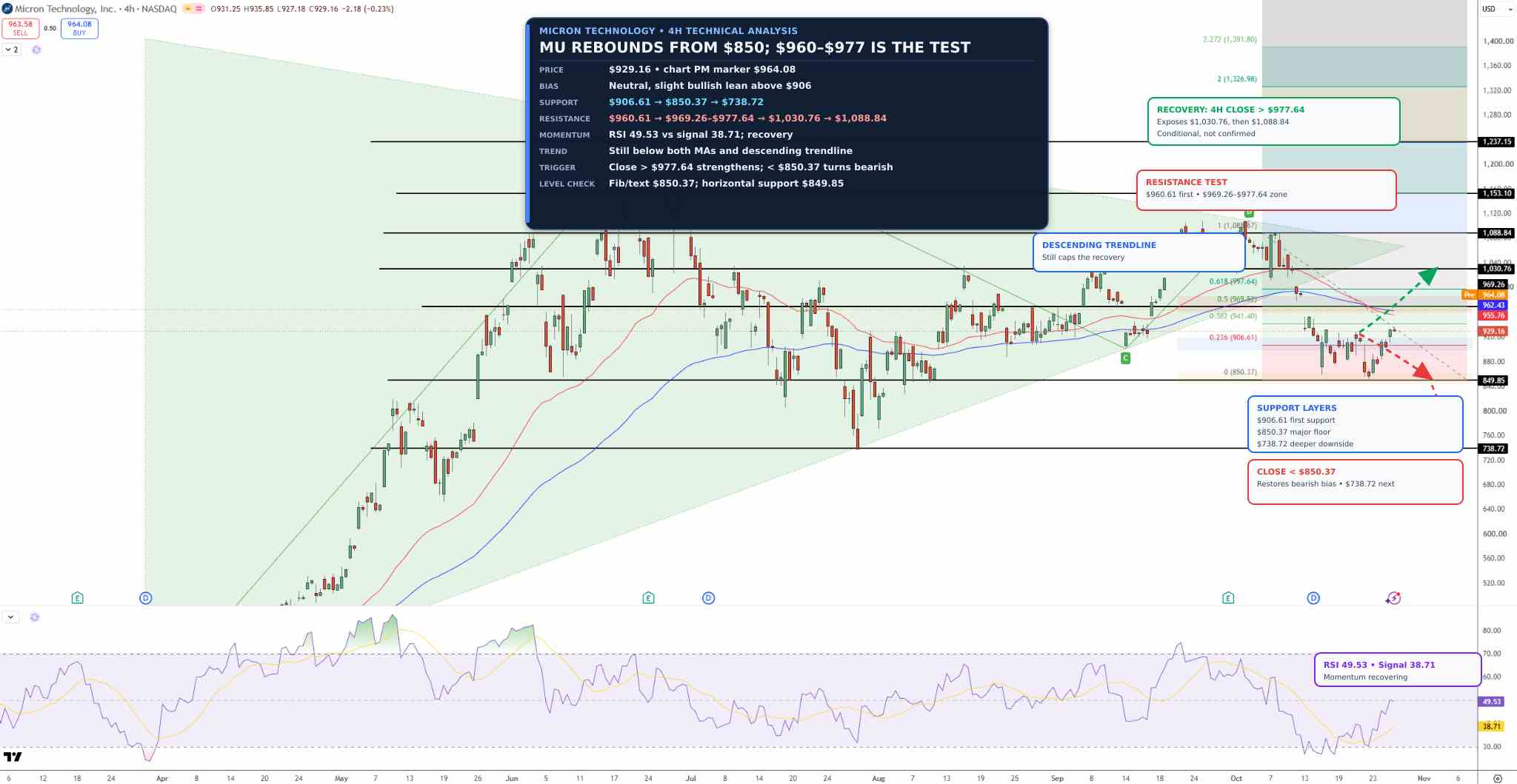
Micron Stock Price Chart - Source: Tradingview
The first resistance is $960.61, followed by a tighter band between $969.26 and $977.64. A sustained four-hour break above that zone would strengthen the recovery and open the way toward $1,030.76 and then $1,088.84. Immediate support stands at $906.61, followed by $850.37. A break beneath $850 would bring $738.72 back into focus.
RSI is near 50, above its plotted signal line around 39, suggesting momentum has improved from oversold conditions. My bias is neutral with a slight bullish lean while MU holds above $906. A sustained move above $977 would make the upside case more convincing, while a loss of $850 would turn the setup bearish.
MU Stock Forecast: Key Levels to Watch
- $960.61: First resistance on the recovery.
- $969.26–$977.64: Breakout zone that must be cleared for stronger upside confirmation.
- $1,030.76 / $1,088.84: Higher upside targets after a confirmed breakout.
- $906.61: Immediate support and near-term bullish threshold.
- $850.37: Major support; a break would undermine the rebound.
- $738.72: Deeper downside level if the broader downtrend resumes.
Frequently Asked Questions
Why is Micron stock attracting investors in 2026?
Micron has reported record revenue and profits as AI infrastructure investment increases demand for advanced memory and data-center storage. Tight industry supply has also lifted pricing and margins.
What is the near-term MU stock forecast?
The technical outlook is cautiously improving above $906.61, but MU needs to clear $960.61 and then $977.64 to confirm a stronger recovery. A failure near resistance and a move below $850.37 would revive downside risks. These are conditional chart levels, not guaranteed targets.
Bottom Line
Micron has the earnings momentum, cash generation and AI product pipeline to support further long-term growth. Its greatest risk is that investors are extrapolating today's exceptional memory prices and margins too far into the future.
I remain fundamentally constructive, but the chart calls for patience. A sustained break above $977 would strengthen the near-term bullish case. Until then, $906 and $850 are the levels I would watch for evidence that the rebound is failing.
Find out more
Comments