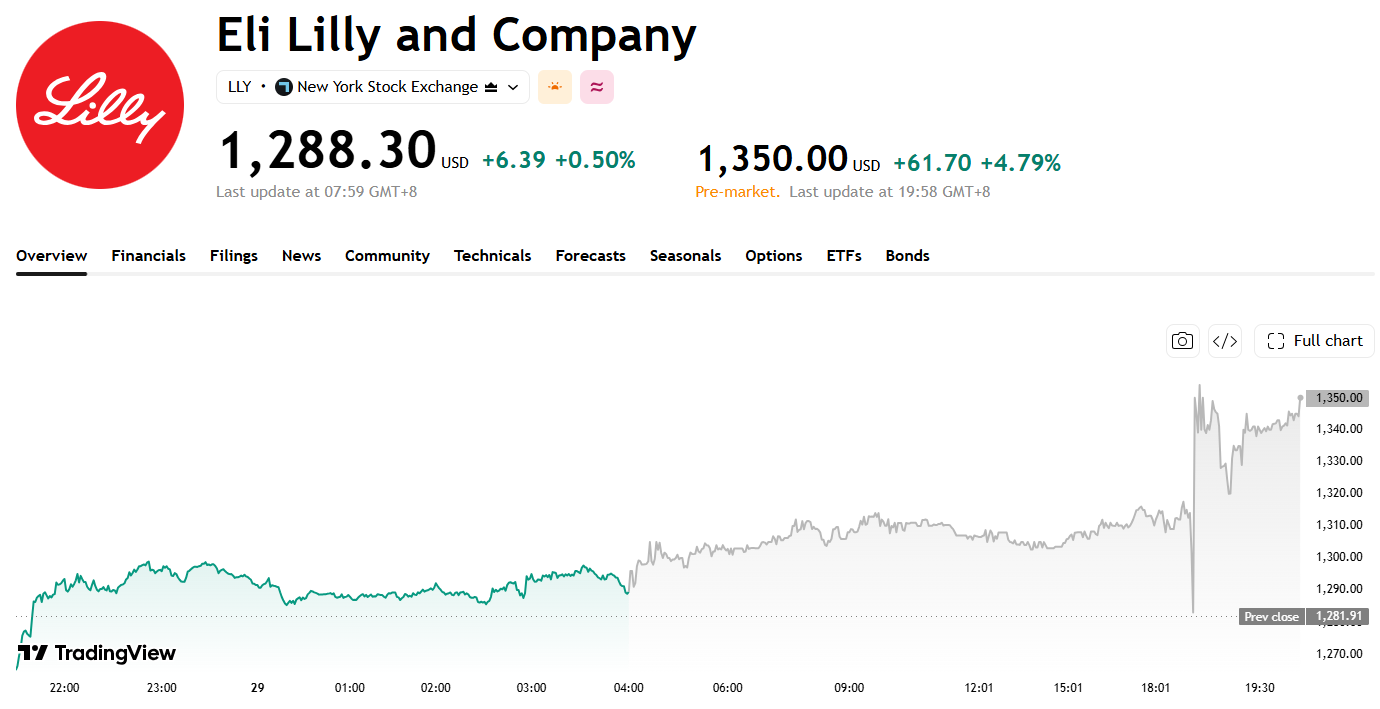
TradingKey - On October 29, Eli Lilly (LLY) reported better-than-expected third-quarter results and raised its full-year revenue outlook once again. Driven by continued growth in demand for Mounjaro and Zepbound, the company's quarterly revenue reached $24.397 billion, up 39% year-over-year, significantly higher than Wall Street's forecast of approximately $22.6 billion. Following the news, Eli Lilly's stock rose over 5% pre-market at one point.
Source: TradingView
Eli Lilly's third-quarter net profit was $6.451 billion, up 16% year-over-year; adjusted earnings per share reached $7.48, up 7% year-over-year, also beating analysts' expectations. Although realized drug prices in the U.S. market declined, rapid growth in prescription volume offset price pressures, indicating that Eli Lilly's lead in the diabetes and weight-loss drug markets continues to expand.
Global sales of core product Mounjaro rose 65% this quarter to $10.72 billion, with revenue outside the U.S. jumping 93%. Sales of the weight-loss drug Zepbound grew 49% year-over-year to $5.35 billion, with the two drugs combined accounting for about two-thirds of Eli Lilly's quarterly revenue. The strong volume performance not only reflects that demand for GLP-1 drugs remains in an expansion phase, but also demonstrates that Eli Lilly continues to hold an advantage in its rivalry with Novo Nordisk for weight-loss market share.
By regional performance, Eli Lilly's U.S. market revenue grew 34% year-over-year to $15.1 billion, with product volume up 41% but realized prices down 7%; overseas revenue grew 47% to $9.3 billion, with volume surging 76%, partially offsetting a 29% price decline. The volume and price dynamics indicate that price cuts and expanded insurance coverage are improving drug accessibility and driving more patients to initiate treatment.
Expanding coverage in the U.S. obesity treatment market also presents new growth opportunities for Eli Lilly. U.S. Medicare programs have begun expanding coverage for certain GLP-1 weight-loss treatments through temporary pilot arrangements, which is expected to lower the barrier to medication for some patients. As more patients gain access to these drugs, Eli Lilly may further expand its sales scale, though the exact contribution remains dependent on coverage scope, actual patient usage, and subsequent changes in payment policies.
In contrast to the strong performance of its injectable products, Eli Lilly's newly launched oral weight-loss drug Foundayo has yet to meet market expectations. Approved in the U.S. in April this year, the drug generated third-quarter sales of approximately $184 million, below analysts' estimate of about $229 million. As the oral GLP-1 drug market gradually heats up, Eli Lilly also faces competition from products by Novo Nordisk (NVO). Although Foundayo is still in its early commercialization stage, its sales progress will serve as an important indicator of whether Eli Lilly can expand its product portfolio and maintain its competitiveness in the weight-loss drug market.
Driven by strong demand for its injectable weight-loss and diabetes drugs, Eli Lilly significantly raised its full-year 2026 revenue guidance from the previous $85 billion–$87 billion to $91 billion–$92 billion, lifting the midpoint of the range by approximately $5.5 billion, well above original market expectations. The company expects full-year adjusted earnings per share to be $35 to $36, a slight downward revision from the prior range of $35.50 to $36.50, mainly due to increased expenses related to acquisitions, R&D investments, and drug pipeline expansion.
Find out more
Comments