TradingKey - U.S. stocks fell following the release of the U.S. October Producer Price Index (PPI). Although the month-over-month increase was lower than expected, the year-over-year gain still reached a nearly four-year high. Coupled with hawkish remarks from Federal Reserve officials, the market continued to assess the magnitude of a December interest rate hike and the likelihood of subsequent policy tightening.
As of press time, the Dow Jones Index fell 0.43% to 52,069.75; the Nasdaq Composite Index declined 1.82% to 24,903.84; and the S&P 500 Index dropped 1.16% to 7,504.66.
The Philadelphia Semiconductor Index fell over 5%, breaking below the 10,000-point mark. Among its components, AMD (AMD) plunged 9.45%, Broadcom (AVGO) fell 6.04%, Intel (INTC) dropped 6.03%, Micron Technology (MU) shed 4.61%, Nvidia (NVDA) dropped 3.88%, TSMC (TSM) fell 2.83%, and ASML (ASML) slipped 1.42%.
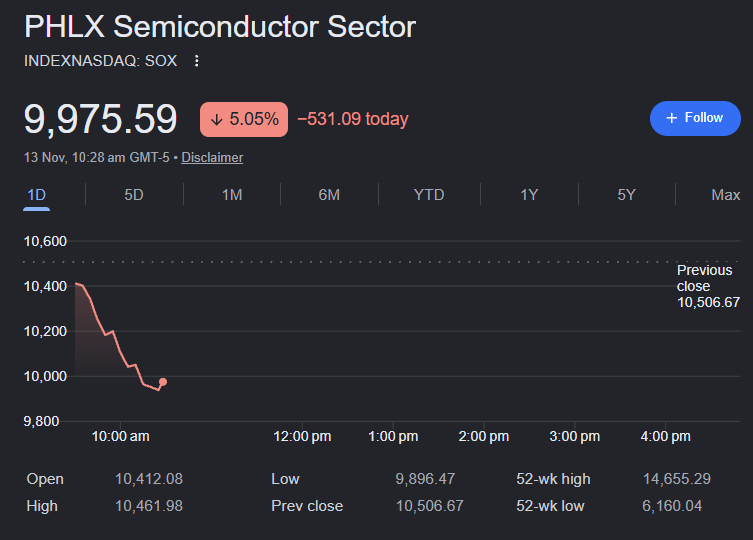
Philadelphia Semiconductor Index, Source: Google Finance
The U.S. Bureau of Labor Statistics reported Friday that the October PPI rose 0.3% month-over-month, below the market expectation of 0.4%, with the previous figure revised upward to 1.4%; it increased 6.5% year-over-year, up from 6.3% in September, marking the largest increase since November 2022.
Goods prices rose 0.5% during the month, primarily driven by increases in the prices of food and basic organic chemicals; services prices rose 0.2%, climbing for the fifth consecutive month. While the slowdown in month-over-month growth provided some signs of easing, the continuing acceleration in year-over-year inflation and persistent increases in service prices indicate that price pressures have not yet meaningfully abated.
Earlier, the October CPI rose more than expected, nonfarm payrolls surged significantly, and the unemployment rate fell from 4.2% to 4.1%. Together, these figures reinforced the view that the economy remains resilient and inflation requires further restraint, prompting the market to reassess between a 25-basis-point rate hike and a larger increase in December.
Boston Fed President Susan Collins stated on Friday that higher interest rates are sometimes needed to cool the economy and control inflation. While this increases the costs of purchasing and building homes, long-term price stability benefits the housing market and the broader economy.
Chicago Fed President Austan Goolsbee told CNBC that inflation is spreading to categories not driven by rising energy costs, and that demand from data centers is also driving up prices. He believes the Fed is not currently on track to achieve its 2% inflation target, and more aggressive policy action may be required if data continues to worsen.
For U.S. stocks, pressure stems from the possibility that high interest rates could persist for longer, or even continue to rise. Higher borrowing costs increase corporate interest expenses, while higher rate expectations also depress the valuations investors are willing to assign to future earnings. These two factors have an especially direct impact on companies reliant on external financing for expansion and on high-valuation growth stocks.
Find out more
Comments