TradingKey - On November 27, Eastern Time, chip stocks opened strongly before paring some gains. As of press time, SanDisk (SNDK) was up 10.51%, SK Hynix (SKHY) rose 4.08%, Micron Technology (MU) gained 3.99%, Qualcomm (QCOM) climbed 3.94%, Marvell Technology (MRVL) added 3.86%, and Intel (INTC) advanced 2.49%.
Notably, chip stocks had previously staged a sharp rally and retreat: the Philadelphia Semiconductor Index surged 14.03% on Monday to close at 9,588, but retreated a cumulative 8.5% over the next two trading sessions to finish Wednesday at 8,775. In just two days, nearly 70% of Monday's point gains were erased. For chip stock investors heading into 2027, what determines whether the sector can hold onto its gains will be whether chip orders and corporate earnings can weather the test of an economic slowdown.
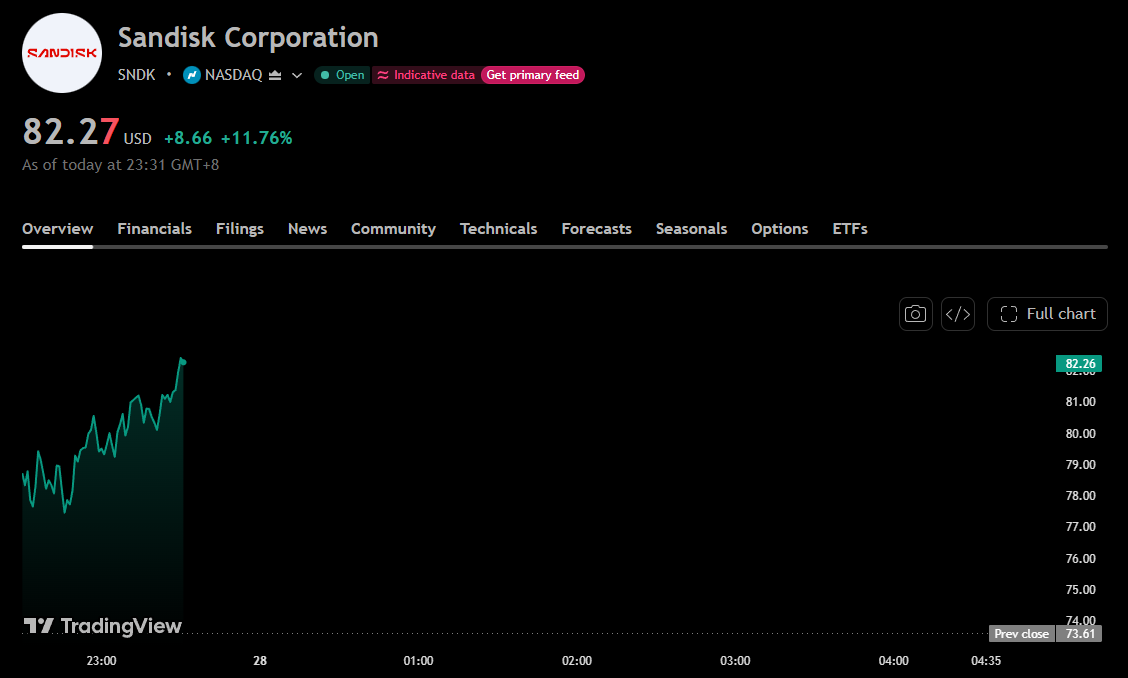
SanDisk stock price chart, Source: TradingView
Khuram Chaudhry, head of European quantitative strategy at JPMorgan, and his team noted from a market-cycle perspective that the recent sell-off in AI stocks may be nearing the end of its first phase, but the market could still experience a more prolonged downturn afterward.
JPMorgan's European quantitative strategy team pointed out that its global investor sentiment indicator has been as low as current levels only five times over the past 20 years, while corporate earnings expectations and purchasing managers' indexes have not deteriorated to the same degree. This gap leaves room for chip stocks to rebound: as long as orders and profits beat the pessimistic expectations priced in during the sell-off, share prices could recover first.
The risk is that while sentiment can improve quickly, changes in demand often take several quarters to be reflected in financial reports. JPMorgan noted that the ratio of U.S. manufacturing new orders to inventories has already peaked. If the economy slows in 2027 and customers prioritize inventory digestion, industrial and automotive chipmakers may be the first to see a slowdown in reorders.
For AI chips, the outlook hinges on another front: if interest rates stay high but cloud service providers remain willing to build data centers as planned, orders will remain supported; if rising financing costs force project delays, the pressure will extend to demand for GPUs, high-bandwidth memory, and advanced packaging.
For now, chip stocks meet the conditions for a rebound, but the Philadelphia Semiconductor Index has yet to hold onto the gains from Monday's surge. In the short term, investors can watch whether the index can reclaim Monday's close of 9,588 points once selling pressure eases, and whether the rally can broaden from a few AI leaders to memory, equipment, and analog chip stocks. Further out, if customers maintain orders and analysts stop cutting earnings estimates as stock prices recover, this rebound could evolve from fund repositioning into a fundamentally supported rally.
Find out more
Comments