TradingKey - Apple (NASDAQ: AAPL) rose $1.51, or 0.43%, to $355.58 on Wednesday, November 25, its third straight gain, after falling as much as 2.52% to $345.13 early in the session. That left the stock just 0.19% below its record close of $356.27 from November 13, going into today's shortened Black Friday session.
US markets reopen today, Friday, November 27, after Thanksgiving, with trading running from 14:30 to 18:00 GMT. The holiday weekend also starts the December quarter, which Apple expects to be the best revenue quarter in its history, so shoppers and traders are looking at the same thing.
Apple Has Held Up While AI Spenders Fell
Apple's steady climb stands in contrast to the rest of big tech this week. On Tuesday, it rose 1.43% to $354.07 while Nvidia fell 5.86% and the Nasdaq Composite lost about 1.5%. On Wednesday, the stock shook off an early drop as October PCE inflation came in at 3.8% and the Trump administration proposed new tariffs on 14 major trading partners, according to Fox Business.
Notice what did not happen, though. Hot inflation and tariff headlines that included a proposed 20% levy on China did not stop Apple from recovering a 2.52% early slide and closing higher. One likely reason is that Apple is not spending hundreds of billions on AI data centers at a time when the companies that are face rising borrowing costs.
Cash returns add to that appeal, since Apple returned $28 billion to shareholders in its fiscal fourth quarter, including $24 billion of share buybacks and $3.9 billion of dividends, and it pays a quarterly dividend of $0.27 a share. Buybacks reduce the number of shares, which lifts earnings per share even when profit growth slows.
The stock is now about 46% above its 52-week low of $243.42 and right under its intraday record of $360.83 from November 13.
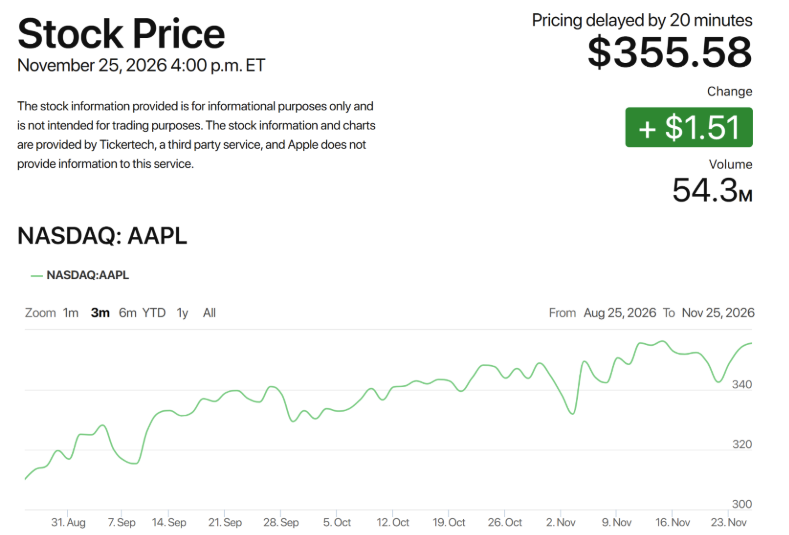
Source: Apple investor relations stock price page, close of November 25, 2026 (investor.apple.com)
A Record Year, but Memory Costs Are Hitting the Margin
Apple's fiscal fourth quarter, which ended in September, set a record for that quarter. Revenue rose 12% to $114.48 billion, above the $113.39 billion LSEG estimate, and EPS of $2.10 beat the $1.99 forecast, with about 5 cents coming from tariff refunds. iPhone revenue reached $57.58 billion and Mac revenue $10.79 billion, both above estimates. For the full fiscal year, revenue rose 15% to $478.8 billion and EPS rose 20% to $8.98.
China was weaker, with revenue of $17.54 billion missing the $18.58 billion Visible Alpha estimate, and for Services, Apple guided December-quarter growth to 8% to 9%, below the 10.7% analysts expected, according to Reuters.
The bigger concern is memory chips, since Apple guided its December-quarter gross margin, the share of sales left after production costs, to 45% to 46%, down from 47.9%, and CFO Kevan Parekh said memory costs are expected to keep rising into next year. COO Sabih Khan said Apple's purchase commitments rose $33 billion during the quarter as it works with memory suppliers. Shares fell as much as 4% during the earnings call before paring the loss.
The Holiday Quarter Starts Now
For the December quarter, Apple expects revenue to grow 7% to 10% from a year earlier and called it likely "the best quarter for revenue in the history of the company," according to MacRumors. That makes Black Friday and Cyber Monday the first real test of the guide, with the full results expected in late January.
Supply is the open question for that guide, because CEO John Ternus, who succeeded Tim Cook on September 1, said "Duo is constrained as of today," referring to the new iPhone Duo, and that Apple cannot yet predict when supply will catch up with demand. At $355.58, Apple trades at about 39.6 times its fiscal 2026 EPS, by my calculation, so a holiday quarter that falls short would leave little room at this price.
Apple Technical Analysis: 4-Hour Close Above $360.92 Could Open $372.26
The 4-hour chart shows how steadily AAPL has climbed since July, with every pullback holding above the rising trendline, a line drawn under its higher lows. Buyers defended the blue moving average, which tracks the average price over recent candles, at $342.03 again this week. That lifted AAPL back above the $348.07 pivot and the red moving average at $347.99.
RSI, a gauge of buying and selling strength that runs from 0 to 100, has risen to about 59, above its signal line. The MACD, another momentum indicator, has also crossed bullish, a sign that momentum is turning back toward buyers.
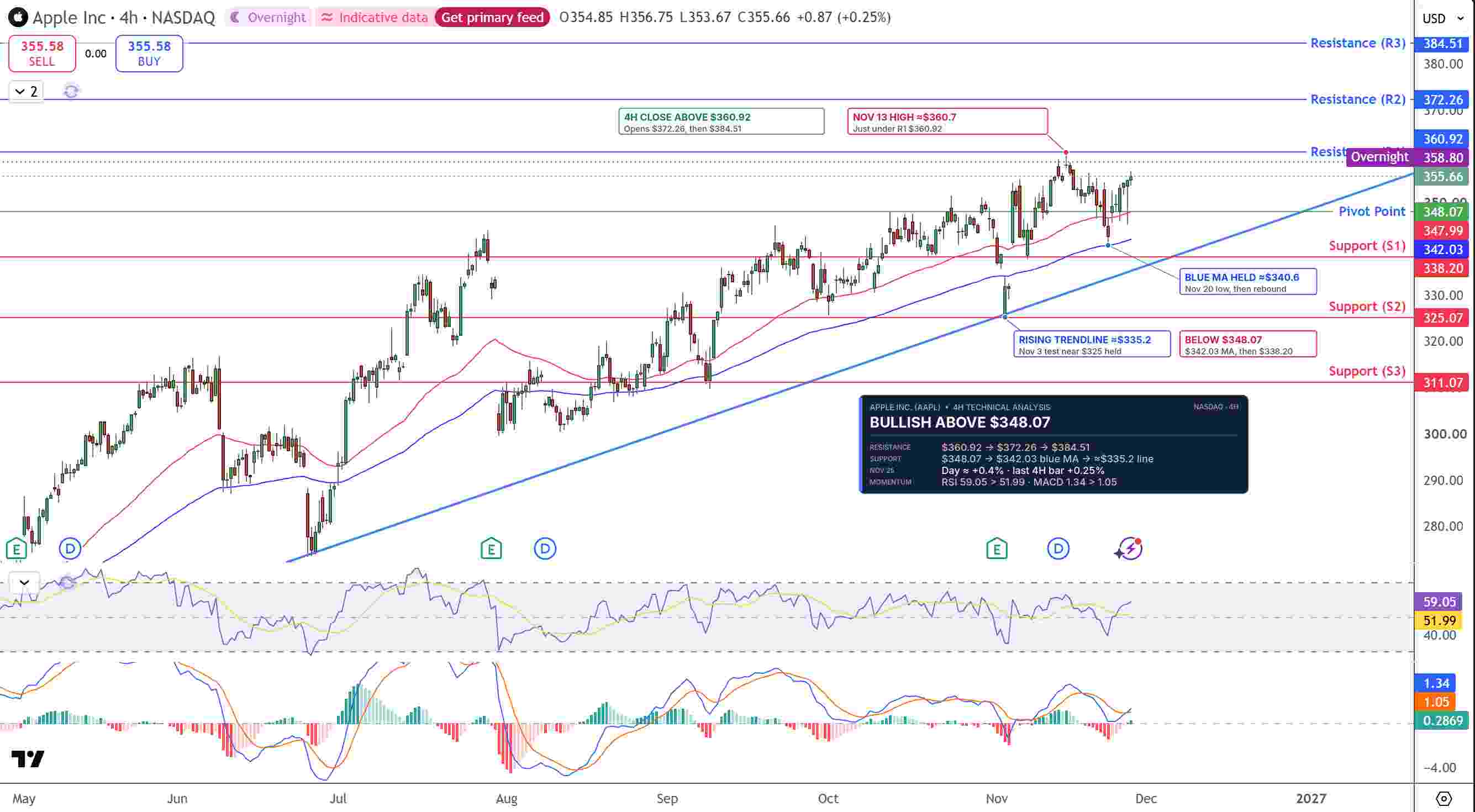
AAPL Price Chart - Source: Tradingview
The key hurdle is $360.92, near the November 13 high. A 4-hour close above it could open $372.26, followed by $384.51. On the downside, a 4-hour close below $348.07 could send AAPL toward $338.20, with $325.07 below that.
I'm bullish while AAPL holds above $348.07, and $360.92 is the breakout level to watch.
Key Levels
- Last close: $355.58, up 0.43% on Wednesday, November 25 (overnight: $358.80)
- Support: $348.07, $347.99, $342.03, $338.20, $325.07
- Resistance: $360.92, $372.26, $384.51
- RSI: 59.05
- Bullish trigger: 4-hour close above $360.92
- Bearish trigger: 4-hour close below $348.07
FAQs
Is Apple stock near a record high?
Yes. Apple closed at $355.58 on Wednesday, November 25, just 0.19% below its record close of $356.27 from November 13. Its intraday record is $360.83, set the same day, so any close above $356.27 would be a new closing high.
What is the Apple stock forecast now?
The bias is bullish while AAPL holds above $348.07. A 4-hour close above $360.92 could open $372.26 and $384.51, while a 4-hour close below $348.07 could send the stock toward $338.20 and $325.07.
Bottom Line
Apple goes into Black Friday just below its record, helped by investors who prefer its lighter AI spending, but memory costs are already cutting its margin and iPhone Duo supply is tight. The level that matters is $360.92. In my view, a 4-hour close above it would open a new leg higher, while a 4-hour close below $348.07 would signal that the run toward the record has stalled.
Find out more
Comments