1) Valuation
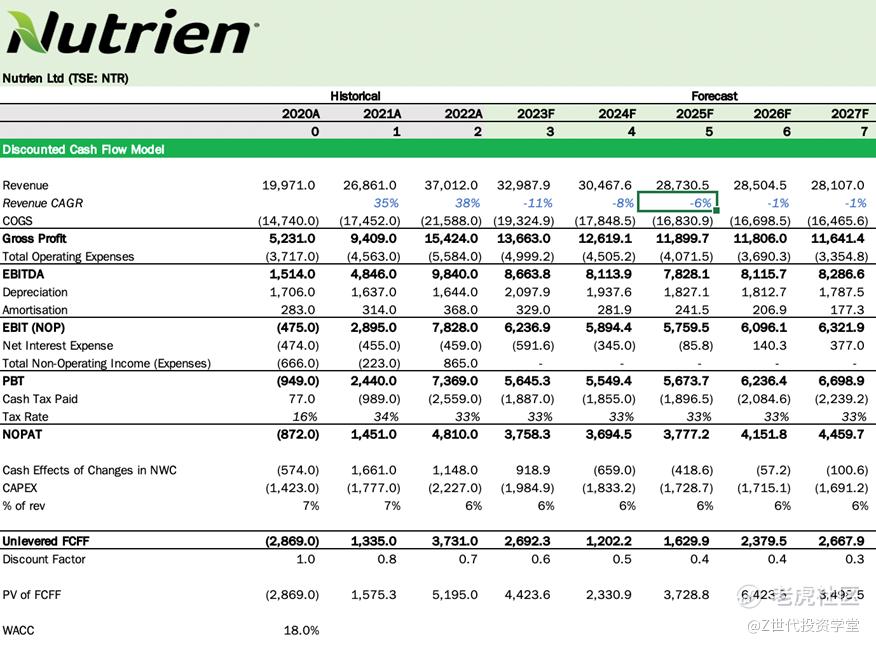
By doing a simple DCF analysis, we observed that the company is currently undervalued. Some assumptions taken in this analysis include:
WACC of 18%
Revenue projection based on the assumption that Nutrien can keep its market share amidst the growing Agriculture industry
Perpetuity growth of 1.83%
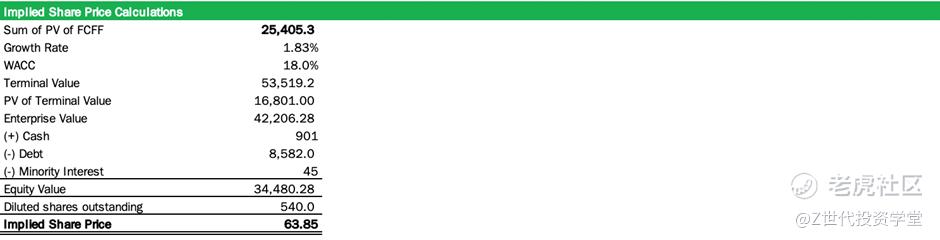
The analysis led us to the implied share price of US$ 63.85/share, which represents +8.48% of the current share price of US$ 58.87/share.
Prices for corn, soybeans, and wheat have recently declined as a result of seasonal pressure brought on by expectations of increased crop production in the US and Brazil. However, fresh crop futures are still around 15% above the 10-year average, and grower margins are still strong, giving farmers an incentive to make crop investments and increase production. Nutrien can expect increased global potash demand in the second half of 2023 as a result of lower expected inventories and improved grower affordability compared to 2022. Belarusian shipments will be down 25% to 40% this year and Russian shipments down 25% to 35% compared to 2021. These factors explains the lower performance for Nutrien in the near future.
2) Risks and Mitigation Strategies
Climate related risks (High): Physical risks from a changing climate can impact its operations, customers and supply chain. These include more intense weather events, longer droughts, rising sea levels, and changes in average temperature and precipitation patterns. Global decarbonization ambitions and the resulting energy transition are driving carbon regulations and informing capital allocation priorities of investors. Nutrien faces evolving transition risks related to potential regulatory changes, including carbon pricing.
Mitigating strategies:
Physical risks: Nutrien currently have its weather analytics system in place which uses atmospheric science to provide new perspectives for growers and crop consultants to better manage weather risks. Its whole-acre solutions and continued investment in technology have also helps improve s soil health, increase soil organic carbon sequestration, optimize nutrient-use efficiency, reduce GHG emissions, improve water quality and retain water while conserving and restoring biodiversity.
Transition risks: [MOU1] Minimisation of compliance costs through the implementation of various efficiency and emissions reduction projects, including cogeneration at Carseland, AB Nitrogen facility and at Cory, SK Potash mine and carbon capture, utilization and storage (“CCUS”). They supply CO2 from the Redwater, AB Nitrogen facility to the Alberta Carbon Trunk Line. They are currently also rolling out initiatives to N2O abatement technologies, energy efficiency improvements, expanding the use of CCUS technology, renewable energy options and low-carbon and clean ammonia development to reduce its scopes 1 and 2 operation emission intensity.
Volatility of the macroeconomic conditions: Trade tariffs, volatility in global markets, supply chain constraints, increased price competition, or a significant change in agriculture production or consumption trends could lead to a low crop price environment and reduced demand for our products or increased prices or decreased availability of raw materials used in making products. Geological and geopolitical events can result in disruptions to global supply, as was seen in 2022 with sanctions imposed on Belarus and Russia that limited the amount of potash shipments from these countries. In 2022, Nutrien estimated that Russian shipments were down approximately 30% and Belarussian shipments were down approximately 50% from 2021, constraining available supplies and resulting in shifting trade flow patterns.
Mitigating strategies: To cope with the potential supply shocks derived from the volatility of macroeconomic conditions, Nutrien’s low-cost, flexible operations are backed by a reliable supply chain. They are able to adjust their production plans by pulling forward some maintenance activities during downtimes which allowed them to preserve the flexibility to quickly ramp up production when demand re-emerge. The ability to respond timely to market demand at low cost is made possible through Nutrien’s flexible production capability. With that Nutrien has announced the ramping up of its annual operational capability to approximately 18 million tonnes in 2026.[MOU2]
3) ESG Assessment
In terms of its 2022 ESG ratings profile, Nutrien have outperformed its peer average across all esg ratings such as MSCI ESG ratings, S&P and Sustainalytics ESG risks ratings. Furthermore, as compared to its 2019 performance using the same metrics, they have improved across all ratings that have been considered which shows the improvement in its ESG efforts.
The company has announced to achieve at least a 30% reduction in its scopes 1 and 2 GHG emission intensity by 2023 from the baseline of 2018. In 2022, Nutrien’s scopes 1 and 2 emission intensity and absolute emissions have decreased in comparison with 2018 figures. Its scope 1 and 2 GHG intensity have reduced by 4% and 14% respectively. With regards to its scope 3 emissions, they have yet to conclude a reduction target but is currently working on its measurement with external advisors to establish a Scope 3 emissions data collection, quantification and reporting process.
According to its AR, its Nitrogen operating segment is the largest contributor to its overall GHG emissions. However, Nutrien is uniquely positioned well in the carbon space of the agriculture industry. They are vertically integrated from mine to farm which provided them with the ability to influence at different areas of the value chain. Given that they are one of the largest Nitrogen production company globally and the higher potency of nitrogen molecules, this calls for the need for Nutrien to manage its emissions effectively.
4) Conclusion
In the near future, the global agriculture commodities markets continue to be impacted by geopolitical and weather-related issues, such as Ukraine's considerable output and export reductions and Argentina's catastrophic drought conditions. Given Nutrien’s strategic and flexible production mine network, it can help them to cater to fluctuations in demand at a lower price which is more favourable as compared to its competitors. Increase in demand for potash over the years coupled with the reduced in supply of Potash suggests that Nutrien will be able to capture a larger market better than its peers.
*Do note that all of this is for information only and should not be taken as investment advice. If you should choose to invest in any of the stocks, you do so at your own risk.
If you want to learn about investment opportunities in cutting-edge technologies, learn investment secrets from real investment bosses, and invest in your own life, then come and buy the "Big Winner" comic! The comic interviews many professional investors and listed companies, conveying investment concepts through interesting stories. We believe that you will definitely gain something from reading it. https://product.dangdang.com/29564921.html#ddclick_reco_reco_relate
Comments