1. Introduction
Hershey’s. A company that I’m sure many of us already know. for some, this tasty treat transports us back to our childhood, while for others, it's a delight reserved for festive occasions. Allow me to dive deeper into this case to determine why this could be a sweet opportunity.
It all started in 1894 when Milton S Hershey chanced upon a chocolate processing machine at a convention. Taking a leap of faith, he sold his business, Lancaster Caramel Company, to venture into the manufacturing and sale of milk chocolate bars. Today, Hershey’s (NYSE: HSY) operates one of the largest and finest chocolate businesses in North America, boasting over 19,000 employees across 100 brand names. It dominates 45% of the chocolate segment in the US and generated $10 million in revenues in 2022. The company markets, sells, and distributes its products across 80 countries worldwide. Through acquisitions and new brand portfolios, Hershey has expanded its product offerings, catering to individuals of all ages. Some of its notable products include Dots Pretzels, Lily sweets, and the iconic Kit Kat chocolate under a licensed agreement with Nestle.
Michele Buck assumed the positions of Chairman of Board and CEO position in March 2017. At Hershey’s she served as Chief Operating Officer, President, and Chief Growth Officer. Prior to joining Hershey’s in 2005, Buck took on senior positions at Kraft and Frito Lay. With Buck’s extensive experience within the consumer-packaged goods industry, she accelerated the company’s growth by expanding into new snack offerings. She has proven herself to be the right person for the position, showcasing her strength in understanding consumer consumption patterns and shopping habits.
2. Business Overview
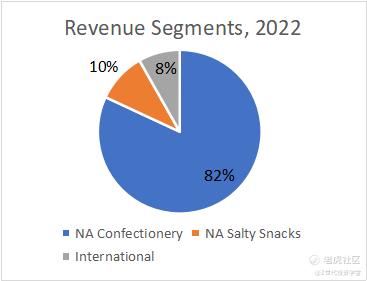
Over 55% of chocolate & candy bar consumers in the US indulge in Hershey’s. Beyond its traditional chocolate and candies, the company has diversified its portfolio to cater to more snacking occasions. The company revenue is mainly from three segments:
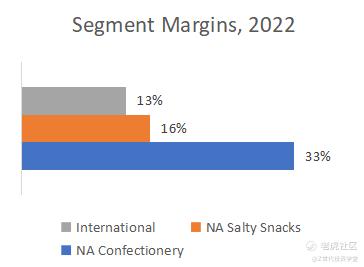
(1) North America Confectionary – Business in chocolate and non-chocolate confectionery, gum and refreshment products, protein bars, spreads, snack bites and mixes, as well as pantry and food service lines. Renowned brands such as Hershey’s, Reese’s, Kisses, and Twizzlers fall under this category.
(2) North America Salty Snacks – Ready to eat popcorn, baked and trans fat free snacks, pretzels and more. Great brands acquired such as SkinnyPop, Pirate’s Booty and Dot’s. Retail sales 3 Year CAGR for the salty snacks segment grew 10.6%. This growth was supported by Ready-to-Eat Popcorn and Pretzels, which grew by 11.4% and 11.5%, respectively.
(3) International – Sell the same brands and other segments that are not individually material outside of North America
Hershey’s Product Portfolio – Sweet and Savoury
The business is mainly involved in 5 major product segments:
(1) Chocolate: This includes the iconic classics such as the Hershey’s® bar, Hershey’s® with almonds, Special Dark and Kisses.
(2) Reese’s: Peanut butter meets Hershey’s chocolate, comes in cups, pieces and sticks
(3) Candy: Mints and chewing gum from brands such as Jolly Rancher and Breath Savers. Caramel and toffee delights such as Werther’s Original. Other candies like gummies, Twizzlers.
(4) Snacks: Started recently in late 2017, includes salty munchies such as SkinnyPop and other indulgences like the barkTHINS and REBA protein bars.
(5) Better-for-You Focus: As consumers become more health conscious, Hershey’s started this segment to include snacks that are organic, plant-based or reduced in sugar. An example is the acquisition of Lily’s in 2021 bringing in no added sugar chocolate bars and stevia sweetened gummies.

Images from: Hershey’s Investor Day 2023
Financial Results
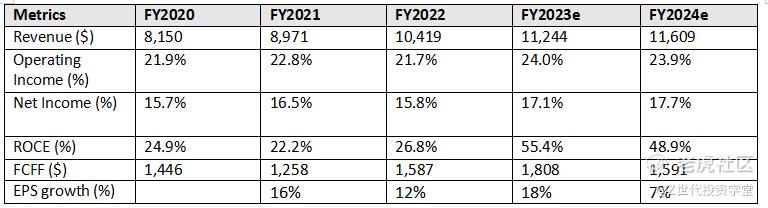
Business Model – Leading Snacking Powerhouse
Aspiring to be a leader in the snacking industry, Hershey’s is broadening its participation by innovating consumer-centric products and expanding the boundaries of its core confection brands to capture new snacking categories through acquisitions, such as Dot’s Pretzels. A prime example of this strategy is the Reese’s Camel Big Cup, which was released in November of this year. This innovation is coupled with augmented reality and image recognition to gather data, boosting future sales.
The image recognition technology identifies the merchandise and the exact in-store location of the display. This capability allows Hershey’s to track and collect data, helping them make better decisions regarding the placement and ways to improve their future products.
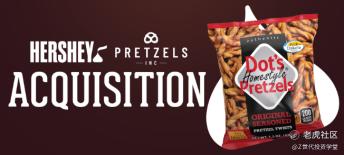

Images from: Hershey’s
Hershey’s distributes its products to customers both online and in-store. In the disruptive retail world, the consumer shopping experience has influenced the company to adopt a commerce strategy, addressing the space as an ecosystem with the consumer at the center of every decision. The company operates eight Hershey’s Chocolate World Stores (in the US and one in Singapore) and distributes its products to customers who run chain grocery stores, merchandisers, wholesale clubs, and wholesale distributors. These customers typically resell the products to end customers in retail outlets. In 2022, 28% of their net sales were made to McLane Company (a wholesale supply chain services company and a primary distributor to Walmart Stores Inc).
Images from: Hershey’s Website
More recently, Hershey’s has adopted an omnichannel strategy, which has grown to constitute over 5% of its business today. With slowed growth in the merchandising sector due to a retail partner pivoting to its eCommerce initiatives announced in the recent quarter (Q3 2023), Hershey’s direction through omnichannel and digital business is expected to place them in an advantageous position, enabling growth in the long run.
In addition to having an efficient product distribution channel, Hershey’s unique occasion-based marketing and innovation have played a vital role in driving strong brand equity. Focused on creating emotional connections with consumers and ensuring product quality, Hershey creates market campaigns associated with the feelings of togetherness and memorable moments. These pop-up events and brand experiences help Hershey stay on top of the minds of consumers, encouraging repeated purchases and driving brand equity.
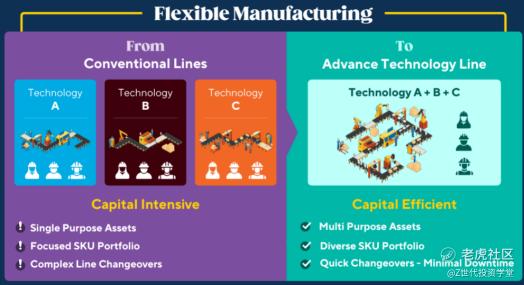
The company views the supply chain as a growth enabler instead of a cost center. Today, Hershey’s operates 16 chocolate plants, mostly in the US, with other locations in Brazil, Canada, Mexico, etc. Constant upgrading of Hershey’s supply chain capabilities is crucial for efficiency and margin expansion. The team invests in advanced technology, eliminating bottlenecks and complexity through modularity, which reduces the time for changeovers and cleanings between product runs. Kit Kat was a prime example where they found opportunities in schedule and item changes, bringing in an additional $35 million in capacity. Additionally, investing in automation has eliminated Payday capacity growth by over 25%, constituting about 1/5 of their overall retail sales growth last year.
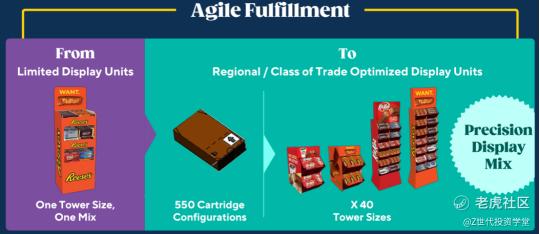
Agile fulfillment is another approach used by Hershey’s to bring brands together onto one display unit, allowing precision merchandising. This strategic approach provides better distribution based on the consumer’s preferences for different products (e.g., Texas preferring Payday over York). This reduces waste and increases sell-through.
Images from: Hershey’s Investor Day 2023
Value Chain
Annually, Hershey’s sells 3 billion of its iconic chocolate bars. The product mainly uses 2 ingredients; 70% cocoa and 30% sugar.
1. Extraction of Raw Ingredients
Hershey’s sources its cocoa beans from Theobroma Cacao, mainly found in the central and southern parts of America, West Africa, and Asia. A kilogram of quality cacao beans costs approximately $3.50, and 2.3 kilograms of sugar cost around $4 (purchased from US suppliers). In recent years, Hershey’s removed PGPR and vanillin from their ingredient list and replaced them with natural vanilla, which is more expensive.
2. Manufacturing process
After the ripened beans are transported to the plants, they are processed into cocoa butter and chocolate. The beans undergo cleaning, winnowing, and crushing to form liquid cocoa butter. This process concludes with conching, which involves rotating the chocolate to remove its bitter taste and mold it. The full cost of farmer operations is approximately $25 per kilogram, inclusive of packaging, labor, and facilities.
3. Purchase
Final product transported to distributors and retailers for sale.

The entire process would cost Hershey’s approximately $1.39 for a 50g Hershey’s chocolate bar (ignoring the ability for scale, which would bring down costs drastically – quick research suggests it costs around $0.15 to make a 50g chocolate bar). Based on these numbers, it seems like the majority of the costs are coming from the plant facility. With 7 out of 16 plants located in the US and Pennsylvania being the largest factory, electricity and labor costs are a concern for Hershey’s.
Economic Moat
(1) Cost advantage
Having a large scale in production and a strong distribution network, Hershey’s benefits from negotiating better terms to increase volume and margins. The company would be able to replicate competitive products and ultimately offer it to retailers at a lower cost compared to its smaller peers. Limiting its competitors and new entrants shelf space. Operating income margins in 2022 21.7% and expected to be 24% in 2023.
(2) Intangible assets – Branding
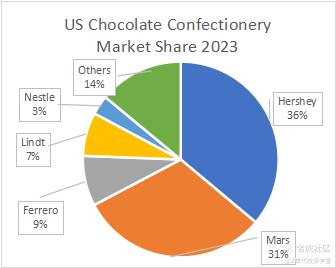
Hershey’s dominates the US chocolate confectionery industry, accounting for over 45% compared to Mars' approximately 30%. Over the years, Hershey’s has continued to strengthen its market-leading position. Since 2018, Hershey’s market share has grown from 32.4% to 36.1%, while Mars lost market share from 28% to 27.1% in 2021 before gradually regaining market share to 31.2% this year.

Comments