Porter's Five Forces
Competition Within The Industry - High
With numerous large players and low switching costs, the competitive rivalry in the waste management/garbage industry is high.
Bargaining Power Of Buyers - Moderate
While individual customers may have limited bargaining power, larger commercial and municipal customers can negotiate contracts and prices based on volume. However, switching costs for customers can be high due to the specialised nature of waste management services. Thus, the bargaining power of buyers is moderate.
Bargaining Power Of Suppliers - Moderate
Suppliers providing necessary equipment and supplies to waste management companies establish substantial bargaining power due to their direct impact on the company’s operations. However, due to the dominant market position and wide geographical coverage by WM, suppliers’ bargaining power is moderate as the company does not procure from a single supplier and could negotiate favourable terms.
Threat Of New Entrants - low
The waste management industry needs a significant capital investment in equipment, facilities (e.g. landfill) while meeting stringent environmental regulatory requirements. As such, the threat of new entrants who could not achieve economies of scale would be low.
Threat Of Substitutes - Low
Waste management services are essential for maintaining public health and environmental sustainability. There are few viable substitutes for waste collection, recycling, and disposal services. Thus, the threat of substitutes remains low.
Economic Moat
WM adopts a resilient business model and benefits from a wide economic moat established through intangible assets and cost advantage.
Cost Advantage
WM benefits from economies of scale and operational efficiency derived from its wide customer base and extensive network of infrastructures. As one of the largest waste service providers in the U.S., WM is able to spread fixed costs over a larger volume of waste handle and lower its average cost per unit of service, making it difficult for smaller competitors to compete based on price. Additionally, economies of scale enable WM to invest in advanced technology, innovation, and sustainable practices, further enhancing its competitive advantage.
Intangible Asset
The waste management industry is heavily regulated, requiring companies to comply with environmental, health, and safety regulations at local, municipal, state, and federal levels. WM has been consistently compliant with these regulations for its landfill operations and its expertise in navigating complex regulatory environments create a significant barrier to entry for new competitors. These stringent regulatory requirements may also pose challenges for existing competitors (and impact their operations), further solidifying WM's market position.
Financial Performance
WM has consistently delivered strong financials, including high ROE and low volatility, making it a solid long term investment.
Profitability Analysis

In the last five years, WM has shown a positive trend in revenue growth, rising by 32.16% from $15,455.0 million in 2019 to $20,693.0 million in the trailing twelve months ending in March 2024. In comparison to its industry peers, WM has also performed well both in terms of absolute and relative revenue performance.
Return on Assets
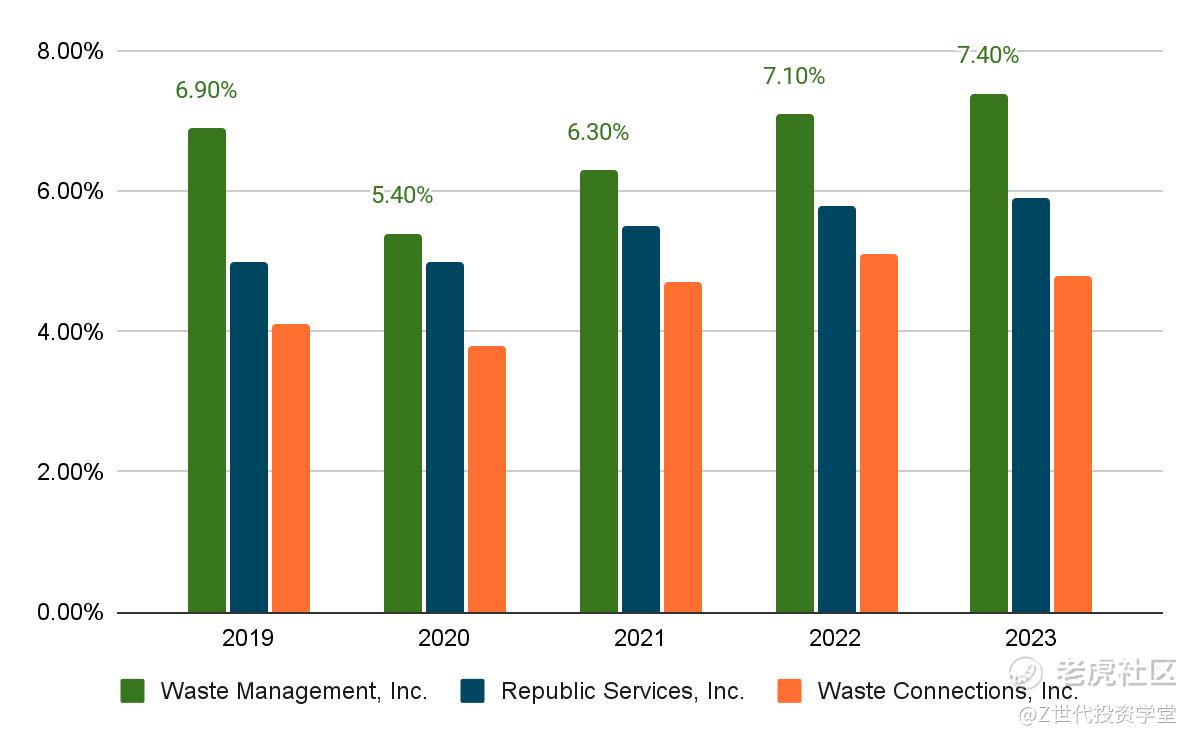
WM's strong profitability is underscored by its superior return on assets (ROA) compared to its industrial peers. Despite a decline from 6.90% in 2019 to 5.40% in 2020 due to the pandemic, WM's ROA has steadily climbed to 7.40% by 2023.
Return on Equity
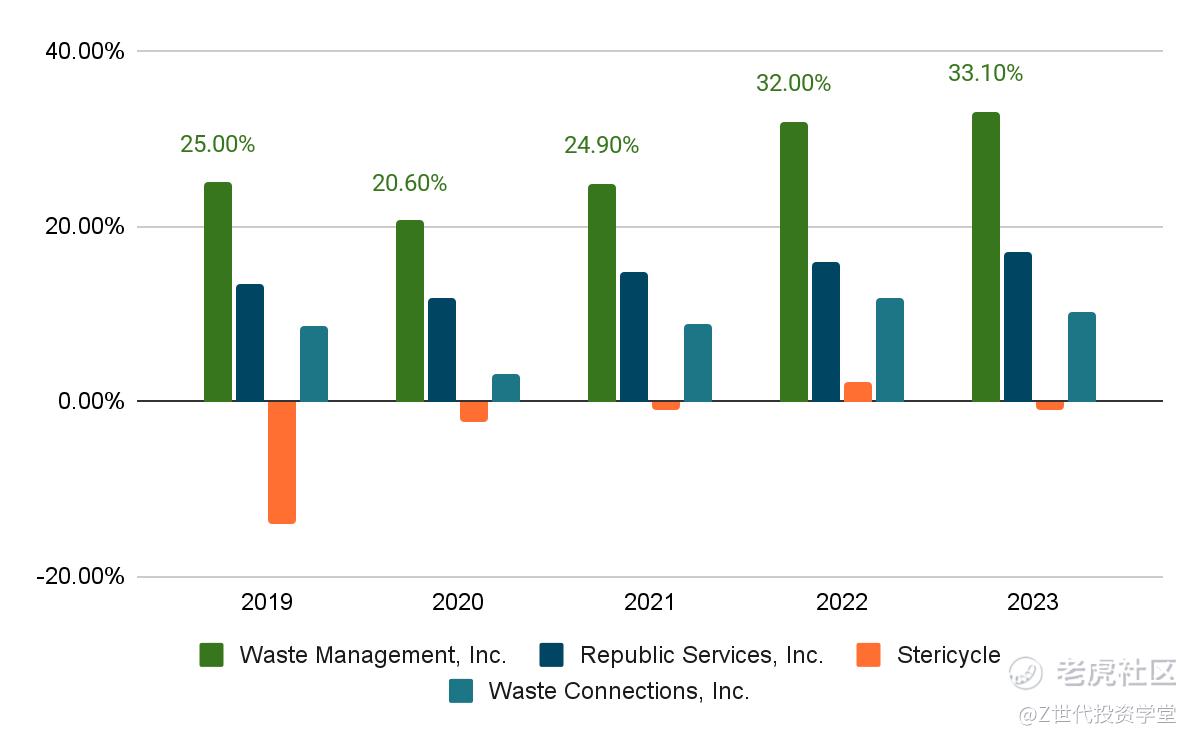
WM's profitability is further evidenced by its return on equity (ROE) figures. Similar to its ROA, WM's ROE dropped from 25.00% in 2019 to 20.60% in 2020 due to the pandemic, but has since steadily risen to 33.10% in 2023. This demonstrates WM's improvement in efficiently utilising its equity financing to generate profits.
Return on Capital
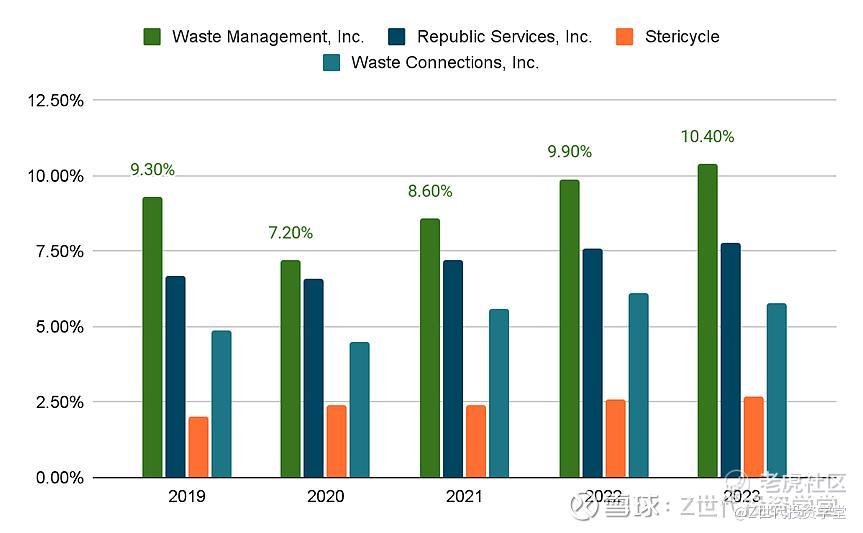
WM's profitability is also evident in its return on capital (ROC), which evaluates its effectiveness in deploying capital. Over the past five years, WM has consistently outperformed its competitors while enhancing its ROC.
Margin Analysis

WM has maintained relatively stable gross margin, EBITDA, EBIT and net income margins. These stable margins reflect the financial health and stability of WM's business. A consistent EBIT margin also indicates that the company is generating stable and sustainable profits to meet debt obligations and operations. Moreover, maintaining stable margins also signals WM's competitive strength within the waste management industry, indicating that the company has pricing power, cost control measures, and a solid market position relative to its competitors.
Dividends
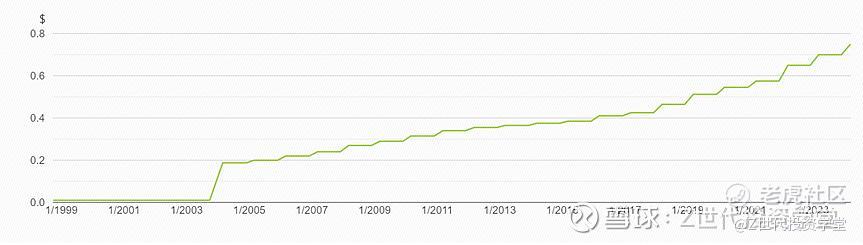

WM is committed to growing shareholder returns and maintains a strong track of dividend growth. The company has been increasing the dividend rate for more than 15 years with a compound annual growth rate of approximately 6% over the last 5 years.
Investment Theses
Market Leader With Diversified & Stable Revenue Streams
WM stands as a market leader in the waste management industry, leveraging its extensive customer network and diversified revenue streams to drive sustainable growth and long-term value. As the largest waste management company in North America, WM has built a reputation for reliability and excellence, providing a wide range of services across the entire waste management spectrum. These services include collection, recycling, disposal, and renewable energy solutions, ensuring that WM can meet the diverse needs of its residential, commercial, and industrial customers.
WM’s comprehensive and integrated service offerings are key to its market leadership and financial robustness. By catering to various sectors with different needs, WM has created a diversified revenue base that reduces reliance on any single source of income. This revenue diversification not only ensures more stable and consistent revenue streams as WM captures and maintains a significant share of the market, fostering long-term customer relationships and loyalty.
The company’s diversified revenue streams translate into consistent and stable revenue growth, which in turn generates strong cash flow. This financial strength allows WM to capture growth opportunities, such as renewable energy projects, that align with sustainability trends. Additionally, the robust top line performance also enables WM to return value to shareholders through regular dividends and share buybacks. WM’s robust cash flow also supports a strong balance sheet, enabling the company to manage debt effectively and maintain healthy financial leverage, which is crucial for navigating economic cycles and unexpected market challenges.
WM’s market leadership, paired with its diversified & stable revenue streams create a compelling investment proposition. The company’s ability to generate strong, recurring cash flow positions it well to meet future industry challenges and regulatory demands, driving long-term value for investors.
Strategic Focus On Sustainability Well Positioned To Capture ESG Opportunities
WM’s strategic focus on sustainability is well positioned for it to capture ESG growth opportunities through expanding its recycling capabilities, emission reduction initiatives and investing in innovative waste-to-energy technologies. WM can capitalise on growing demand for sustainable waste management for its top-line performance due to increasing environmental concerns and regulations.
As countries shift towards a circular economy, waste is increasingly recognized as a valuable resource that can be reused, recycled, and processed. As the largest recycler of post-consumer materials, WM is able to recover more post-consumer materials than any other provider in North America. The company’s Material Recovery Facilities (MRFs) provide manufacturers with a reliable source of recyclables, serving as essential material inputs. WM’s proactive approach to incorporating new materials into its recycling programs, such as polypropylene (PP) and post-consumer resin (PCR), further strengthens its market position. Initiatives like the Association of Plastics Recyclers (APR) Demand Champion Program and partnerships with organisations like Cascade Cart Solutions demonstrate WM’s commitment to promoting the use of recycled materials. The company also invests in advanced recycling technologies and automation that improves material capture rates and operational efficiency. Through its recycling business, WM can unlock value from downstream materials and enhance its top-line performance.
With cleaner and renewable energy solutions gaining momentum, WM’s strategic focus in growing its renewable energy segment also presents growth opportunities. The company operates or hosts over 130 landfill gas-to-energy facilities, with 17 producing renewable natural gas. By capturing and converting landfill gas into energy, WM creates an additional revenue stream while contributing to greenhouse gas reduction. Plans to invest over $1 billion in new renewable natural gas facilities by 2026 further underscore WM’s commitment to expanding its renewable energy segment.
In conclusion, WM is well-positioned to benefit from the increasing demand for sustainable waste management solutions. With its strategic focus on sustainability, WM is poised to drive top-line performance and deliver long-term value to investors in the evolving landscape of waste management.
*Do note that all of this is for information only and should not be taken as investment advice. If you should choose to invest in any of the stocks, you do so at your own risk.
Comments