Microsoft said it reached a milestone in its quantum computing journey, which drove shares of quantum computing-focused companies like D-Wave Quantum and Rigetti Computing higher on Thursday.
The tech giant unveiled its Majorana 1 chip on Wednesday afternoon, claiming to be one step closer to building quantum computers "capable of solving important industry-scale problems."
D-Wave Quantum and Rigetti Computing were the biggest gainers, gaining 6.6% and 2.8%, respectively. Quantum Computing Concept gained 2.6%, while IonQ pulled back 2.7% after gaining in premarket trading. S & amp; The P 500 is down 0.8%, while the tech-heavy Nasdaq Composite is down 0.9%.
Microsoft said the latest development marks a turning point in the company's process "from scientific exploration to technological innovation" after 17 years of research.
Majorana 1 is a quantum processing unit, or QPU, commonly referred to as the brain of a quantum computer. QPU uses quantum mechanics for calculations, relying on particles that can exist in multiple states at the same time, such as electrons or photons.
A QPU can be analoged to a central processing unit in classical computing, while a qubit, or qubit, is the basic unit of information in a quantum system, similar to a traditional bit. Microsoft said they engineered a "completely different type of qubit" called topological qubit, and described it as "small, fast and digitally controllable".
IBM aims to deploy a "quantum-centric supercomputer" with 100,000 qubits by 2033, but Microsoft may surpass that goal. The architecture used by Majorana 1 "provides a clear path to mounting a million qubits on a single chip that can fit on the palm of your hand," the company said.
Microsoft wrote on Wednesday that it is preparing to build a scalable quantum computer prototype in "years, not decades."
Nvidia RGTI in quantum computing
Known for developing quantum processors and cloud services, RGTI has built the Forest cloud platform, which is committed to making quantum computing more accessible and practical. At the end of this year, RGTI's stock price began to soar, rising nearly 1600% during the year.
However, despite Rigetti's potential, investors will have to be patient to see these results materialize, according to Seeking Alpha analyst Joseph Parrish. Parrish says:
"Rigetti gives us the hope that quantum computing technology will become widespread, but at the moment I don't think this possibility will materialize until the end of this decade (late 2030), and there will be many risks for companies that need to raise capital in the process."
Also dazzling is QBTS, which simplifies complex optimization problems in logistics, finance and other industries with its quantum annealing technology and Leap QCaaS platform. So far this year, QBTS's stock price has risen by more than 1100%.
Introduction to Call Spread short selling strategy
A call spread is an options strategy that is achieved by buying and selling call options with different strike prices but the same expiration date. Short selling here specifically refers to using this spread to profit from the underlying price correction.
Sell Near-Price Call: Earn higher premium by selling call options with lower strike prices.
Buy a far call option: At the same time, buy a call option with a higher strike price and hedge the risk with a lower premium.
This combination can make profits when the underlying price stays or pulls back, while limiting potential losses.
Strategy Example: Shorting RGTI's Rally
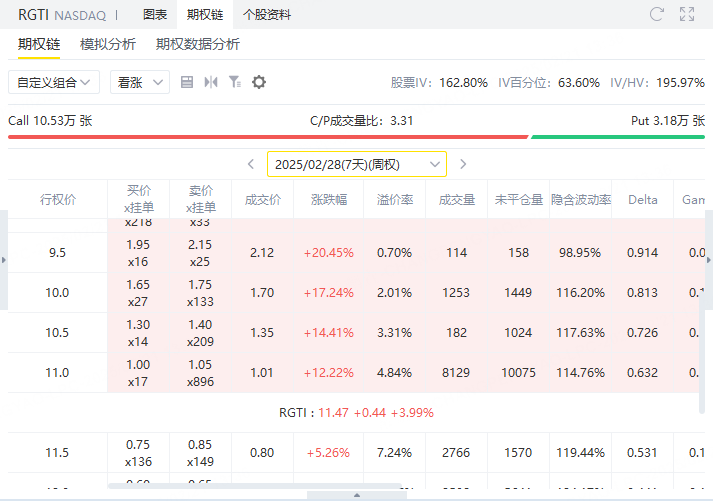
Taking RGTI as an example, assume that its stock price is currently at$11 or so, we expect it may pull back or trade sideways due to short-term hype. Here's a specific bullish spread shorting strategy:
Sell a call option on RGTI expiring February 28, 2025, with a $10 strike price, received $170 from premium.
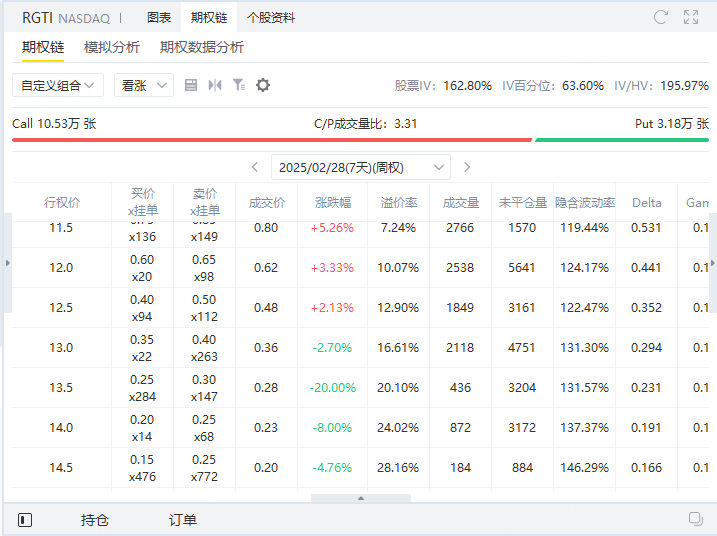
Buy RGTI Call Expiring February 28, 2025, Strike Price $14, paying premium $23.
Collect premium and expenditure:
Sell a call option with a strike price of $10: Get premium $170.
Buy a call option with a $14 strike price: Pay premium $23.
Net income:
Net income= 170-23 =$147
Maximum profit and loss analysis:
Maximum profit: Maximum profit occurs when RGTI's share price expiresLess than or equal to $10。 At this time, neither option will be exercised, and you can keep the entire net premium income.
Maximum profit=$147(i.e. premium you receive)
Maximum loss: The biggest loss occurred when the RGTI share price expiredOver $14, that is, both options will be exercised. Selling an option with a $10 strike price requires selling the stock at a price of $10, while buying an option with a $14 strike price allows you to buy the stock at a price of $14. So the loss is the strike spread between the two options minus the net premium you receive.
Maximum loss= Exercise spread (14-10) * 100 shares-net income
Maximum loss= (14-10) * 100-147 = 400-147 =$253
Break-even point:
The break-even point is the level the stock price needs to reach when the option expires to keep you from making or losing money. That is, when the stock price must just reach the break-even point, the premium income and loss you receive are just equal.
Break-even point= Put option exercise price + net expense/per share
Break-even point= 10 + (147/100) = 10 + 1.47 =$11.47
Summary:
Maximum profit: $147 (when the stock price is below or equal to $10)
Maximum loss: $253 (when the stock price exceeds $14)
Break-even point: $11.47 (when the stock price is at this point, your income is zero)
Strategy Conclusion:
ThisBear Call SpreadStrategy fits you think the RGTI share price will stay below $10, but not above $14. If the stock price exceeds $14, you will face the maximum loss, and conversely, if the stock price is below $10, you will make the maximum profit.
Comments