On Thursday morning Eastern Time, Trump said that the tariffs on Mexico and Canada originally scheduled to take effect on March 4th will be implemented as scheduled. The April 2 reciprocal tariff plan will still be in full effect. In addition, according to CCTV news, the French Finance Minister said that if the United States imposes tariffs, the EU will respond with the same measures; The Prime Minister of Canada said that if the tariff policy imposed by the United States and Canada is implemented, it will respond immediately and strongly. Trump's latest statement means that the U.S. government will push forward tariff measures in an all-round way, pushing the US Dollar Index to rise rapidly in intraday trading, rising nearly 0.5% in the day, once standing at 107, while the Canadian dollar, Mexican peso, euro, offshore RMB and U.S. stocks all fell.
Large technology stocks generally fell, Nvidia fell more than 8% and its market value fell below US $3 trillion, Broadcom fell more than 7%, Tesla fell more than 3%, Amazon, Google, and Meta fell more than 2%. Ultra-microcomputer fell nearly 16%, and Micron fell more than 6%.
Most popular Chinese concept stocks fell, and the Nasdaq China Golden Dragon Index closed down 0.93%. Kingsoft Cloud fell more than 13%, Li Auto fell more than 3%, and Alibaba fell nearly 2%.
If you choose an option strategy for hedging or shorting, then the best choice is undoubtedly the bear market spread strategy
What is a bear spread?
A bear spread strategy is an option strategy in which an option trader expects the price of the underlying asset to fall in the coming period, the trader wants to short the underlying, and wants to limit the trade to a certain risk range. Both call options and put options can be used to build a bear market spread. If you use a call option, it is generally called a bear market call spread. If you use a put option, it is generally called a bear market put spread. (Bear Put Spread).
Specifically, the bear market call spread is achieved by buying a call option at a specific strike price while selling the same number of call options with the same expiration date at a lower strike price.
A bear put spread is achieved by buying a put option at a specific strike price while selling the same number of puts with the same expiration date at a lower strike price.
The main advantage of a bear spread is that it reduces the risk of short trading (buying a call at a higher strike price helps offset the risk of selling a call at a lower strike price). Because if the stock moves higher, there is theoretically unlimited risk in shorting the stock, and the risk of shorting using a bear market call spread is much lower than shorting the stock directly. On this basis, options with different expiration dates can also be combined to turn the strategy into a calendar spread, etc.
Short Volatility Bear Market Spread Demonstration
$S&P 500 Volatility Index (VIX) $It is called the S&P 500 Volatility Index (also known as: Panic Index). Theoretically, vix is a percentage, and the value is between 0-100 (actually it is between 15-25 most of the time, extremely low is 9, and extremely high is 80). It is calculated based on the volatility of options on the S&P 500 index. The specific formula is complicated, but it can be popularly described as: "the potential decline of the S&P 500 index in the next 30 days."
$1.5 x Long Panic Index Short-Term Futures ETF (UVXY) $It is a U.S. stock fund, also known as: 1.5 times long vix index. The operating model of the fund is to go long vix index according to a leverage ratio of 1.5 times. Theoretically, vix rises by 10%, and uvxy should rise by 15% (pure theory).
Take UVXY as an example, the price of UVXY is around 20.82 premarket, if investors expect UVXY to return to around 18 in the next month. Then investors can establish a bear spread in two steps.
In the first step, investors can sell a call option with an exercise price of 18 expiring on March 28 and receive $380.
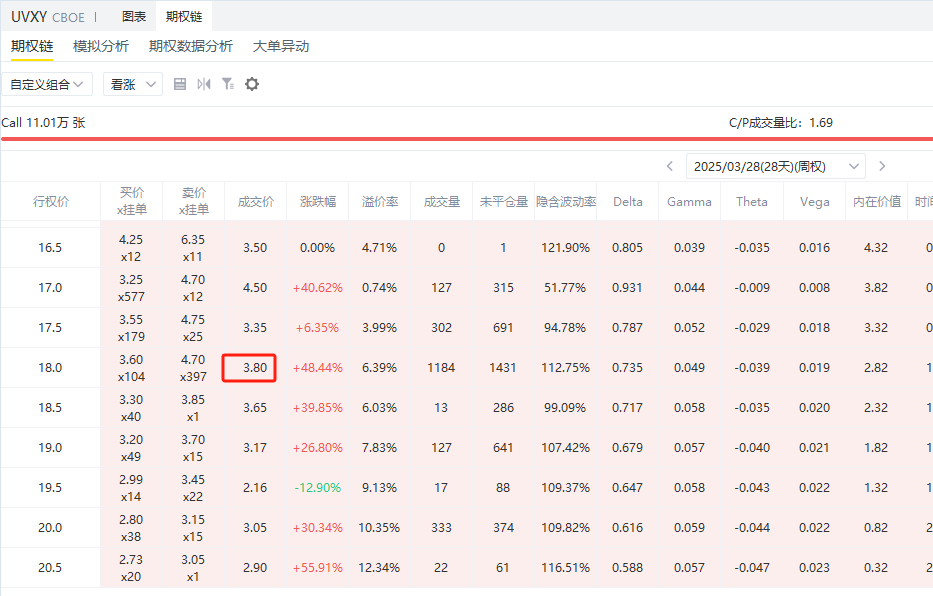
The second step is to buy a call option with an exercise price of 30 expiring on March 28 at the same time, which costs $145, and the bear market spread is established.
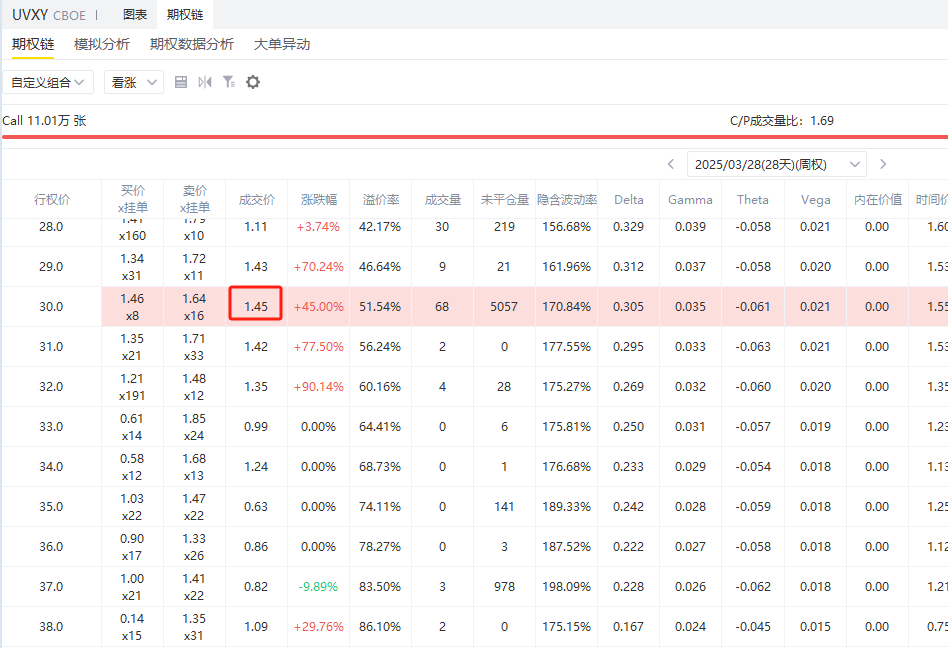
When UVXY falls to 18, investors get the maximum profit. At the same time, because of the existence of call options, even if investors make a misjudgment, the maximum loss caused by this strategy is limited.
A bear call spread is the preferred strategy when investors predict a neutral or downward price and want to limit risk. It is also known as a "short call spread" and a "credit call spread". A bear call spread is a strategy that "collects premium and limits risk at the same time", and the strategy profits from time decay and stock price decline.
Comments